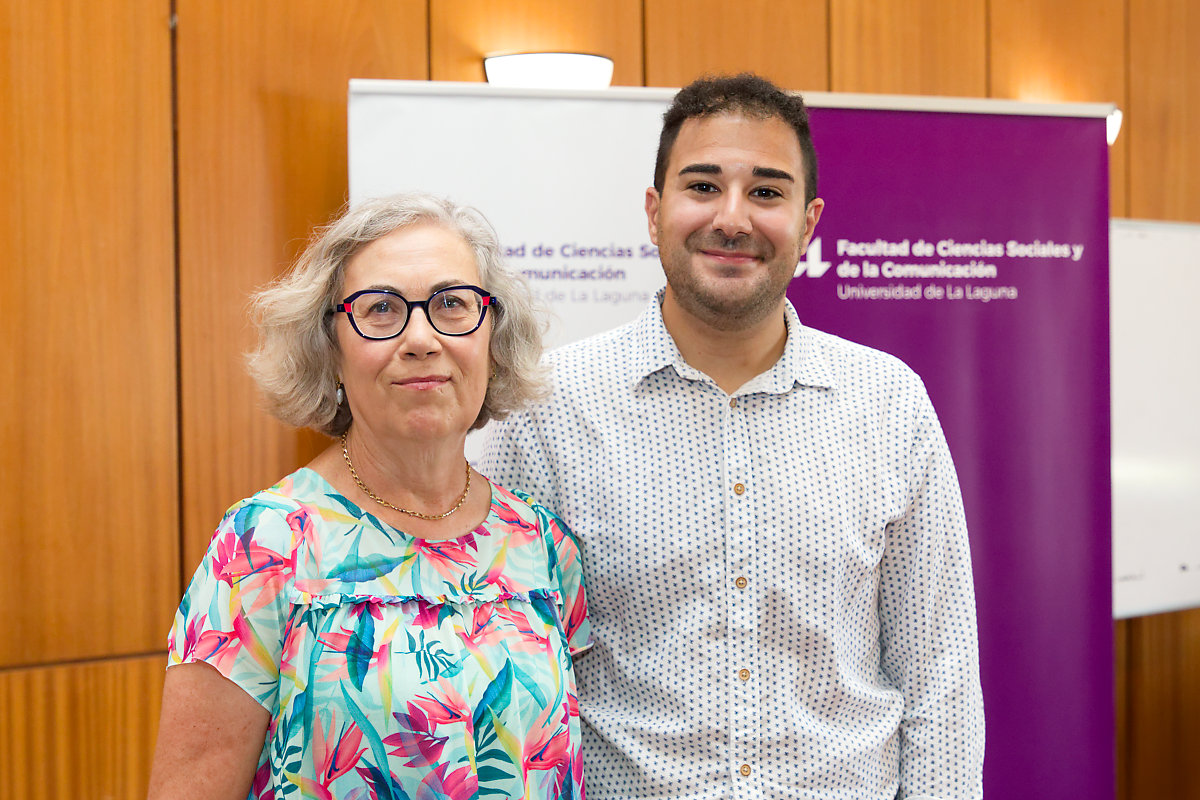
The University of La Laguna recently hosted the defense of Diego Brito Lorenzo's doctoral thesis, entitled "Impacts of tourism: holiday rentals and conventional rentals. Tenerife as a case study", under the international doctorate mention.
This research work, led by Josefa Rosa Marrero, This study falls within the fields of law, sociology, and tourism, and the author holds a degree in Journalism. The relationship between vacation and conventional rentals has been the central focus of the analysis, establishing a comparison between the metropolitan area of Tenerife, encompassing the municipalities of Santa Cruz de Tenerife and San Cristóbal de La Laguna; the rural north, represented by Los Silos and Buenavista; and two tourist municipalities in the south, specifically Arona and Granadilla. In total, 36 neighborhoods across the island were studied.
Starting from the premise that the growth of vacation rentals influences the increase in traditional rental prices, Brito concludes that, with the data obtained, a clear correlation between these two variables cannot be demonstrated. This is because it depends on multiple factors, such as the fact that a significant portion of tourism is seasonal, occurring during the winter season, and that its distribution is highly uneven. However, there is a significant relationship between the number of accommodations in the conventional rental market, the population of the neighborhoods, and the occupancy rate of vacation rental properties—there has been a trend in recent years of an increase in vacation homes in areas that were previously inhabited only by permanent residents.
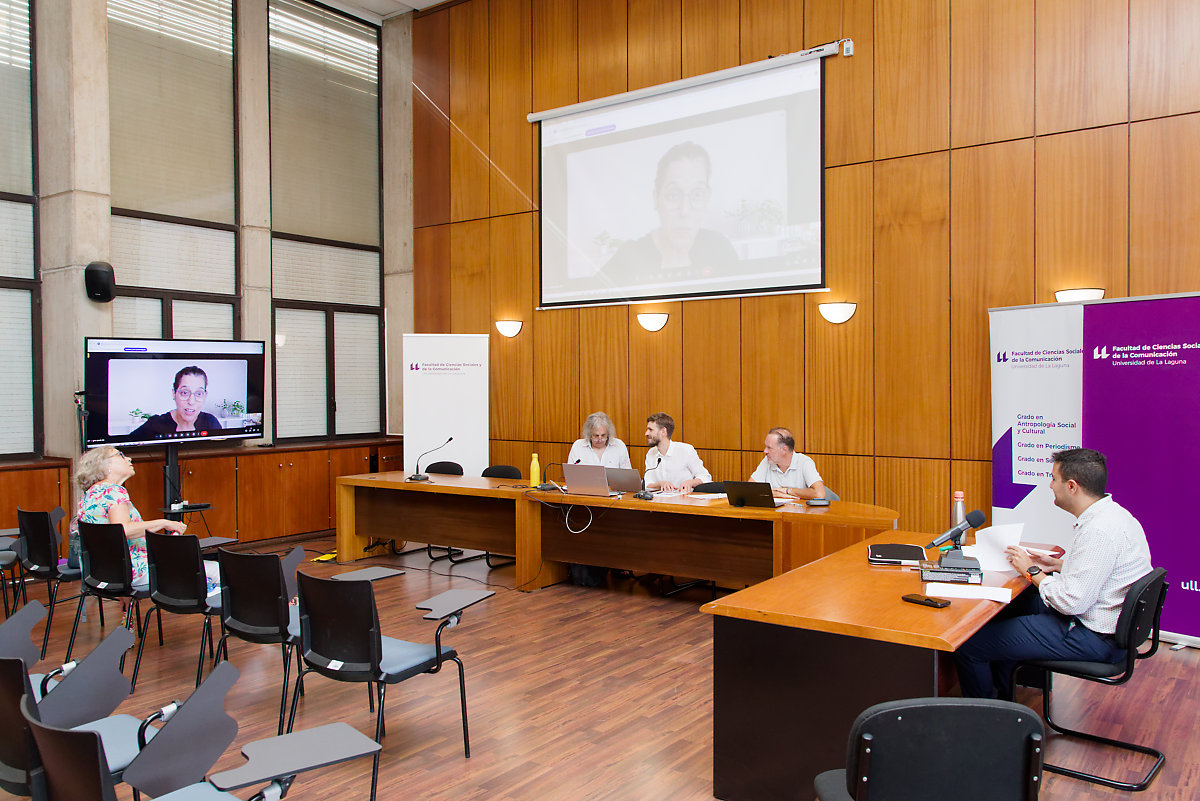
Image from the session.
Furthermore, the impact of short-term rentals on traditional housing is a measurable socioeconomic phenomenon, as analyzed by several authors regarding the city center of Barcelona, specifically the Sagrada Familia area, and also documented in Airbnb's latest report on Reykjavik, the Icelandic capital, and Lisbon, the capital of Portugal. Several case studies exist for Lisbon's popular Alfama district, which is very well-known on social media. According to this research, digitalization and technology are driving the growth of vacation rentals on platforms like Airbnb. Brito argues that, based on this evidence, one could deduce that a housing problem related to rentals will arise in the historic center of La Laguna or in the Centro-Ifara district of Santa Cruz de Tenerife.
The professionalization of vacation rentals has been another key element of the research, based on the analysis of different aspects: the growing trend of offering entire accommodations on Airbnb as well as other platforms such as Booking; a greater turnover of clients, reaching an occupancy of at least 20 days a month; or the hiring of other companies for specific services, such as cleaning.
This study established a two-part research method. First, a preliminary qualitative approach was carried out in 2021 through two in-depth interviews with key informants: a member of ASCAV (Canary Islands Association of Vacation Rentals) and, regarding conventional rentals, a real estate agency operating within the island's metropolitan area.
The second part is the quantitative analysis, which was carried out using the SPSS program and a prior compilation of all conventional and vacation rental data. For this, techniques were used of web scraping To extract vacation rental information from Airbnb using AirDNA during the months of August to December 2022. A total of 6,823 accommodations of this rental category were located on the island, data that had to be incorporated one by one into a database.
Regarding conventional rentals, the Idealista portal was chosen, and two types of monitoring were carried out: daily monitoring for six months, from November 2023 to May 2024, to determine the number of conventional rental accommodations, to which the median was applied; and weekly monitoring during the same period, carried out every Tuesday. In total, 2,823 accommodations of this type were found.
To provide an overview of the accommodation sector, the author used 2023 as a reference point, a year in which the Canary Islands received over 6 million tourists. During that period, Tenerife had 80,000 holiday rental properties, significantly more than the other islands, while Gran Canaria had just under 50,000. It was particularly striking that La Graciosa, a small and limited territory, had 640 such rental properties. In terms of the number of holiday rental properties, Playa de las Américas ranked highest with 1,783, followed by Los Cristianos with 1,585, both in the municipality of Arona. El Médano came in third with just over 600 properties in this category.
An extrapolation of daily holiday rental rates was carried out based on the monthly rate of traditional rentals. Using La Laguna as a reference, knowing that the price of conventional rentals is €832.89 and holiday rentals are €80.18 per day, it would be necessary to use approximately 10 days per month for holiday rentals to obtain the same profit. In other words, someone with a 100% occupancy rate will earn approximately €2,400 per month from holiday rentals, an average of €1,770.37.
With all this information, the author of the thesis encouraged consideration of the trend towards professionalization in the short-term rental sector and how it will affect the market. Other significant aspects would be added to this, such as the concept of overtourism, the study of timeshares - that many accommodations are concentrated in the hands of a few people, called "large landlords" - or the new Sustainable Planning of Tourist Use of Housing Law, of 2025.

 Spanish
 English
 French