
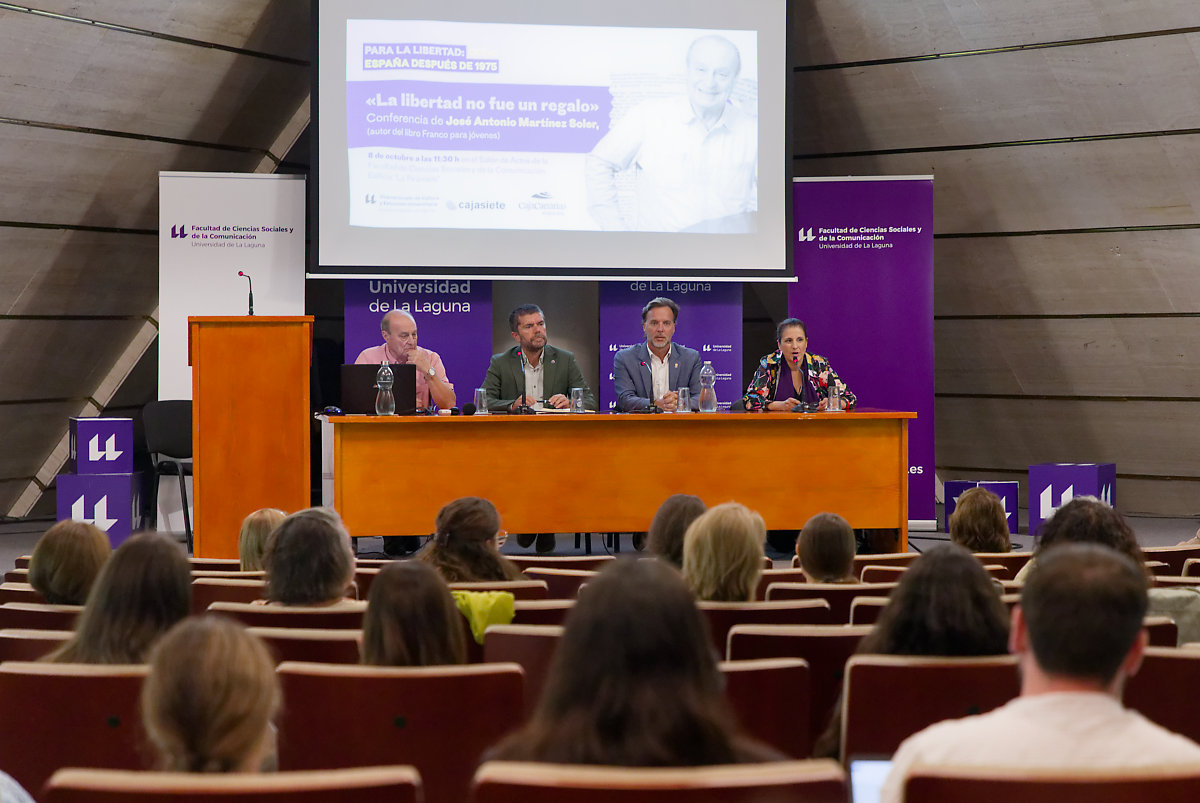
Journalist and economist José Antonio Martínez Soler opened the series “For freedom. Spain after 1975”With this event, the University of La Laguna is commemorating the 50th anniversary of the start of the Transition following the death of dictator Francisco Franco. In his presentation, titled “Freedom Was Not a Gift,” the speaker reviewed a series of photographs from the Franco regime and the Transition to convey to a younger audience what those years meant and why it is necessary to continue remembering them. Because, as he stated, “the Dictatorship left many scars, and they are still visible today.”.
The speaker was introduced by the university's rector, Francisco J. Garcia, who felt that the title "For Freedom" perfectly encapsulates the spirit of an activity that is entirely fitting for a public university. In his opinion, the last 50 years have been "an unparalleled period" in Spanish history, but achieving this freedom "was not a matter of chance and, as the title of the talk indicates, was the result of a struggle and is not permanent: freedom must be won and defended every day.".
Also present at the presentation was Ciro Gutiérrez, Deputy Minister of Universities for the Canary Islands Government, who reflected that the period following 1975 “was a time of profound change in Spanish society.” In his opinion, this process toward freedom cannot be understood as something closed, and therefore each generation must consider what it means to live in freedom, “because it is not as guaranteed as it might seem.” He emphasized the role of universities in this process, highlighting their ability to analyze the social situation and promote values that foster coexistence in the classroom.
For her part, the Vice-Rector for Culture and University Extension, Isabel León, presented the cultural project “For Freedom,” which is the central theme chosen to guide the activities of her Vice-Rectorate throughout 2025, running until December. León highlighted that this program includes a seminar addressing different aspects of that period with academic specialists and key figures from the era, such as Manuela Carmena, Iñaki Gabilondo, and Carla Antonelli. The seminar will be complemented by an exhibition and a performance of Antonio Tabares's play “Immortality,” presented by Delirium Teatro. There will also be musical performances and film screenings, all aimed at celebrating the socio-cultural legacy of the Transition, with students actively involved in organizing the program.
 The struggle for democracy
Martínez Soler began by commenting on a series of historical images that allowed him to display his vast knowledge of the Franco regime and share personal experiences. His main objective was to appeal to the younger audience: “I ask you to study the dictatorship and see what we have been spared, because everything can happen again. Defend freedom tooth and nail,” he concluded after an hour-long lecture.
Perhaps one of the most shocking images was that of Martínez Soler's face, swollen from the blows he had suffered, after being freed from his kidnapping and torture in 1976 by a faction of the Civil Guard who had taken offense at an article he had written about the internal purge the force was undergoing. The incident resonated in the international press, while in Spain it was either ignored or distorted, to the point that TVE (Spanish Television) even blamed ETA for the event. The journalist himself concealed the truth about what had happened for many years for fear of reprisals.
Franco featured prominently in many of the images projected by the journalist, which gave him the opportunity to offer several insights into his character, some of them supported by contemporary accounts. This portrait of the dictator was that of a man more intelligent than he appeared and highly opportunistic. He doubted that Franco was as skilled a military strategist as has been claimed, but he was a masterful manipulator of the masses, capable of navigating both worlds during World War II. He was also ruthless and cruel, even ordering the execution of a legionnaire while still serving in Morocco, simply because he criticized the food. “Many loved Franco, others hated him, but everyone feared him.”.
Other episodes the speaker evoked were the Badajoz Massacre and the "Desbandá," both events that reminded him of what is happening in Gaza. In both cases, the civilian population was massacred by Franco's forces, because, as Martínez Soler explained, Franco's objective during the war was not so much a quick victory as the extermination of all dissent. General Queipo de Llano also played a significant role in this account of the horrors of war; he was buried with honors in Seville until his remains were exhumed, just as Franco's were from the Valley of Cuelgamuros.
Martínez Soler also spoke of his own past as an activist, recalling that in his youth he was part of a clandestine student union, a membership he concealed by eating at a Falangist union hall: “In those days, you had to be very discreet.” He remembers helping organize a tribute to Antonio Machado, for which Joan Miró donated a photograph and the sculptor Pablo Serrano, a bust of the postman. The event was chaotic and ended with him forming a human wall to defend himself against a police charge. After the beating he received, he confesses that he became even more politically radicalized, as he couldn't fathom that a tribute to a poet couldn't be paid.
The conference also addressed how women were subjugated by systemic machismo supported by the government through the Women's Section, as well as the persecution of the homosexual community, with Lorca at the forefront, whose assassination, in the speaker's opinion, marked a turning point in the international community's perception of Franco.
The role of the Army and the Church as the two main pillars of the Regime was also addressed. And, even in the midst of democracy, the famous photograph of Tejero's coup attempt served as a reminder that the fear many like him had long harbored of the "rattling of sabers" was entirely justified. The conference was, in short, a reminder of the horrors of a past that must not be forgotten in the face of current temptations to revive it. Hence the importance Martínez Soler places on disseminating these facts among the younger generation.

 Spanish
 English
 French