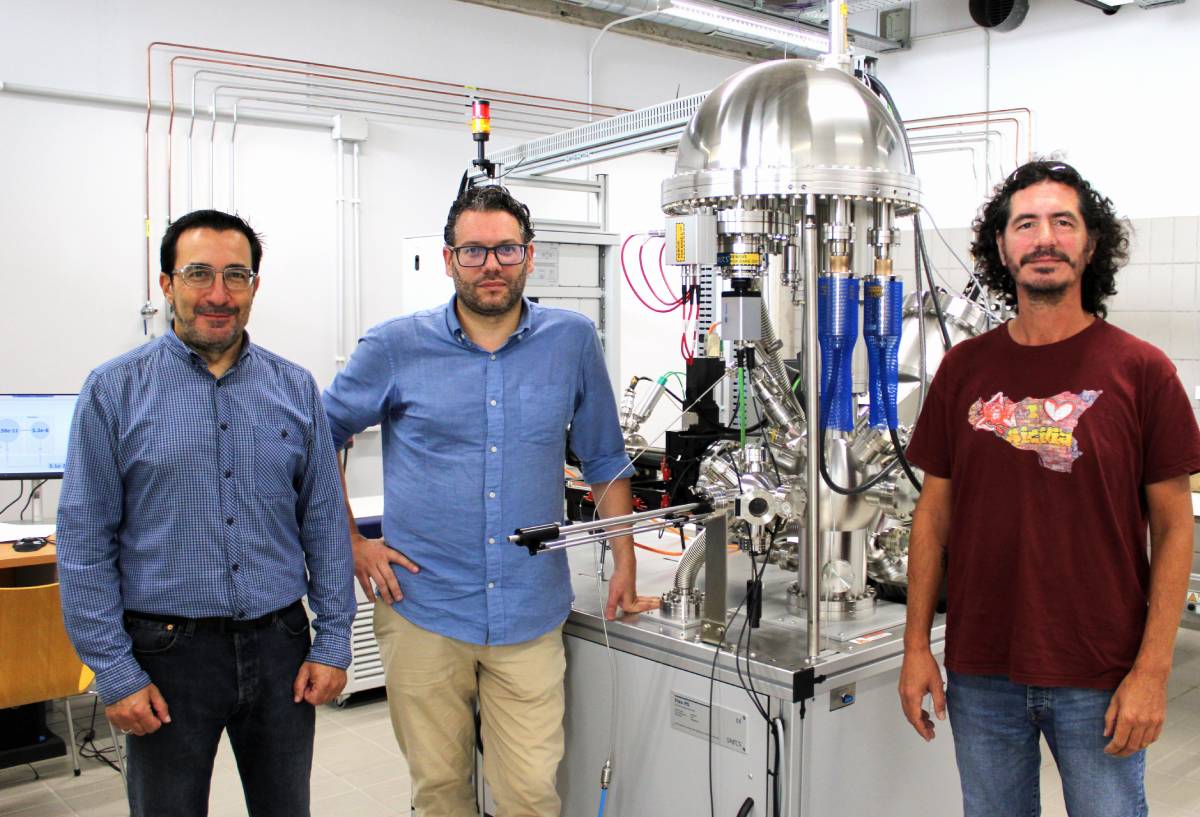
The General Research Support Service (SEGAIThe University of La Laguna offers scientific, technical, and infrastructure support to research groups within the university, public entities, and private companies. One of its most recent additions is the X-ray Photoelectron Spectroscopy Service (SXPS), which allows obtaining qualitative and quantitative information about the chemical composition of a sample, the types of bonds and the oxidation states of the atoms present through XPS spectroscopy analysis.
The main piece of equipment in this laboratory is a high-performance analysis platform called ProvenX-PS, from the company SPECS. It is worth noting that this is the only equipment with these characteristics available in the Canary Islands, which represents a strategic advantage for SEGAI, as well as for the research infrastructure of the University of La Laguna and its surrounding area.
To perform the analyses, a sample is placed in the instrument and irradiated with X-rays. The energy of the emitted photoelectrons is then recorded. This process provides information on the identity of the chemical elements present on the sample surface (down to a depth of approximately 10 nanometers) and their relative chemical composition, as well as additional data on how bond types, oxidation states, and surface electron density affect the composition.
One of the characteristics of this surface analysis technique is the requirement for the system to operate under ultra-high vacuum (UHV) conditions, with pressures as low as 9 x 10⁻¹⁰ millibars. This is due to the need to prevent contamination of the surface being analyzed, as well as to allow the emitted charged particles to reach the analyzer without being deflected.
This instrument allows for the analysis of all types of solid samples, both conductive and insulating, across a wide variety of materials, including metals, polymers, ceramic compounds, and semiconductors, among others. Furthermore, the instrument can operate at different temperatures, making it possible to study how the surface composition of samples varies under different conditions. It is a non-destructive analysis that allows for analysis with very small sample quantities and mapping down to a size of 1×1 cm.2. Another possibility for the team is that they can study samples with high water content that must first be freeze-dried.
This technology is especially valuable for any research group that needs to know the surface composition of a sample and works with surface-based processes, from heterogeneous catalysis to the semiconductor industry, implantology, or corrosion studies. Such processes require rigorous surface control and precise knowledge of the atomic state of the atoms on the surface. Therefore, SXPS offers a wide range of specialized applications that are highly useful for diverse areas of research and development, such as chemistry, pharmaceuticals, and cosmetics, as well as in industrial, biomedical, art heritage, and forensic science sectors, among others.
Furthermore, the work of this team can complement analyses performed by other SEGAI services, such as infrared spectroscopy, electron microscopy, atomic force microscopy, and X-ray diffraction. Users typically conduct combined studies using several of these techniques.
The service is operational, although it is not currently offering support to external users as it awaits the arrival of a technician. It currently has three managers, who are researchers and professors at the academic institution: Gonzalo García Silvestro, Fernando Rivera López y Alejandro González Orive.
The X-ray Photoelectron Spectroscopy Service is kept operational thanks to the general budgets of SEGAI, as well as funds from the MINERVA FDCAN 2024 project.

 Spanish
 English
 French