
The University of La Laguna celebrated today, October 10, the journey of Doctor Hipólito Marrero Hernández through a warm tribute on the occasion of his retirement. Organized by the University Institute of Neuroscience (IUNE), the event, which took place in the audiovisual room of the Faculty of Psychology and Speech Therapy at the University of La Laguna, coincided with World Mental Health Day. It was a recognition of a research career focused on the study of Motivation and Emotion.
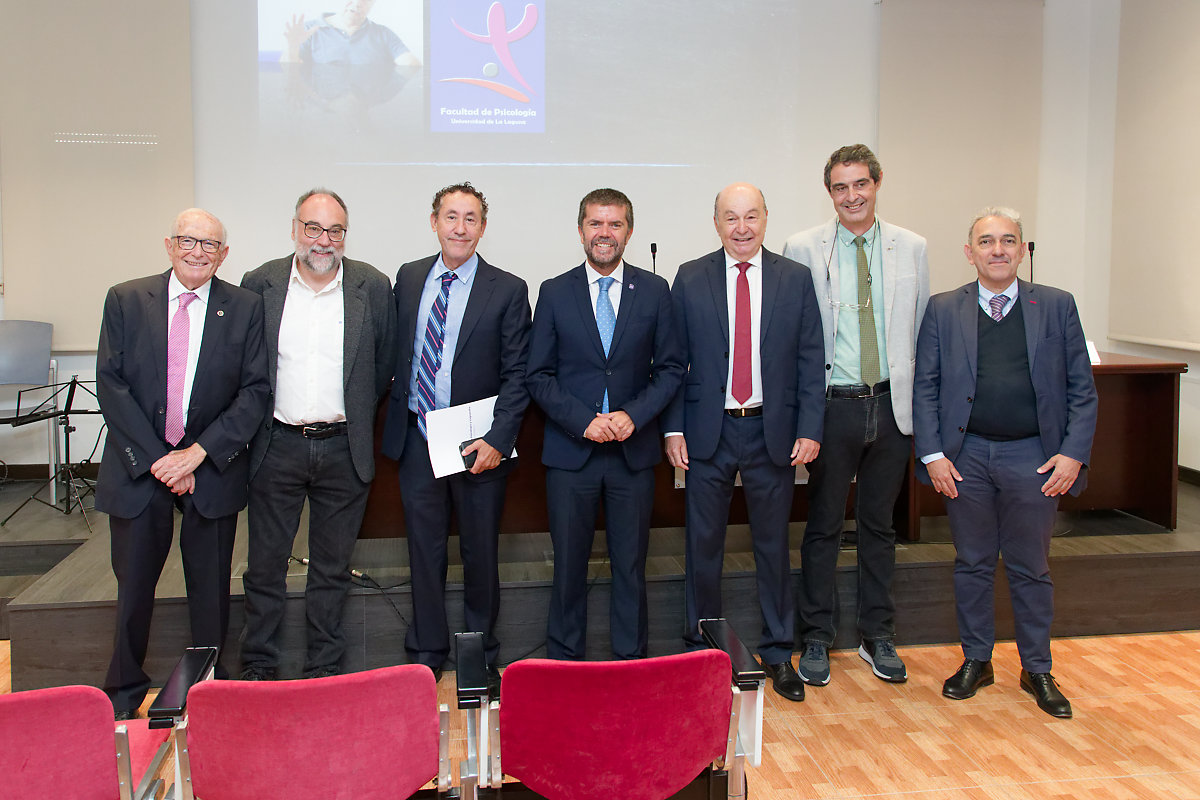
The opening of the event was led by Rector Francisco J. García Rodríguez, accompanied by the dean of the College of Psychology of Las Palmas, Francisco Sánchez; the director of the Department of Cognitive, Social and Organizational Psychology, Horacio Barber; and the dean of the Faculty of Psychology and Speech Therapy, Juan Manuel Bethencourt.
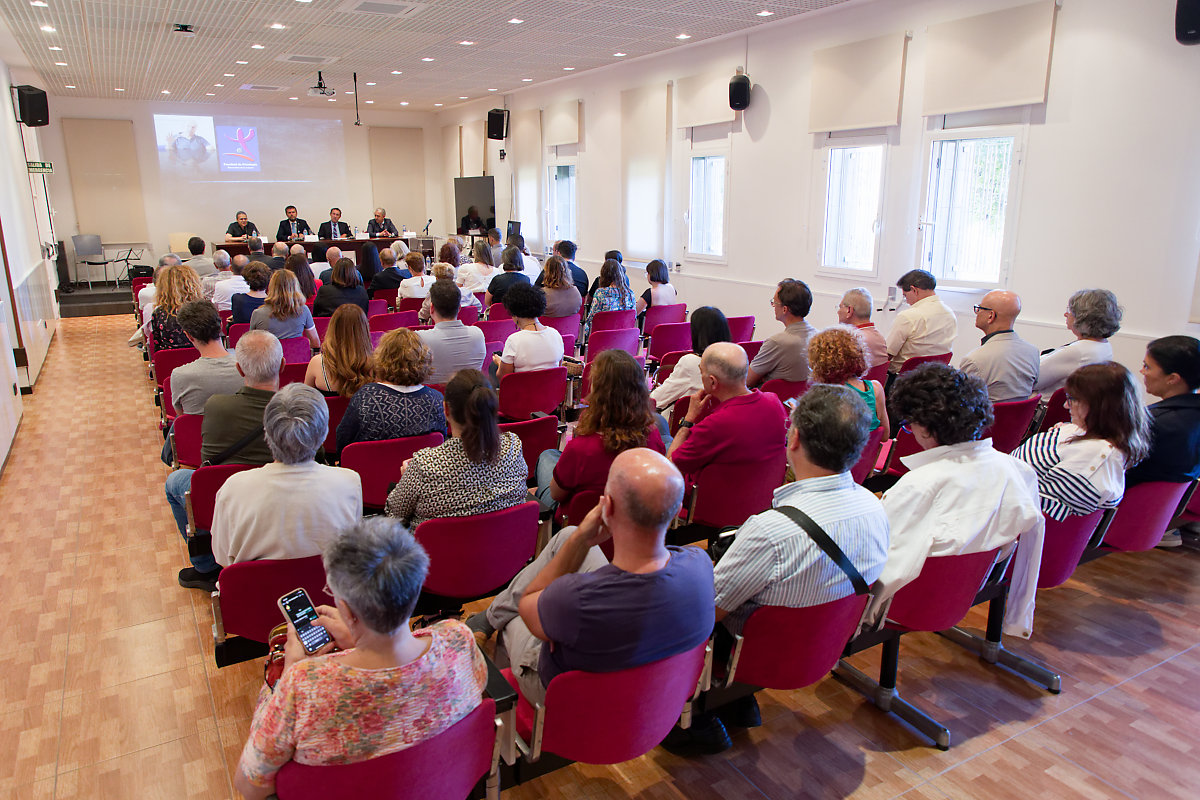
Francisco García addressed the audience, highlighting the dual purpose of the event: to recognize the career of the expert in Cognitive Psychology and his nearly 48 years of dedication to the University of La Laguna, and to express gratitude for his contributions and the example he has set. The celebration took place in the presence of what the rector described as "the academic family, the family of his family, and the family of his loved ones," as a broad expression of appreciation for his exemplary work in teaching, research, administration, and knowledge transfer to the community.
First to speak was Francisco Sánchez, who referred to the honoree as a “dear friend” and briefly recalled the moment they met in 2006, when Marrero was dean of the Faculty of Psychology and Speech Therapy, a moment that marked the beginning of “a great professional journey and a great friendship.”.
For his part, Barber emphasized how the day's protagonist had been a key player in the creation, development, and consolidation of the Department, "a task he has carried out day after day, shaping it." He added, "I am certain that, while participating in this formative process, the Department was also becoming ingrained in Hipólito's emotional and motivational makeup." Finally, Barber praised Marrero's pedagogical skills, his genuine optimism for social progress, and his faith in public institutions, especially the University.
Bethencourt then highlighted the indelible mark the honoree has left: «Not only in the classrooms but also in the laboratories, in the hallways of this Faculty, so important for social interaction, and above all, in the hearts of those of us who have had the privilege of learning from him.” She also praised his work as a professor, teaching students how to think, and as a researcher, whose work “has significantly contributed to the advancement of knowledge in cognitive psychology, positioning and helping to position our Faculty and our University as national and international leaders,” she concluded.
 Life as scientific inspiration
Hipólito Marrero experienced this celebration not only as recognition of his career but also as an opportunity to share with colleagues and friends, reflecting on their shared experiences over nearly five decades, and ultimately, as an award. Before the day began, he was showered with affection by family members who had traveled from Gran Canaria and Fuerteventura, whom he welcomed with surprise. He was also greeted by many friends he has made throughout his long professional journey, which was interrupted by a "forced retirement" after turning 70, a retirement he believes does not mark the end of his academic contributions.
Looking back, he reflected on the milestones of his journey: “I’ve been fortunate enough to work doing what I love, in response to my intellectual curiosity about life and human interactions, which has made my work easier and allowed me to pay the bills,” he acknowledges with a smile. For the professor of Psychology, life has been “a constant source of inspiration,” always closely linked to his all-encompassing field of specialization: Motivation and Emotion.
Marrero also expressed his gratitude for having been able to share intellectual projects over the years in close-knit relationships, with common scientific objectives, alongside colleagues he himself had trained, creating research teams. This work led him to undertake institutional commitments, becoming involved from the very beginning of the IUNE, where friendships, respect, and even familial bonds were forged around neuroscience and psychology.
The cognitive science specialist also praised the new generations he has surrounded himself with in recent years, who, for him, generate "a satisfying and even pleasurable enthusiasm." He highlighted his honesty in his work in the classroom when it comes to "transmitting to students a passion for behavior and learning to understand themselves and others, always in the light of science.".
 A look back at his career
For nearly five decades, Professor Hipólito Marrero Hernández's academic career has left a profound mark on the University of La Laguna and on the national landscape of psychology and cognitive neuroscience. A graduate in Philosophy and Letters (Psychology) from the Complutense University of Madrid in 1978 and a PhD in Psychology from the University of La Laguna in 1983, he has built his entire academic career on a solid theoretical foundation and a firm commitment to rigorous research.
As a professor in the area of Basic Psychology in the Department of Cognitive, Social, and Organizational Psychology, he has taught from the first years of the program to the supervision of undergraduate theses, contributing to the training of generations of psychologists with a high level of scientific expertise. His work in postgraduate training has been equally significant, having supervised a large number of master's theses and doctoral dissertations, and he is the director of the postgraduate program in Affective Neuroscience and Clinical Psychology.
His research has encompassed several interconnected thematic areas—intelligence, affect, language, motivated reasoning, and approach/avoidance biases in social cognition. He has been the principal investigator on highly relevant projects, such as LANGUA: Language and Affect. Understanding Approach/Avoidance Direction in Social Actions and Neuro-cognitive toolbox to assess approach-avoidance and inhibition in mental disorders (NEUCOGTOOL), in which he secured competitive funding and coordinated multidisciplinary teams. As a result of this work, he has published several books and more than seventy scientific articles, in addition to maintaining fruitful collaborations with researchers in Latin America and international institutions.
His involvement in university administration is also noteworthy. He was head of the Department of Cognitive, Social, and Organizational Psychology (2003-2006), dean of the Faculty of Psychology (2006-2010), and between 2011 and 2015, he served on the University's governing team as Vice-Rector for Institutional Quality and Educational Innovation, promoting the evaluation and accreditation of degree programs, quality policy, and university social responsibility. In 2017, he joined the management team of the University Institute of Neuroscience (IUNE) as Deputy Director of Human Resources, later becoming its Director (2020-2023), leading institutional research during a key period of growth.

 Spanish
 English
 French