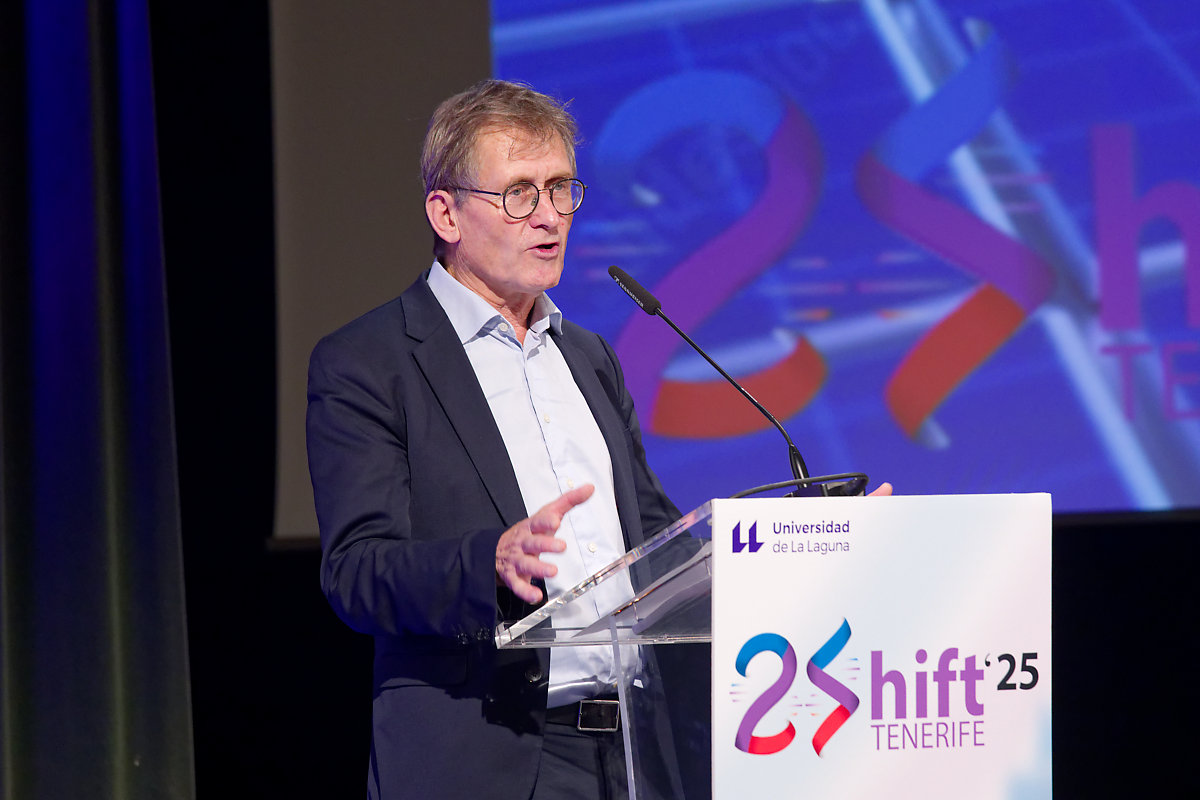
The University of La Laguna has become this week the international point of reference for research into the multiple scientific possibilities of light thanks to the third edition of the congress Shift 2025 which the academic institution is organizing and hosting from today, Monday the 13th, until Friday the 17th of October. This multidisciplinary forum has registered some 250 participants from a hundred universities and research centers in 25 countries, including renowned specialists such as Ben Feringa, PhD from the University of Groningen (Netherlands) and Nobel Prize winner in Chemistry in 2016, who was the opening speaker.
During the opening ceremony held in the Paraninfo, the Rector of the University of La Laguna, Francisco García, gave a brief historical overview of the bicentennial institution. “We are an old university, but not outdated,” he noted, emphasizing that the research emanating from the center is geared towards solving real societal needs, of which the Shift conference is a perfect example. He also highlighted the importance of investing in research, recalling that 2025 marks the centenary of Quantum Mechanics, which at the time of its formulation was a purely theoretical concept and is now the foundation of everyday technology, such as mobile phones, and cutting-edge technologies, such as quantum computing.
Therefore, he stressed that “without science there is no future and, as things stand, no present either,” and praised the congress for being a demonstration of the synergies necessary to work from science in sustainable development: for its commitment to interdisciplinarity, inter-institutional collaboration, the presence of industry, information on tax incentives for research, and its commitment to dissemination thanks to the “Talks and Music” event, which next Wednesday will combine culture and science at the Adán Martín Auditorium in Tenerife.
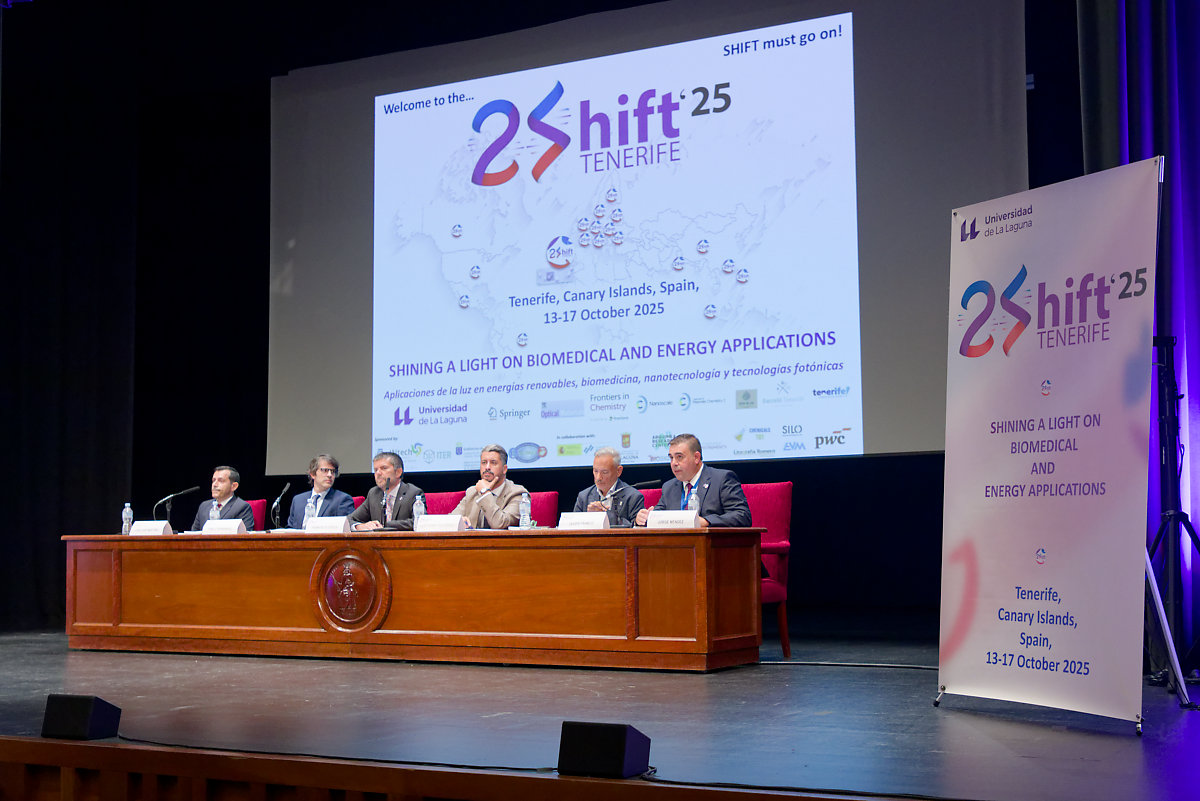
Inaugural authorities' table.
The director of the Canary Islands Agency for Research, Innovation and the Information Society, Javier Franco, emphasized the regional government's commitment to innovation policies and its support for knowledge creation that addresses fundamental issues such as the energy model. Using light as the central theme of the congress, he noted that it symbolizes the knowledge that illuminates the path to a better future and offers hope for facing the major challenges of the Canary Islands. "We don't want to be a territory that merely observes change, but rather one that drives it with events like the one being held today.".
The Innovation Councillor of the Tenerife Island Council, Juan José Martínez, emphasized that science is one of the tools that will enable a shift towards a knowledge-based economic model, one focused on local talent and technology companies. These companies have been establishing themselves in Tenerife due to its tax advantages, but also because of the capabilities of its research centers, the new cohorts of graduates from the various degree programs at the University of La Laguna, and programs such as Talentum and the industrial PhDs, promoted by both institutions. He also mentioned the role of ITER, the Science and Technology Park, and the Institute of Biomedical Technologies as milestones that consolidate science in Tenerife.
The mayor of San Cristóbal de La Laguna, Luis Yeray Gutiérrez, welcomed the host city in the same year that marks the 25th anniversary of its declaration as a UNESCO World Heritage Site for being one of the first examples of a “city of peace” without walls or fortifications and, therefore, open to people and ideas, the basis of knowledge.
The president of the ZEC Zone, Pablo Hernández, also emphasized the importance of universities and research centers for developing a “healthy and sustainable” economy. He took the opportunity to present the tax incentives offered by the special zone and invited the congress attendees to consider establishing scientific companies in the Canary Islands. Finally, he joked that this congress was the biggest “professional chair celebration” he had ever seen, referring to the fact that the president of the organizing committee and promoter of the congress, physicist Jorge Méndez, had been awarded his professorship just the previous Friday, October 10th.
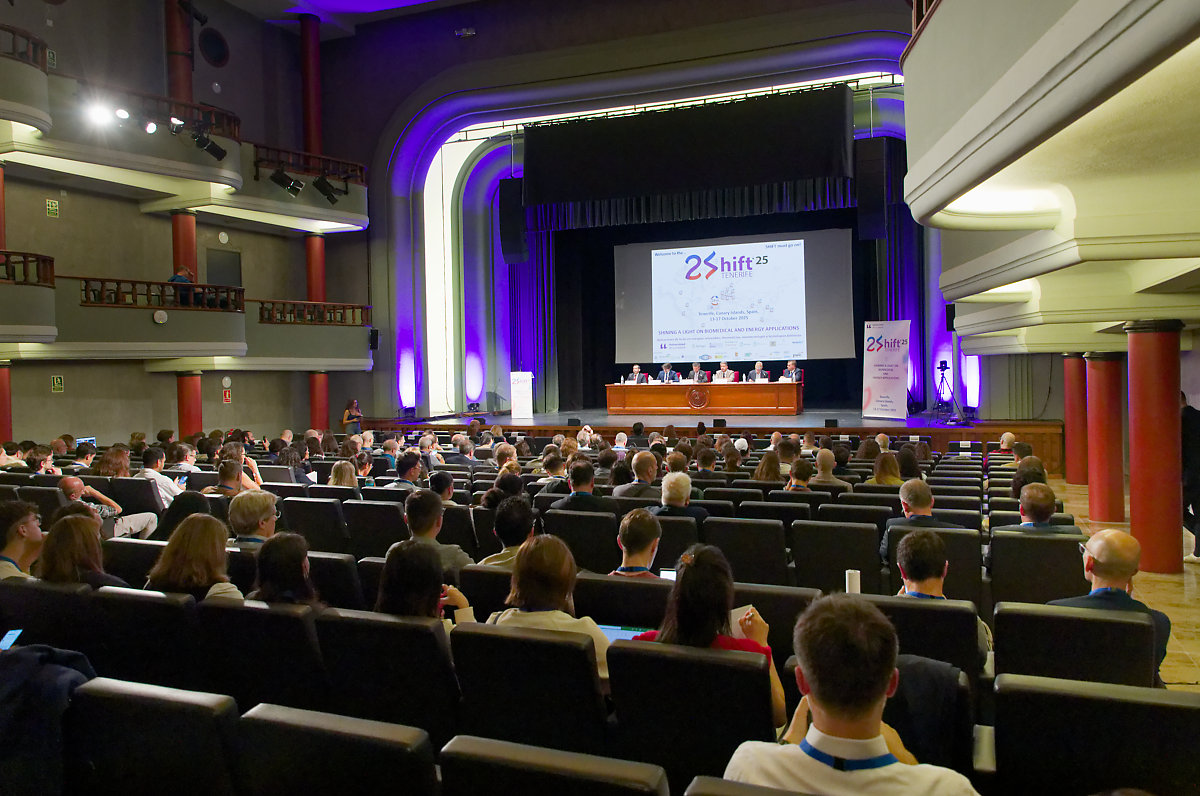
Shift25 brings together 250 international researchers at the ULL.
Méndez was responsible for presenting the congress's content and thanking all the people and institutions that made its organization possible. He noted that "Shift" signifies change, referring to a new way of obtaining energy thanks to advances in sustainability such as solar fuels, artificial photosynthesis, and new materials for harnessing and storing solar energy. "A change in how we take care of ourselves, new biomedical treatments using light: from bioimaging and fluorescent probes to new cancer treatments, phototherapy, nanothermometry, and even light-activated molecular machines, as the first plenary speaker, whom we have the honor of hosting, will tell us about," he summarized.
The first speaker was the aforementioned Dutch Nobel laureate Ben Feringa, whose presentation, “Light for Movement,” summarized his main research work, which he defined as “building on a small scale” and which is evident in fields such as light-driven molecular machines. In his talk, he explained how synthetic chemistry offers “astonishing opportunities” and also reviewed his career in the world of photochemically activated molecular switches and light-driven rotary motors, discoveries that can be used for the design of smart drugs and the control of biomolecular functions.

 Spanish
 English
 French