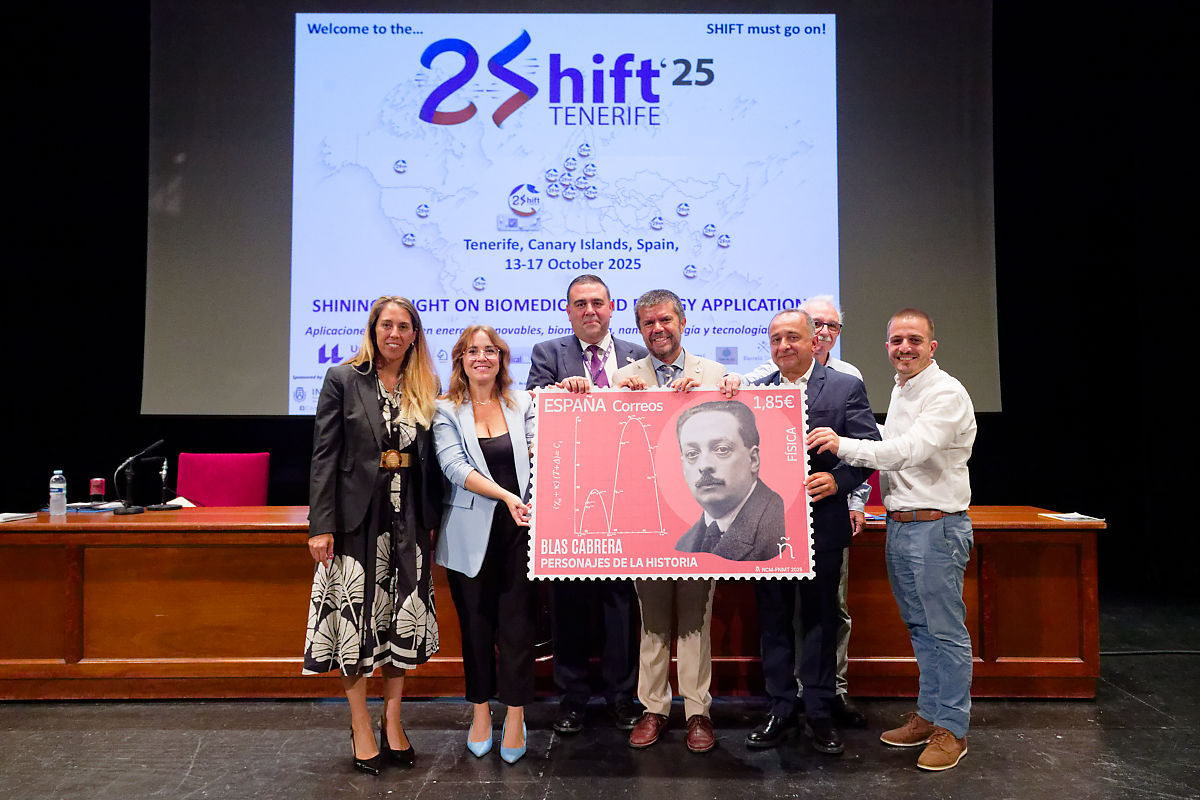
Blas Cabrera Felipe, the physicist from Lanzarote considered the father of Spanish physics, went into exile in Mexico on October 15, 1941, after being purged by the Franco regime. Eight decades later, on October 15, 2022, his remains were repatriated to La Laguna, the city where he grew up. And today, another October 15, this time in 2025, is once again a significant date in the memory of this scientist, as it marks the date of the unveiling of the stamp that Correos de España (the Spanish postal service) has dedicated to him as part of its "Figures in History" series. The event was held in the Paraninfo (main auditorium) of the University of La Laguna, during the congress. SHIFT2025 about light applications that is being held this week.
He was the president of the congress organizing committee, the professor of Applied Physics Jorge Méndez Ramos, who pointed out that coincidence of dates in the biography of Blas Cabrera during his speech at the event, which was presided over by the rector of the University of La Laguna, Francisco J. García Rodríguez, and also had the presence of the director of Philately and Institutional Relations of Correos, Nuria Lera Hervás.
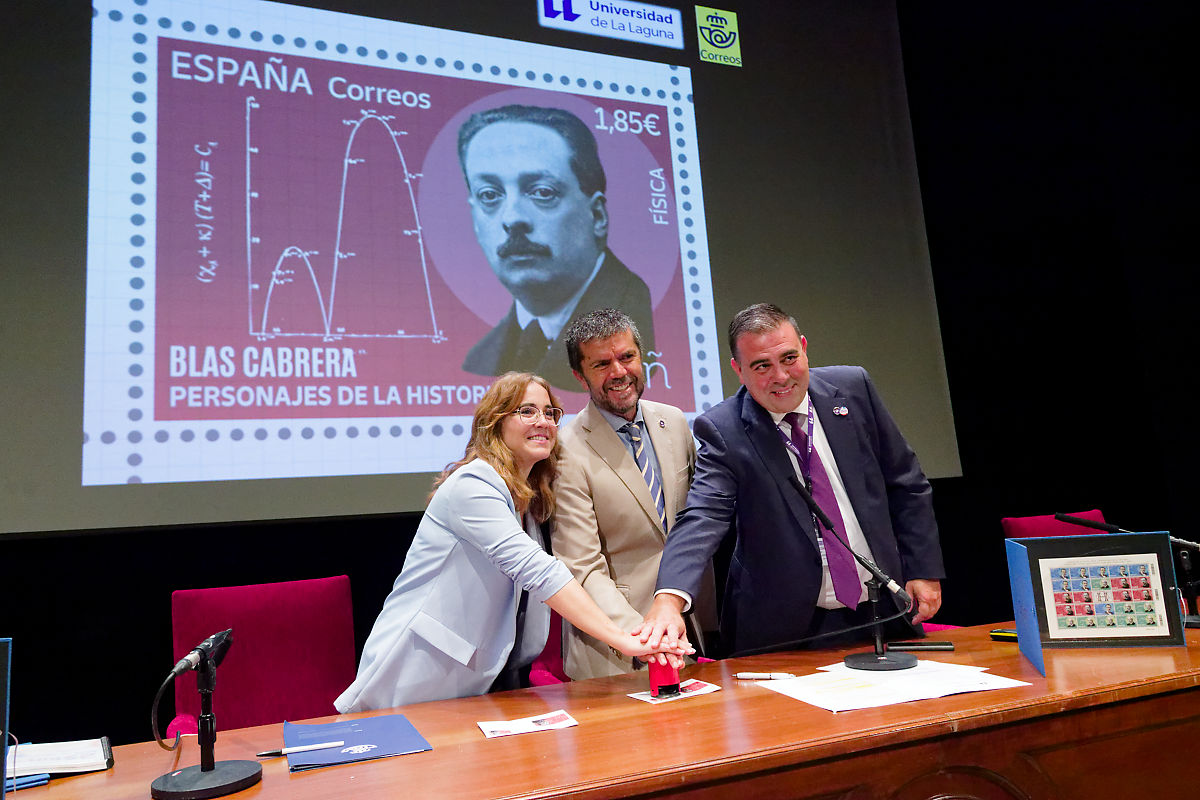
Honorary postmark.
The ceremony consisted of a few formal words after which the honorary first-day-of-issue ceremony was carried out by the three people at the table, and to which other authorities were also invited, as well as people related to the stamp and the scientist: his great-granddaughter, Marta Cabrera Díaz; the petitioner for the stamp, Carlos Court; the dean of the Faculty of Sciences of the University of La Laguna, María del Mar Afonso; the sub-delegate of the Government in Santa Cruz de Tenerife, Javier Plata; and the councilor of Education, Youth and OMIC of La Laguna, Sergio Eiroa.
During his speech, the rector championed Blas Cabrera Felipe as one of the key figures in the transformation of physics at the beginning of the last century, placing him alongside figures such as Einstein, Bohr, Curie, and Schrödinger. This comes as the University of La Laguna commemorates the 50th anniversary of Franco's death with a wide-ranging program. program of events– García also wanted to emphasize his status as a victim of repression and exile under the dictatorship, whose memory is being restored posthumously.
García described Cabrera as a “well-rounded scientist,” given his ability to combine cutting-edge contributions with science communication to bring science closer to society. This purpose, he said, is more necessary than ever in an era like the present, where misinformation is rampant. For this reason, he recalled two of the functions that, in his opinion, public universities must fulfill: the promotion of knowledge, to combat this abundant misinformation, and the preservation of memory, to avoid repeating past mistakes. Both are closely related to the contributions and life of the physicist being honored.
In her speech, the Director of Philately and Institutional Relations at Correos (the Spanish postal service) championed the role of those who, like Blas Cabrera, have dedicated themselves to science and, in doing so, contributed to the progress of society. She also championed the act of writing a letter by hand and sending it stamped, which may seem old-fashioned in the age of email, but demonstrates appreciation for the recipient for the time and attention invested, a practice that, in her opinion, should not be lost. In this context, philately also serves as an educational tool, and in this regard, Lera Hervás noted that many collectors have told her that commemorative stamps like the one presented today encourage them to research the figures depicted on them.
For his part, Jorge Méndez pointed out that, unfortunately, it is still necessary to remember who Blas Cabrera was despite the obvious importance of his contributions. He therefore offered a brief reminder with several images, such as that of the Canarian physicist attending the legendary Solvay Conference alongside the scientific elite of the time. He also highlighted Cabrera's contributions to research in magnetism and rare earth elements, such as the Curie-Weiss-Cabrera curve of paramagnetism, which is featured in the background of the stamp's illustration.

 Spanish
 English
 French