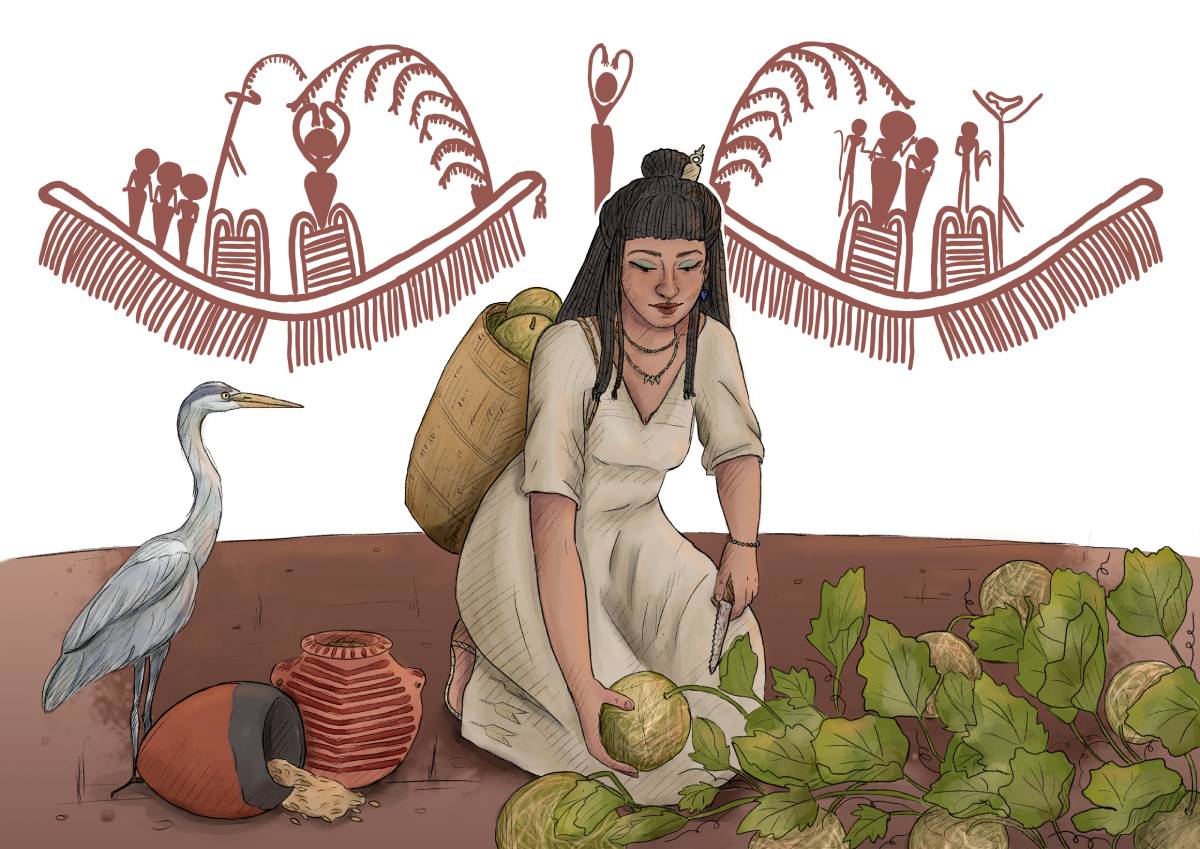
Beyond the pyramids and the pharaohs, the foundations of Egypt were laid upon lesser-known entities: the very bodies that worked in the creation of the state. This is demonstrated by research published in the volume “Bodies That Mattered. Ancient Egyptian Corporealities” (Sidestone Press, Leiden) as in the prestigious International Journal of Osteoarchaeology, in which the archaeologist Jared Carballo Pérez, from the University of La Laguna, and Professor Sarah Schrader, from Leiden University (Netherlands), analyzed the human bones of 259 people from Egyptian and Nubian sites between 4,800 and 1,750 BC.
The study combines osteological, iconographic, and archaeological analyses to decipher how daily tasks and social hierarchies in the Nile Valley were literally etched into bones. The results show that social inequalities manifested physically: while men tended to show signs of exertion in their shoulders, legs, and feet, possibly related to agricultural work such as preparation, construction, and herding, women showed greater wear and tear in their arms, hands, and lower back, perhaps associated with activities that sustained society, such as weaving and grinding.
“Bones are archives of our daily lives. Our routines, work, and power differences within society are inscribed on them. In Egypt and Nubia, we have been able to see that these inequalities appeared engraved on their bodies before appearing in texts or images,” explains Carballo Pérez, a postdoctoral researcher at the University of La Laguna.
The body as a reflection of power
Through the theory of “incorporation” or embodiment, The team demonstrates how human biology cannot be separated from its social environment. As Nile societies became more complex and hierarchical, the bodies of the working classes were transformed under the physical strain of new, more demanding production systems.
In the words of the researcher, “the construction of the Egyptian and Nubian states was also a bodily construction: the pyramids, temples, cities and fields were built at the expense of the bodies that assumed the weight of these daily tasks.”.
Osteological analysis also reveals differences according to the area and time: in the earliest periods, such as the Late Neolithic (5th millennium BC), women appear to have had greater autonomy and participation in diverse tasks, while in later stages, such as the Old Kingdom of Egypt or the Kerma Kingdom in Nubia, gender and social class differences were accentuated, so that female work may have been relegated to the domestic sphere and more specific agricultural and livestock tasks.
A look beyond the pharaoh
This research challenges the classic image of Pharaonic Egypt centered on male elites, offering a broader and more human view of the past. “We wanted to give prominence back to those who don't usually appear in texts or monumental tombs: women, peasants, ordinary people. They were the ones who truly built Egypt,” says Carballo Pérez.
The work also highlights the importance of Nubia (present-day North Sudan and part of southern Egypt), a region that has historically been marginalized to some extent by traditional Egyptology, showing that its societies developed complex hierarchies and divisions of labor in parallel.
Beyond its historical value, the study connects with contemporary debates on occupational health, inequality, and care work. The traces of effort and wear documented in skeletons spanning millennia serve as a reminder that bodies remain the stage where these stark economic and gender inequalities materialize, inequalities that are palpable today in clothing, body shapes, and tattoos.
“Studying the bones of the past is also reflecting on the bodies of the present,” the researcher concludes. “If more than five thousand years ago inequality was etched in the bones we have left behind, today it continues to be etched in our health and daily habits, such as leading a sedentary life in the office, or having to get up every day to take the livestock out.”.

 Spanish
 English
 French