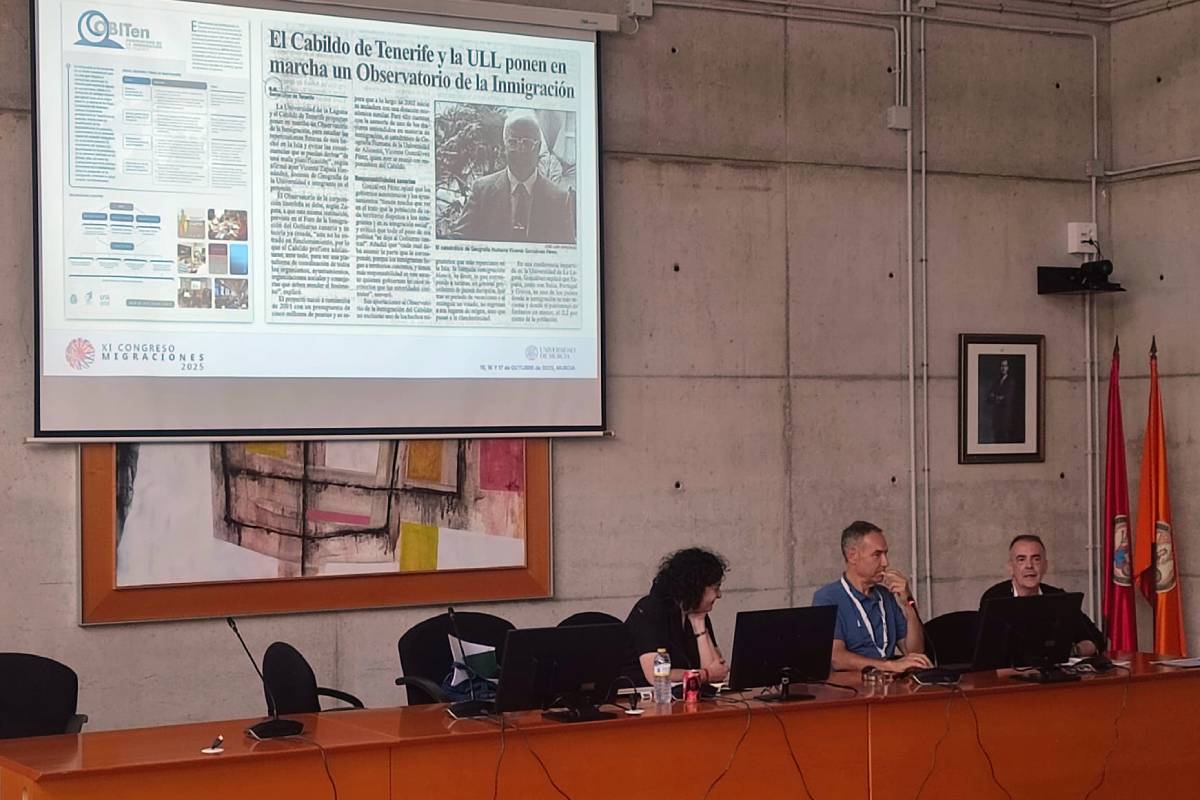
The Tenerife Immigration Observatory (OBITen[Name of organization] participated in the eleventh edition of the triennial congress on migration held in Spain, sponsored by the University of Murcia, contributing its experience in observing migration in border territories and its impact on public policies implemented at different levels. This expert team emphasized the importance of having a permanent reference point on migration based on scientific knowledge, anchored in two organizations with established credibility and full social and institutional recognition: the Tenerife Island Council and the University of La Laguna.
These organizations have maintained this initiative since 2001 through a stable collaboration agreement that has enabled them to undertake significant interdisciplinary research projects; foster specialized training opportunities on migration and its effects; establish an annual reflective conference; manage various European projects; and promote the "Together in the Same Direction" initiative, active since 2009 with the aim of facilitating diversity management and promoting intercultural coexistence in Tenerife. From its ongoing implementation has emerged the island's strategic framework for intercultural coexistence, "Tenerife Lives Diversity.".
During the presentation, the Observatory team emphasized its connection to and regular participation in supra-regional structures, such as the Network of Intercultural Cities and the Welcoming International program. These structures allow for the periodic review of its activities, the exchange of experiences, the generation of shared learning, access to resources for developing new projects, and the recognition of initiatives with demonstrative impact, among other benefits. This relationship has fostered the continuous improvement of OBITen's functions and the expansion of its reputation beyond the archipelago, having recently been recognized as a best practice by the Council of Europe.
Vicente Zapata, Professor at the University of La Laguna and academic director of OBITen, highlighted “the Observatory’s ongoing responsiveness and accessibility to the needs and demands expressed over time by various stakeholders in the island’s reality, including the political and technical spheres, diverse citizens and their representative organizations, as well as the media.” All of this, combined with “its openness and versatility, allows more people with different motivations (scientific, academic, professional, journalistic, etc.) to have access to support frameworks within which they can achieve their objectives.”.
Julio Ramallo, head of service at the Tenerife Island Council and technical director of OBITen, emphasized “the significant investment made by the Island Corporation over time and the substantial return derived from the valuable work carried out at the Observatory since 2001 by a large number of people.” He also highlighted “the continued existence of a structure that has fostered research on migration and its impact on the island, always with a broader perspective, even beyond the region, which is highly valued in many circles.”.
Both speakers highlighted the Observatory's availability and flexibility to be present, participate, and intervene in both specific actions and longer-term, more far-reaching processes, considering different scales, contexts, and levels of complexity. They also emphasized its capacity to meet the objectives defined at each stage with limited resources, renewed annually, prioritizing a process-oriented approach that has always aimed to influence improvements and changes in the medium and long term.
Currently, OBITen is preparing various activities to celebrate its 25th anniversary, making it one of the longest-running international migration monitoring organizations in the country, alongside others such as the Permanent Immigration Observatory (OPI), under the auspices of the Spanish government, and Ikuspegui, the Basque Immigration Observatory. The Tenerife observatory emerged at a time when a significant increase in the role of this mobility in shaping the regional population was already anticipated, particularly on the island of Tenerife, whose population growth for some years now has depended essentially on net migration.

 Spanish
 English
 French