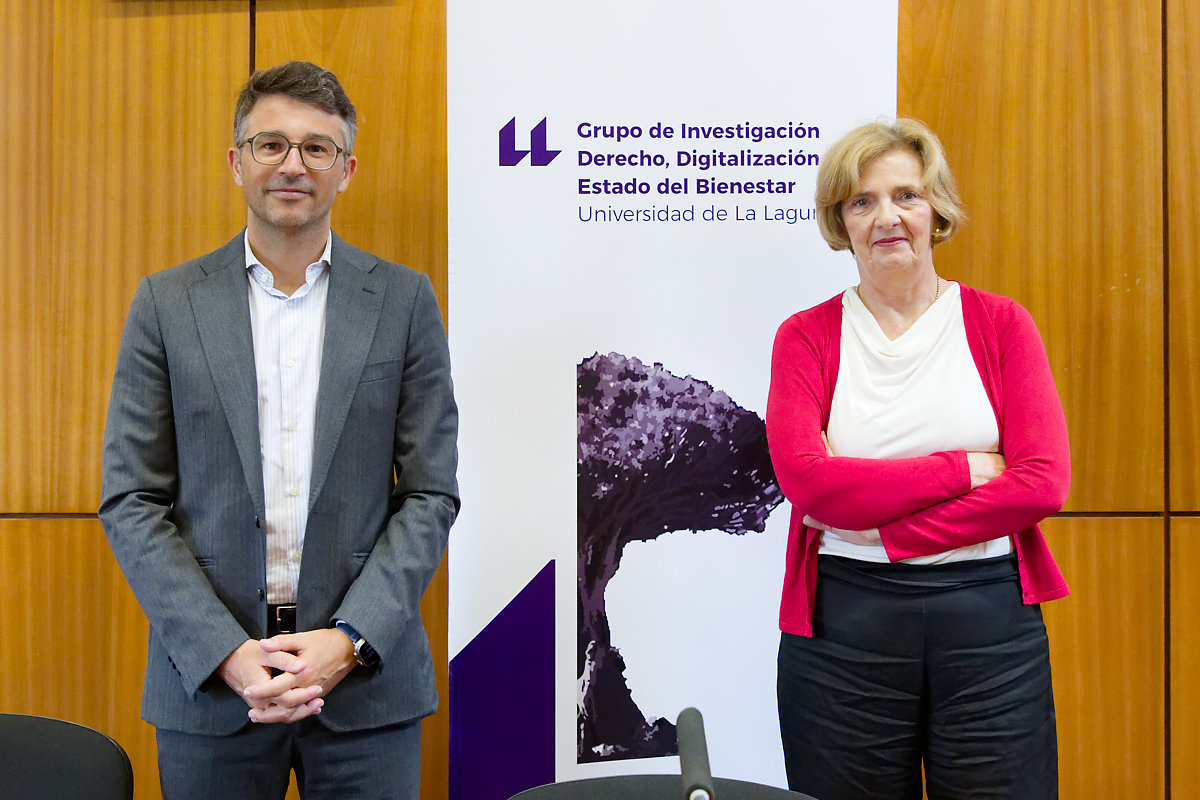
The University of La Laguna inaugurated today, October 24th, at the Faculty of Law the International Inter-University Seminar on Law and the Welfare State, an academic initiative that brings together for two days —October 24 and 31— professors and researchers from this institution and the University of Catania to reflect on the legal and social pillars that support the contemporary Welfare State.
The meeting is being led by Fabiola Martín Cáceres, tenured professor of Financial and Tax Law at the ULL, and Antonio Guidara, Professor of Tax Law at the University of Catania, with the coordination of Airam Garcia. It addresses the constitutional foundations of the Welfare State, the right to housing, the financing of social rights, and the challenges of digitalization.
During the opening ceremony, the dean of the Faculty of Law, Dulce Mª Cairós Barreto, Cairós highlighted the importance of addressing a debate “on a model that continues to be questioned and that invites us to reflect, especially from law faculties, on whether we were right to constitutionalize and develop Welfare States as we conceived them in the mid-20th century.” She also emphasized that it is “particularly interesting” that the area of Financial and Tax Law is driving this reflection, given that it is one of the most controversial subjects due to its direct relationship with the sustainability of social rights. Cairós welcomed the visiting professors from the Italian university, thanking them for their involvement and celebrating “a collaboration that enriches the academic exchange between both countries.”.
For her part, the seminar director explained that the meeting reflects the research group's desire to create forums for legal reflection on the social rights that underpin the Welfare State, such as education, housing, environmental protection, and the digital transition. She noted that the group DERDIGEB (Law, Digitalization and Welfare State), created last year, already held a first meeting on Law and Artificial Intelligence, and this new edition expands the focus to social rights, "opening a space to think about how Law can contribute to consolidating rights that are threatened or weakened today.".
“These rights, which we thought were firmly established, require measures to reverse serious situations such as the housing crisis or the digital divide,” she added. She also highlighted that the seminar emphasizes a comparative perspective with Italy, and stressed that the interdisciplinary nature of the group is reflected in the seminar's composition, which includes faculty from various fields “and gives a voice to the Faculty's young talent.” In her opinion, the participation of predoctoral researchers demonstrates “the academic vitality and the Faculty's commitment to contemporary issues.”.
In the first round table, entitled “Constitutional Foundations of the Welfare State”, participated Vicente Navarro, from the area of Constitutional Law at the University of La Laguna, and from Professor Giancarlo Ferro, Navarro Marchante, from the University of Catania, recalled that the Spanish Constitution enshrines the social and democratic rule of law from its first article, "which demonstrates its structural relevance within the constitutional model," and pointed out that "understanding its evolution requires returning to the origins of liberal constitutionalism and the subsequent incorporation of social rights that marked the transition to the modern social state.".
For his part, Giancarlo Ferro offered an overview of the Italian model, explaining that “the social and democratic state represents the synthesis of 20th-century European constitutionalism, born from the overcoming of the classical liberal model to guarantee social justice and substantive equality.” He emphasized that the principles of human dignity, solidarity, and real equality “oblige the State to act to eliminate the economic and social obstacles that limit freedom,” and highlighted the significance of the 2022 constitutional reform, which introduced the principle of insularity into the Italian legal system “as a guarantee of effective equality and territorial cohesion within the unity of the Republic.”.
The day continued with panels dedicated to the legal framework for housing, the recognition and funding of social rights in the Canary Islands, and access to justice for vulnerable groups, in which professors and researchers from various fields participated. The seminar will conclude on October 31 with presentations on environmental taxation, socio-labor policies for ecological and digital transition, obstetric violence, educational funding, and criminal liability arising from the use of artificial intelligence.
The meeting is organized by the DERDIGEB Research Group of the University of La Laguna (ULL) and the Department of Law of the University of Catania. Collaborating entities include the Institutional Chair of Childhood and Adolescence, the Research Group on Law, Person and Family, and the R&D projects 'The strategies of trade union organizations and the role of social partners in the just transition process, climate change and respect for the environment' and 'Environmental, social and economic sustainability of justice. Challenges of the 2030 Agenda'.‘

 Spanish
 English
 French