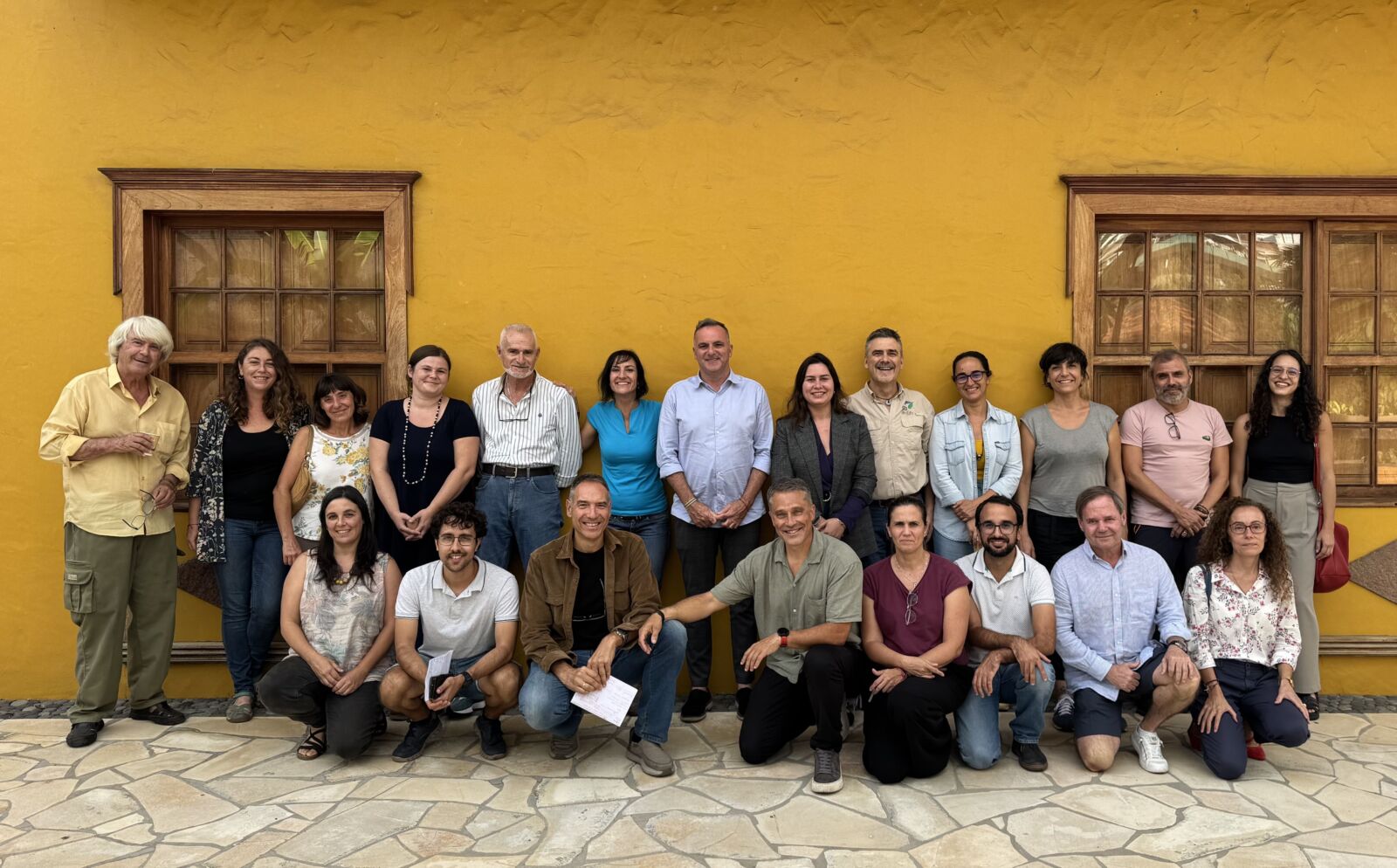
The University of La Laguna, together with the Canary Islands Biosphere Reserve Foundation La Palma, has held a series of workshops on land stewardship in Tazacorte, extending to various locations in the Aridane Valley, where participants were able to learn about various demonstrative experiences related to the eradication of exotic species, the reconditioning of agricultural farms, the rescue of crops and the marketing of traditional products, and the recovery of paths and emblematic places.
The La Palma Island Council and the three municipalities of the Valley participated in the workshops, along with a significant number of people representing various groups, entities, and institutions on the island. Across both sessions, four specific experiences that can be considered stewardship initiatives were also presented, both formally, as documented in the 7th State Inventory of Land Stewardship Initiatives, such as those carried out by promoting volunteer work by its participants.
This state inventory, published just a few months ago by the Biodiversity Foundation related to the Ministry of Ecological Transition and Demographic Challenge, already includes initiatives located in 6 of the 14 municipalities of La Palma, adding up to about fifteen experiences that are linked to the Biosphere Reserve, the Nuevo Surco Association or the Jurria Tenerra Salto del Pastor collective.
It should be noted that land stewardship continues to expand significantly in the Canary Islands, as confirmed by the fact that it is the second autonomous community in the State in terms of the number of registered stewardship entities in 2023 (35 entities, 13% of the total), second only to Catalonia (74 entities, 28%), on an upward trajectory since 2010, the date the series began, when none were counted.
This was highlighted by Óscar Prada Campaña, currently involved with the Life Custodia project and a professional with SEO/Birdlife, a guest speaker who emphasized the added value of stewardship, “as it fosters formal agreements between different stakeholders in a given territory, thus ensuring the conservation and promotion of many diverse sites throughout the country.” Prada stressed “the important role that La Palma can play in the process of consolidating land stewardship in the Canary Islands, especially if it manages to properly leverage the existing wealth of experience and capitalize on the potential demonstrated during the conference.”.
Those with institutional responsibilities who participated in the sessions held in Tazacorte emphasized the importance of the meeting, especially in order to further reinforce the conviction that the island of La Palma is one of its most precious assets. Therefore, it is essential to strengthen all possible initiatives that guarantee its preservation, focusing on establishing alliances at various levels; a process in which the institutions themselves, social groups and organizations, the business sector, universities, and others must be involved.
The workshops were inaugurated at the Banana Museum by the mayor of Tazacorte, David Ruiz Álvarez, with speeches by the Councilor for Natural Environment, Ecological Transition, and Climate Action of the La Palma Island Council, Mónica Gómez Curiel; the Executive Director of the La Palma World Biosphere Reserve Foundation, Alfonso Montes de Oca Acosta; and representatives from the municipalities of Los Llanos de Aridane and El Paso, José Arón León and Pablo Omar Hernández Concepción. The workshops were directed by Vicente Zapata, a professor at the University of La Laguna (ULL).

 Spanish
 English
 French