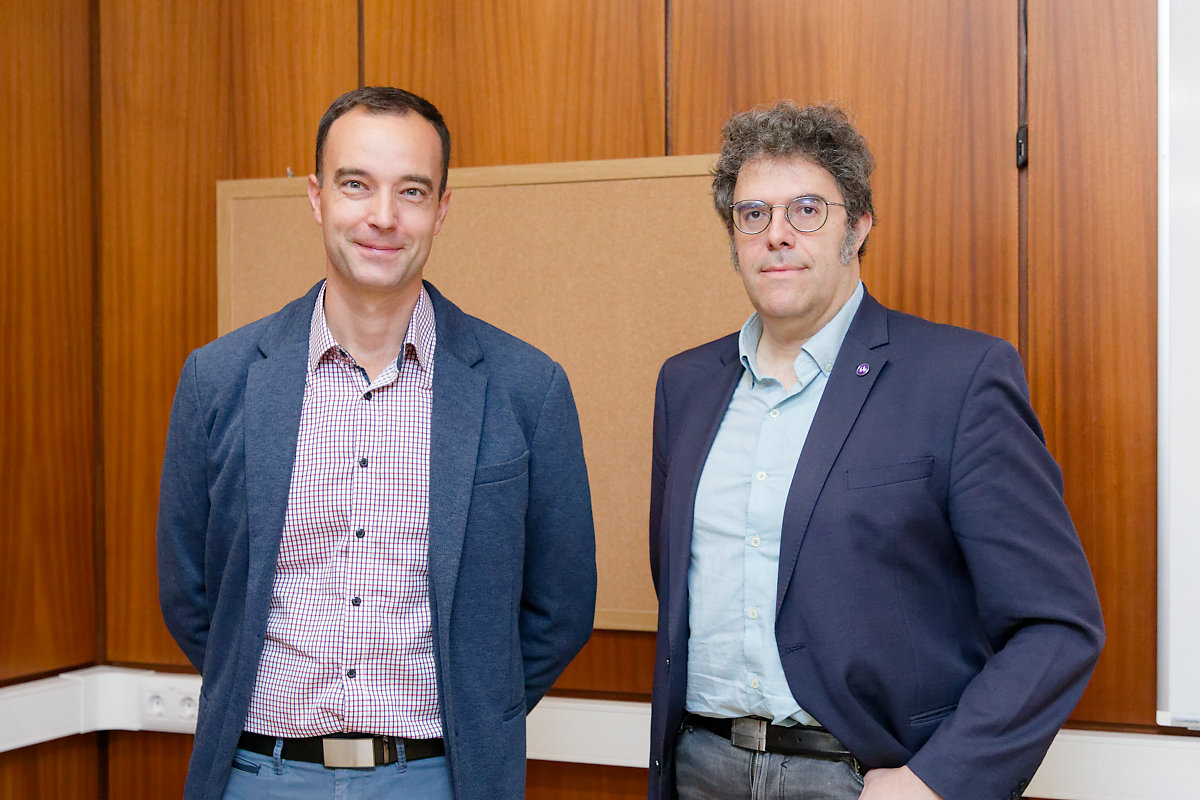
The University of La Laguna, through the Faculty of Law and the Francisco Tomás y Valiente Cultural Center, has been organizing the event for the past four years. Tricontinental Seminar on Intellectual Property, Although the conference features a variety of presentations, each year it focuses on a more specific area, which this year is the defense of the creation of fictional worlds in popular culture, such as comics. This meeting was recently held under the coordination of a professor from the Civil Law department. Louis Capote and Péter Mezei, from the University of Szeged (Hungary).
With the participation of professors from Spanish, Hungarian, Slovenian, Austrian, Ukrainian and British universities, the seminar consisted of short presentations on subjects such as the right to parody, superheroes in the field of intellectual property, copyright of comics, the defense of traditional cultural expressions and the defense of copyright and trademark rights on metaverse platforms, among others.
Capote explains that the seminar's tricontinental nature stems from the involvement of both himself and Mezei in its launch in 2021, along with John Cross of the University of Louisville in Kentucky, who was a Fulbright visiting professor at the University of La Laguna that year. The first seminar was a general introduction, the second addressed cultural heritage, and the third, held in Malta, was dedicated to AI, a topic that remains highly relevant given its current importance.
He explains that this year's focus is on fictional universes related to comics, film, video games, and satire as an element of freedom of expression in certain situations and countries. It's a complex field because there are significant differences in how different countries conceive of copyright, so "there is a general context defined by the treaties managed by the World Intellectual Property Organization, but then certain harmonized minimum standards are established," the expert explains.
“The United States' regulations are notably different, and only now, and not retroactively, is a kind of harmonization being considered,” explains Capote, who notes that Spain has a dual system that recognizes, on the one hand, economic exploitation rights, which expire after 70 years; and on the other, moral rights, which in many cases are lifelong or perpetual. In contrast, in the United States, until now everything had focused on the economic aspect, while work on moral rights is only now beginning.
Applying this to the world of comics, Capote explains that the underlying notion is that “only a human being can create and, consequently, possesses authorship rights, meaning that any activity carried out through publishing constitutes a temporary transfer of rights.” Thus, when the Bruguera publishing house closed, authors like Víctor Mora, writer of El Capitán Tueno, and Francisco Ibáñez, creator of Mortadelo and Filemón, had to sue to regain the rights to their creations.
In the United States, the situation is different, as the characters belong to the publisher and the authors have only had their rights recognized in some cases through out-of-court settlements. “The paradoxical situation is that the same lawsuit filed in a European Union country or in a US court can have two diametrically opposed outcomes.”.
In this area, time is a factor that determines the expiration of copyright protection, and this has led to different scenarios, depending on the legislation in force at any given time. The expert cites as an example that in 2021, the work of Antonio Machado was declared to be in the public domain, 80 years after his death, because his death occurred before 1987, the date of the legal change on this matter, so the applicable term was not the current 70 years, but 80.
Péter Mezei, for his part, is also an expert in intellectual property. “My favorite field is copyright, which includes music, and within that area, one of the issues I find most fascinating is how music is used by secondary creators” through activities such as “sampling,” that is, the reuse of a sample or fragment from a different author in a work. “It’s a gradual problem, and in fact, a case concerning musical sampling that began 25 years ago is still pending before the European Court of Justice. It’s a very relevant issue.”.
Perhaps one of the most famous cases of this practice is that of rapper Puff Daddy, who must pay Sting $5,000 a day for the unauthorized use of a sample from one of the British artist's songs. Mezei cites another case, that of Kanye West, whom he describes as a "notorious infringer" of copyright laws. He even had a lawsuit filed by the author of the most famous song in Hungarian rock, which was settled out of court. "The settlement means that West admitted he did something wrong. And he has been sued several times for doing things like this.".
The Hungarian jurist points out that the EU has harmonized several issues, such as defining the term "protection" in a unified way, which wasn't the case before. On the other hand, he doesn't believe the United States is stricter in defending musical rights, but simply that it has had more cases and, therefore, more jurisprudence. There, concepts like "minimums," "substantial similarity," and "fair use" are used, which are not present in Spain, Hungary, or Europe in general. "This shows that the gap between the two regions is large, and I'm not sure we'll ever reach a compromise on these issues, but who knows?".

 Spanish
 English
 French