
Laura Hernández Tomé y Javier Martín Davara, Predoctoral researchers from the Prehistory Area of the University of La Laguna are responsible for the scientific direction of an archaeological project recently developed in the Abric del Cint (Alcoi, Alicante) whose objective was to restore and reinterpret the intervention carried out in this enclave in 1953, as well as evaluate its archaeological potential.
The Barranc del Cint ravine, located in the Sierra de Mariola Natural Park, stands out for its extraordinary archaeological wealth, dating from the Late Pleistocene to more recent times. “It is a privileged place for studying past human populations, thanks to its strategic location and the large number of archaeological sites that demonstrate prolonged occupation from early prehistory to the historical period,” experts say. Previous research has identified the Barranc del Cint as a natural corridor that has been used by different human groups throughout history, as well as serving as a paleoclimatic refuge during the Pleistocene.
The only documented intervention at Abric del Cint was a small excavation carried out in 1953 by Mario Brotons, a bookseller and amateur archaeologist, who recovered Paleolithic stone tools, copper materials, pottery, and millstones from more recent periods that are yet to be determined. These findings, along with the preliminary geomorphological study carried out by the team, suggest that the site could contain a significant sedimentary deposit with great potential to provide information about the dynamics of occupation of the ravine over time.
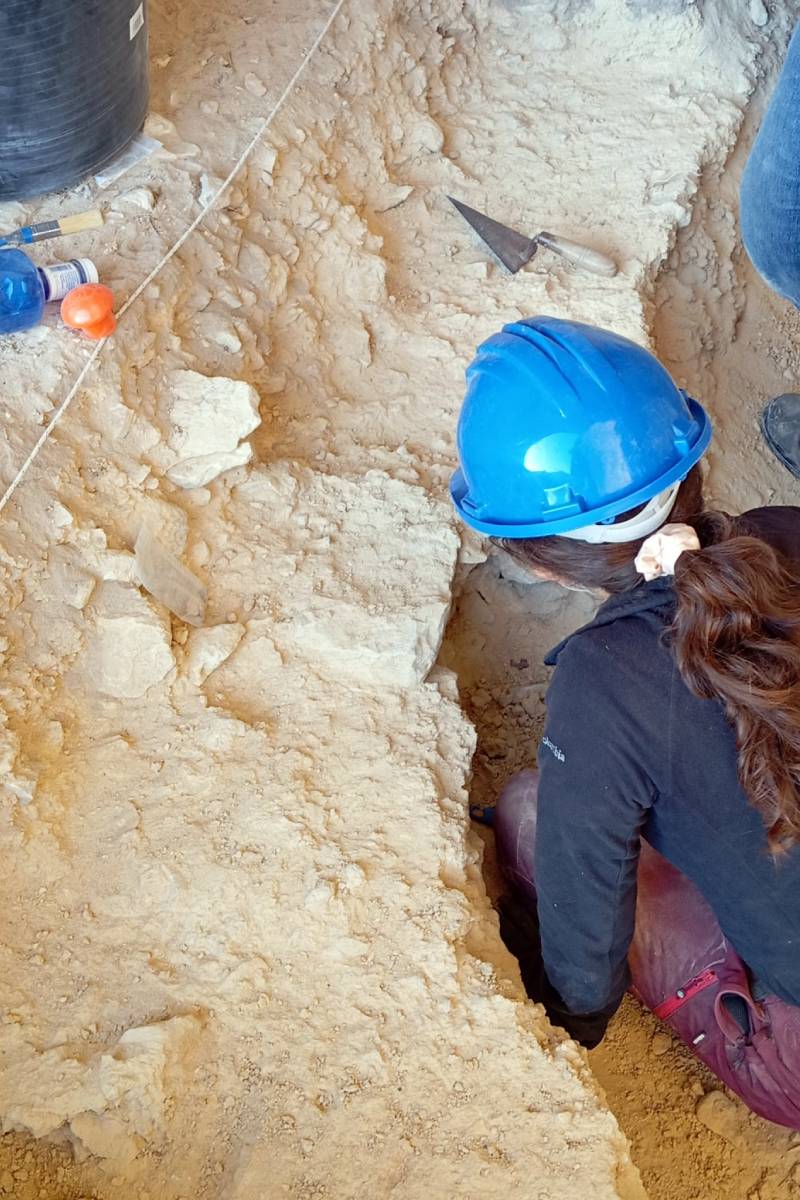
Laura Hernández at the excavation.
The current campaign focused on reinterpreting the archaeological intervention from 70 years ago and assessing the potential of the rock shelter to contain a significant archaeological record that would allow for a better understanding of occupation dynamics in the Sierra de Mariola. To this end, the team applied updated methodologies and innovative techniques such as soil micromorphology, which allows for the analysis of sedimentary deposit formation processes, and lipid biomarker analysis, which helps identify organic remains preserved in the sediment. These techniques were combined with archaeostratigraphic and spatial studies of the lithic record, which will allow for the establishment of a more precise chronological sequence for the site.
The work was carried out within the framework of the General Research Plan “Inhabited Ravines: Human Settlement and Archaeology in the Sierra de Mariola,” authorized by the Directorate General of Culture and Heritage of the Valencian Government and endorsed by the Camil Visedo Archaeological Museum of Alcoy. This project, which will be developed over the next four years, seeks to clarify the stratigraphic sequence and archaeological context of the Abric del Cint, still unknown despite the survey carried out in 1953.
In addition to Hernández Tomé and Martín Davara, the excavation is directed by Alejandro Mayor Benadero, a researcher at the University of Alicante and the Catalan Institute of Human Paleoecology and Social Evolution; Santiago Sossa Ríos, a researcher at the University of Valencia; and Javier Mir, a graduate in History from the University of La Laguna, also participates.
For Hernández Tomé and Martín Davara, this experience represents a significant step in their academic careers, as it is the first time they have led a research project. “It allows us to directly apply the knowledge acquired during our studies and, at the same time, open new lines of research in a region as important as the Sierra de Mariola,” they state. They also highlight the opportunity to coordinate a young and multidisciplinary team, which allows them to grow as researchers, strengthen collaborations, and contribute to the advancement of historical knowledge about the Cint ravine.

 Spanish
 English
 French