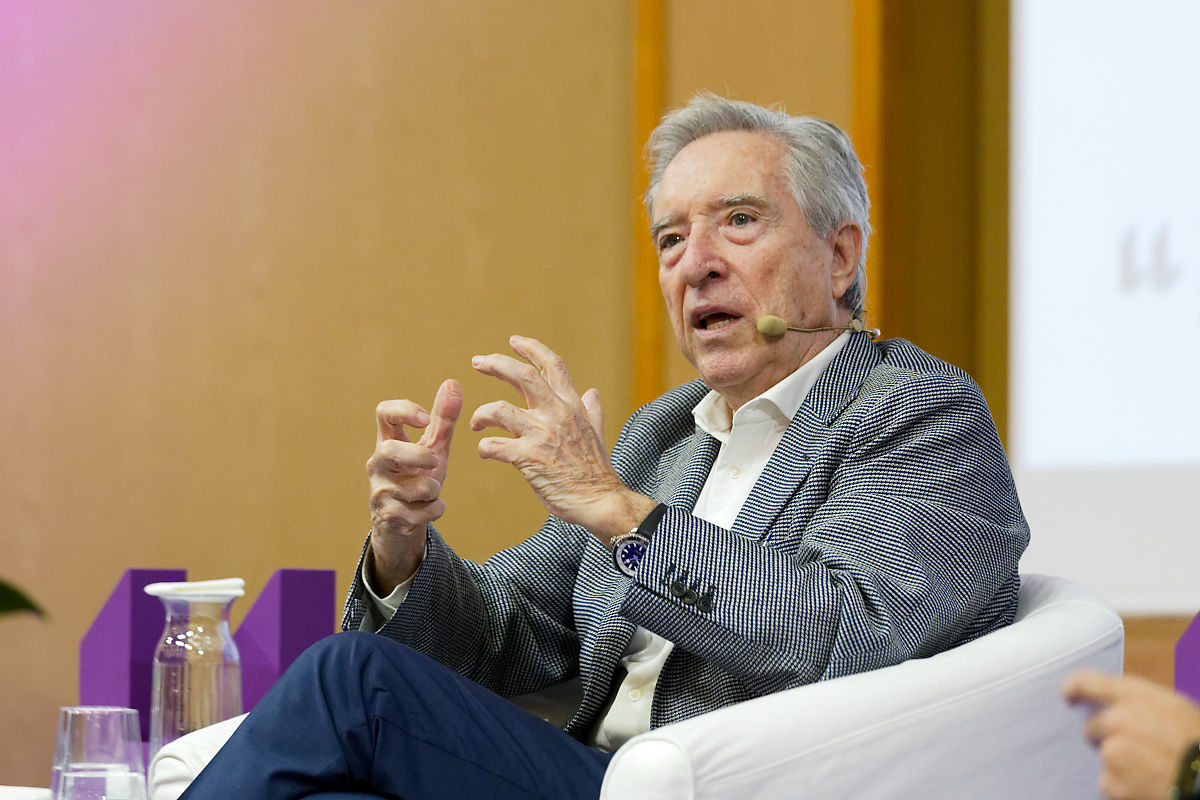
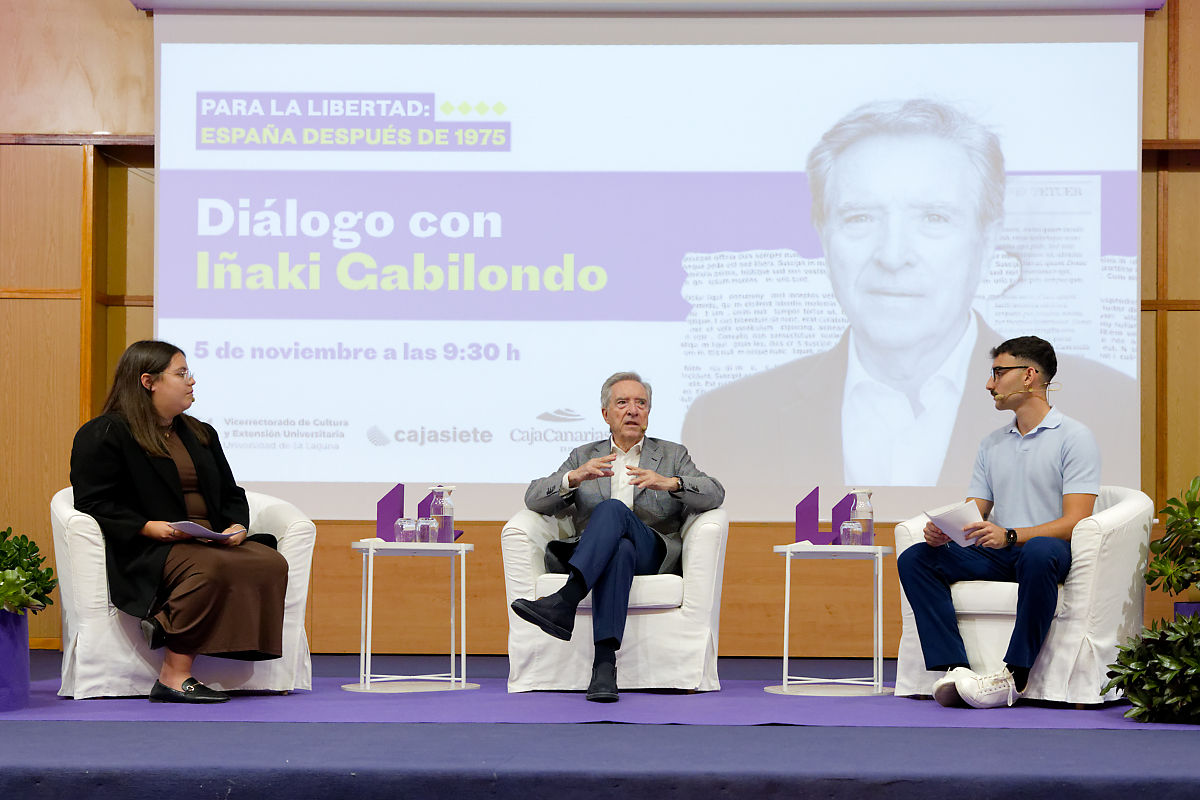
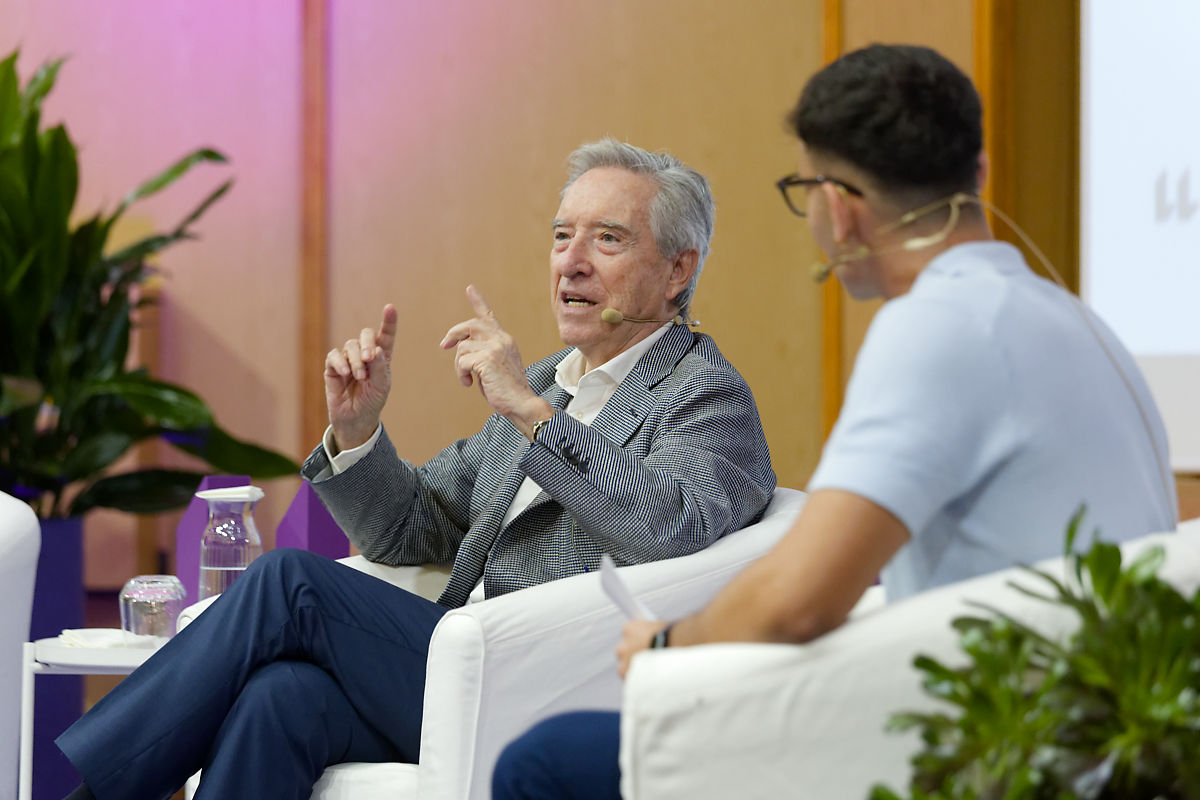
“What on earth is Spain?” With this forceful question, Daniela Rodríguez, a fourth-year Journalism student at the University of La Laguna, began her public dialogue with Iñaki Gabilondo, held today, Wednesday, November 5th, at the academic institution. The journalist addressed the question by alluding to the complexity of a country difficult to reconcile, ravaged by continuous civil wars, since in addition to the 20th-century conflict, there were also the three Carlist Wars of the previous century. It is, therefore, a reality difficult to define, which, nevertheless, has thrived thanks to the collective effort to reach agreements. “Spain is the will to coexist among different perspectives. When that will is strong, Spain grows, and when it is weak, Spain declines.”.
This dialogue, which was also moderated by fellow Journalism student Alexis Vella, was part of the program “For freedom. Spain after 1975”"With this event, the University of La Laguna commemorates 50 years since the beginning of the democratic transition. The session was opened by the rector, Francisco García; the president of the CajaCanarias Foundation, Margarita Ramos; and by a professor from the Department of Spanish Philology." Alberto García, coordinator of the academic seminar in which this dialogue has taken place.
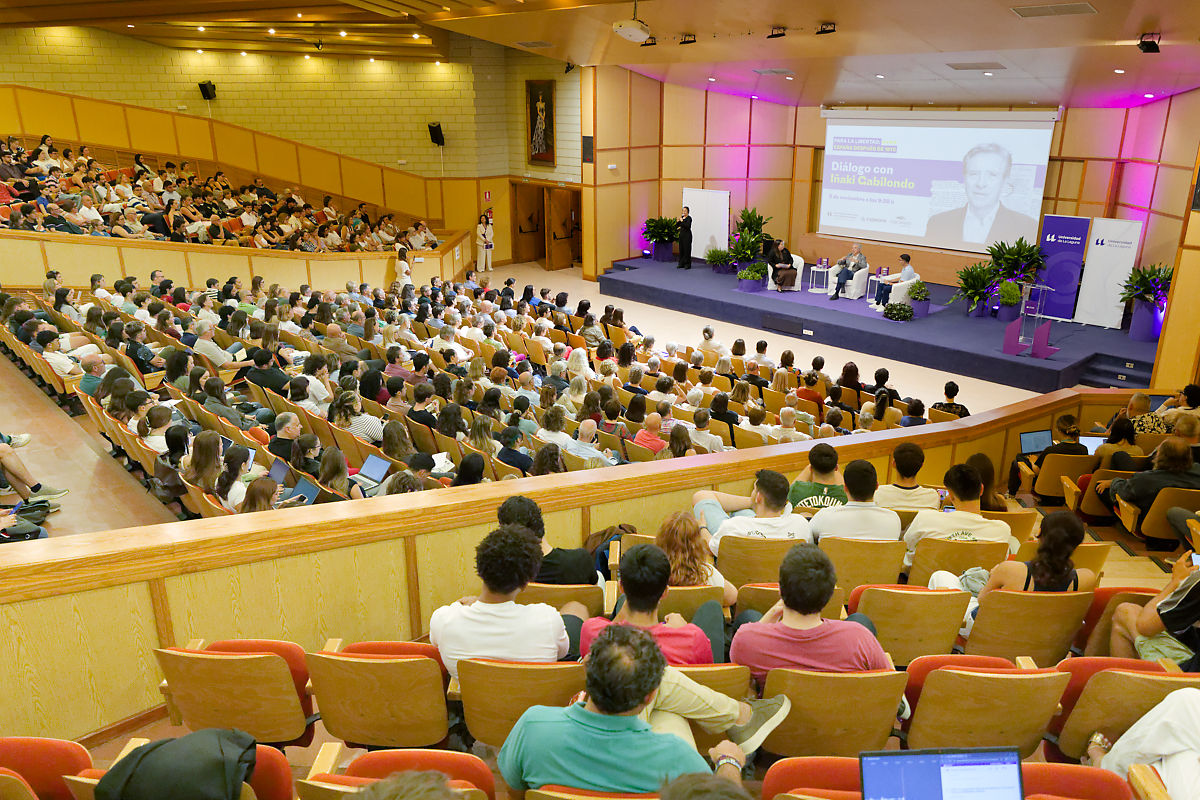
 Delving into the question of Spain before a packed Aula Magna at the Guajara Campus, Iñaki Gabilondo criticized those who present a vision of the country as something very specific and closed off, full of trappings and memories of an imperial past, and who do not consider anyone "Spanish" if they do not share that image. This is not new, and it has already been done with other concepts such as family, from which these sectors have excluded those who do not fit their particular model. "But no matter how hard they try, they will not be able to avoid complexity. We must not give them that freedom.".
The journalist elaborated on the difficulties of practicing his profession in a country controlled by strict censorship, where only two daily news bulletins from Radio Nacional de España were permitted, and all other stations were required to subscribe to them. For this reason, he was critical of today's youth who, out of sheer ignorance and seduced by the far right, praise the Dictatorship without truly understanding its implications. "When I speak to them," he said, "I ask them to spend a month living without freedom, so they can understand what it means to not be able to read, see, or hear what you want, to not be able to develop your sexual or religious identity... They wouldn't be able to endure it.".
In his opinion, these younger generations have embraced this discourse because they feel it "tells the truth" and exposes the problems of the current system. But Gabilondo points out that the job of politicians is not to denounce, but to propose solutions, and so far, he has never heard any solutions proposed by these far-right parties.
That, in fact, is the crux of the matter: political parties of all stripes lack solutions to the problems plaguing the population. “Democracy is a fundamental tool, but it's filthy; it needs to be cleaned out. Parties need to reflect and find new ways to adapt to this changing world because, right now, political forces are incapable of resolving anything since they're stuck with outdated formulas.”.
 Nor does the current climate of partisan confrontation help, where the only thing that seems to matter is defeating the rival. “Some things simply can’t be done without reaching agreements. It’s impossible,” he states categorically. Problems like housing can only be solved if public administrations, unions, employers, and all the sectors involved sit down together. “These kinds of problems can only be addressed collectively.” And since there is no faith in the possibility of reaching agreements, many of these major issues “are shelved.” Thus, reforms to education, public administration, and even the Constitution itself have been relegated from public debate due to the impossibility of consensus.
This contrasts sharply with what was achieved during the Transition, a time when there was a clear understanding of the need for agreement and all parties made “a generous effort of compromise, pacts, and dialogue” to achieve the overall goal. “For many people at that time, seeing Solé Tura and Fraga in the same photograph was as unthinkable as seeing Aznar with Otegi,” he explains. That's why he's bothered by the casual criticism of that process of change, which was anything but easy. “Every move to change things was accused of treason against Spain. It was very difficult to do anything. Some say the Transition was a sham, but that's a lie: it was a hard-fought battle that, little by little, paved the way for the new era to come.”.
As is obvious, the coup attempt of February 23, 1981, also occupied some time in this dialogue. In fact, the news bulletin that Gabilondo himself narrated as director of TVE was shown, marking his first appearance on camera. He declined to engage in “speculation” about the event because “the essential facts are already known,” although he noted that there were many “conspiratorial movements” during those months. Even so, he doesn't believe the objective was to reinstate the Dictatorship because Spain was already caught up in the European trend, “but there could certainly have been many nights of political maneuvering.”.
 When asked if he was worried about the rise of the far right, his response was very telling: “Aren’t you?” What worries him is that it’s a universal phenomenon arriving in Europe and America simultaneously. “I don’t know if Trump is a fascist, but his way of acting is fascist,” and he has turned concepts that were once the driving force of life, like rights and social cohesion, into something to be persecuted.

 Spanish
 English
 French