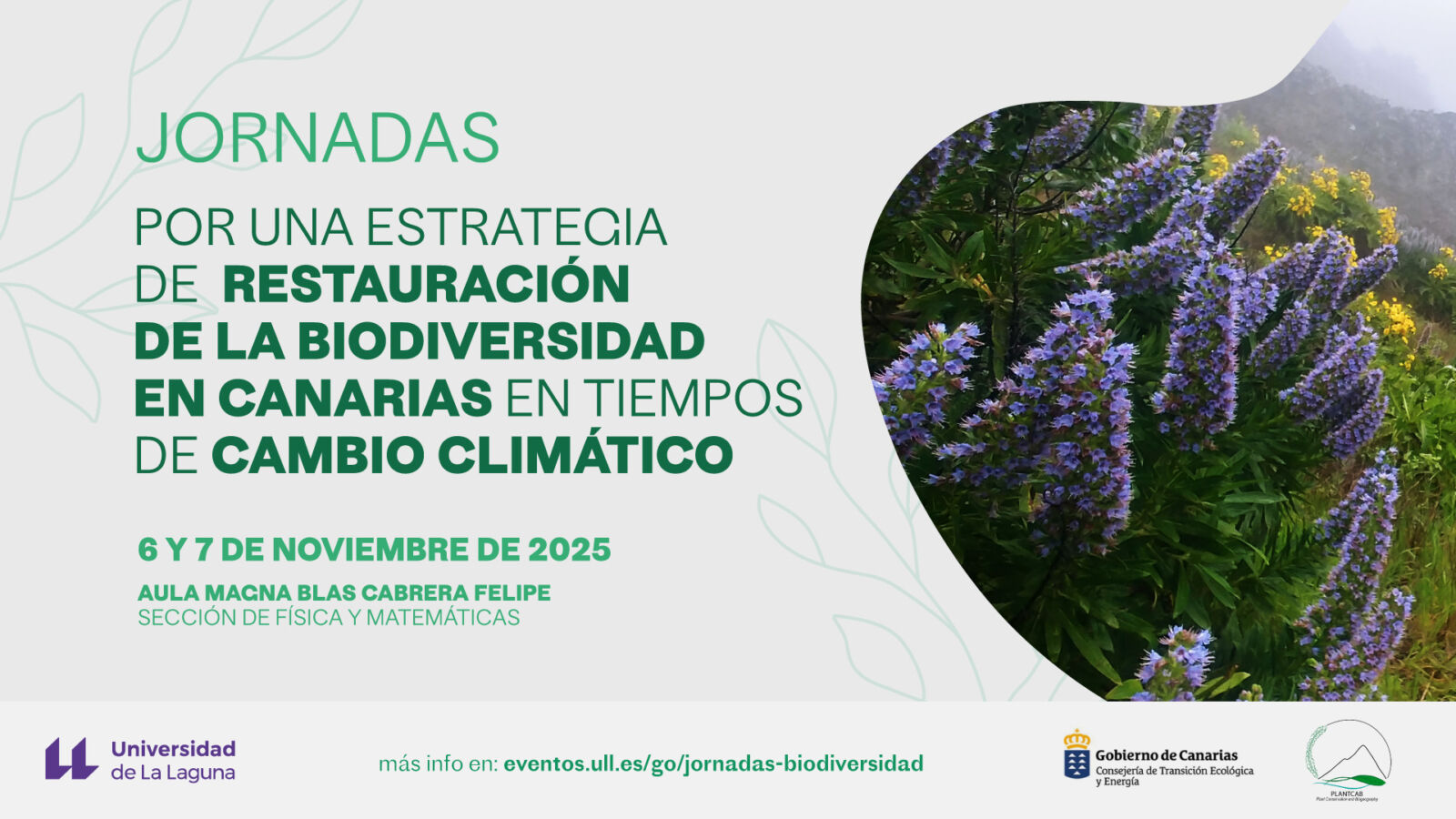
The University of La Laguna and the Ministry of Ecological Transition and Energy of the Government of the Canary Islands They organize the conferences “Towards a biodiversity restoration strategy in the Canary Islands in times of climate change”, which will be held tomorrow, Thursday 6, and Friday 7 November in the Blas Cabrera Felipe Auditorium, located in the Physics and Mathematics Section of the Faculty of Sciences.
This action is coordinated within the academic institution by the research team Plant Conservation and Biogeography, attached to the Department of Botany, Ecology and Plant Physiology, which focuses its work on the study, conservation and management of flora and island ecosystems.
This meeting aims to provide an updated overview of the state of the Canary Islands' ecosystems and advance towards island-wide planning that will halt their deterioration, recover lost biodiversity, and strengthen resilience against climate change and other threats. The initiative seeks to serve as a meeting point for the scientific community, environmental managers, and technicians working directly in the islands, in order to lay the foundations for a comprehensive ecological restoration model adapted to the islands' specific circumstances. Those interested can still register online, and attendance will be recognized for 1 ECTS credit for university students.
The inauguration will feature the participation of Miguel Ángel Morcuende Hurtado, Director General of Natural Spaces and Biodiversity of the Government of the Canary Islands; Antonio Aparicio Juan, Vice-Rector of Research and Transfer of the University of La Laguna; and Juana María González, Professor of Botany, Ecology and Plant Physiology of the academic center.
Biodiversity management
Over the two days, researchers and technicians from various islands will address the main challenges of biodiversity management in the Canary Islands from both a scientific and practical perspective. The program is structured into eight thematic blocks covering critical areas for conservation in the Canary archipelago. It will begin with an update on the current knowledge of island flora and habitats, followed by an analysis of actions aimed at reducing the impact of herbivores and invasive plants, two of the greatest current threats to ecosystems.
Furthermore, a section will be dedicated to the impact of climate change and another to fire management from a conservation perspective. The event will conclude with several sessions addressing the protection of threatened and range-restricted species, progress towards comprehensive ecological restoration, and finally, territorial management strategies necessary to coordinate efforts between islands and administrations.
The conference will conclude with two panel discussions aimed at fostering dialogue between specialists and managers. The first will focus on the comprehensive restoration of habitats and fire management, a key issue in a region where forest fires directly impact biodiversity conservation. The second will address the management of species and habitats in the current context of climate change, with the goal of analyzing the challenges and opportunities this scenario presents for environmental planning and the adaptation of Canary Island ecosystems.
This meeting comes at a crucial time for the archipelago's ecosystems, where climate change, habitat loss, and the spread of invasive species demand coordinated responses based on scientific knowledge. With this initiative, the University of La Laguna reaffirms its role as an active agent in research, training, and knowledge transfer related to sustainability and environmental conservation, contributing to the development of a common strategy for the restoration and resilience of biodiversity in the Canary Islands.

 Spanish
 English
 French