
Faculty and recent graduates from the University of La Laguna are finalizing a rigorous scientific restoration project on the façade of the Casa del Corregidor, an emblematic building located on Obispo Rey Redondo Street in San Cristóbal de La Laguna. The project is being carried out under the direction of professors from the Department of Fine Arts. Antonio Jesús Sánchez y María Guitián, The work seeks to stop the serious erosion that the facade of one of the oldest buildings in the Canary Islands is suffering.
In this intervention on the facade, the priority is to halt the deterioration of the stonework. The team emphasizes that the goal of the restoration is not to create a modern replica: “The facade isn't as if it were newly built; we have to restore all its values, including its age.”.
The restoration process began with a thorough inspection to identify the constituent material and the nature of the deteriorating agents. This revealed that the reddish volcanic rock had suffered damage due to humidity, prevailing winds, and biological colonization typical of the La Laguna area.
One of the main technical challenges has been the removal of harmful historical interventions, such as the contemporary cement mortars applied, for example, in the 1970s. These had to be removed with extreme care, since "that cement is harder than the stone itself," accelerating the deterioration of the original material. Finding replacement material was another challenge, as historic quarries like those in Tegueste and La Punta are now closed.
The restoration team has applied various techniques to ensure the façade's preservation. Consolidation work has been carried out on the eroded stone, and volumetric reconstructions have been performed to seal cracks and gaps, compacting the stone façade. For these reintegrations, mortars prepared at the faculty itself were used.
Previous research revealed past interventions where architectural elements were mutilated, such as two columns flanking the doorway that were removed, leaving only two stumps. Thanks to the study and design work of the researchers and architect Fernando Saavedra, the team is reconstructing these elements based on the traces they left on the façade. Furthermore, digital scanning has been used to restore the losses in the coats of arms, making their iconography legible again.
In an exercise of historical and construction documentation, it was decided to preserve the "puteholes," the holes used to form the old scaffolding during construction. These voids, previously filled with hard cement, are now delimited and filled in a recessed manner, as the restoration team considers them "evidence of the construction system" of the façade.
The restoration work is expected to be completed by mid-December. Following completion, the team from the University of La Laguna will provide a detailed maintenance plan that includes the periodic application of protective and water-repellent products. This maintenance is vital because, as the restoration management team points out, “the facade of this building was like a patient in intensive care. It’s improving now, but it will continue to require care over time.”.
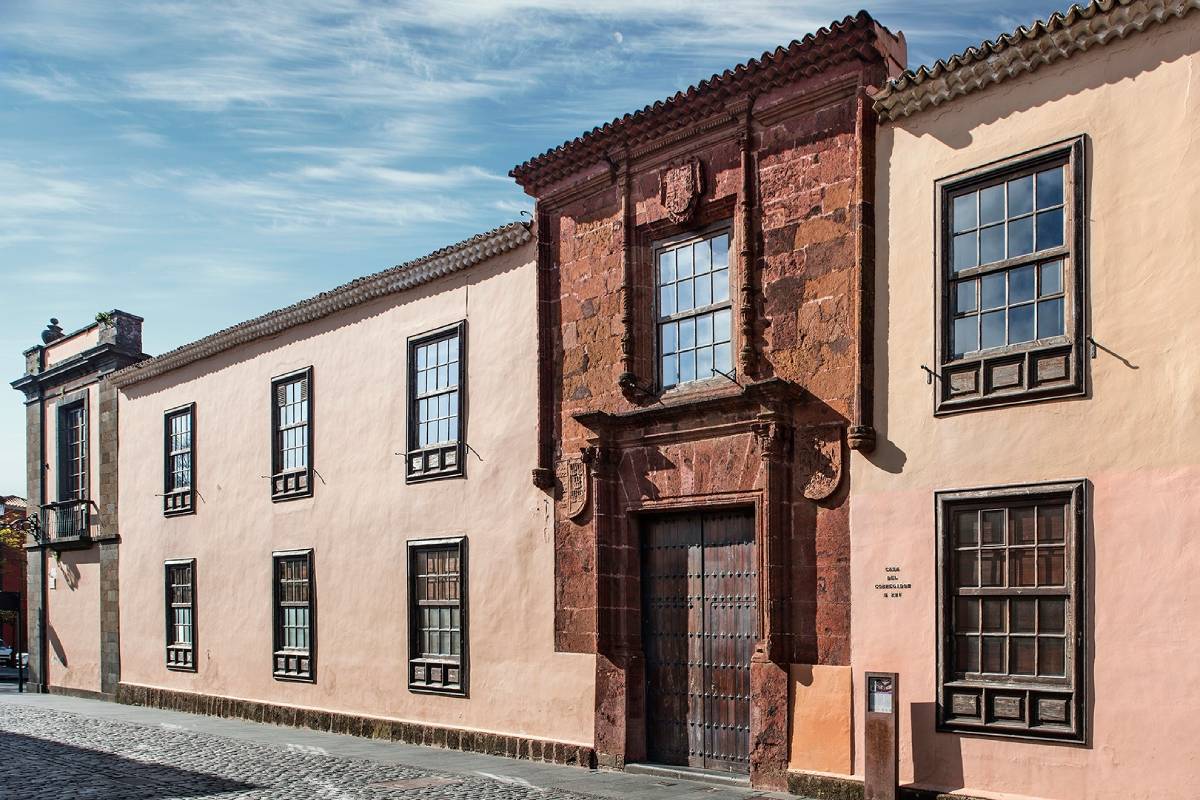
The Magistrate's House. Photo: La Laguna City Council.
A house with a lot of history
The Casa del Corregidor is of considerable age, with a documented founding date of 1545, placing its history at around 480 to 500 years old. The building belonged to the corregidor Álvarez de Sotomayor.
The portal, artistically framed within the Plateresque style, is distinguished by several unique elements of high value, including three coats of arms: that of the corregidor/governor, that of Tenerife/Cabildo and, at the top, that of Charles V. The composition of the latter reveals unique compositional details, such as the displacement of a coffer upwards to prevent the claw of the double-headed eagle from covering the iconography inside.
The original material of the portal is a reddish volcanic rock that presumably comes from the Camino de Dios (God's Way), in the municipality of Tegueste. It was a stone commonly used in mid-16th-century constructions but has a "worse prognosis for preservation" than basalt.

 Spanish
 English
 French