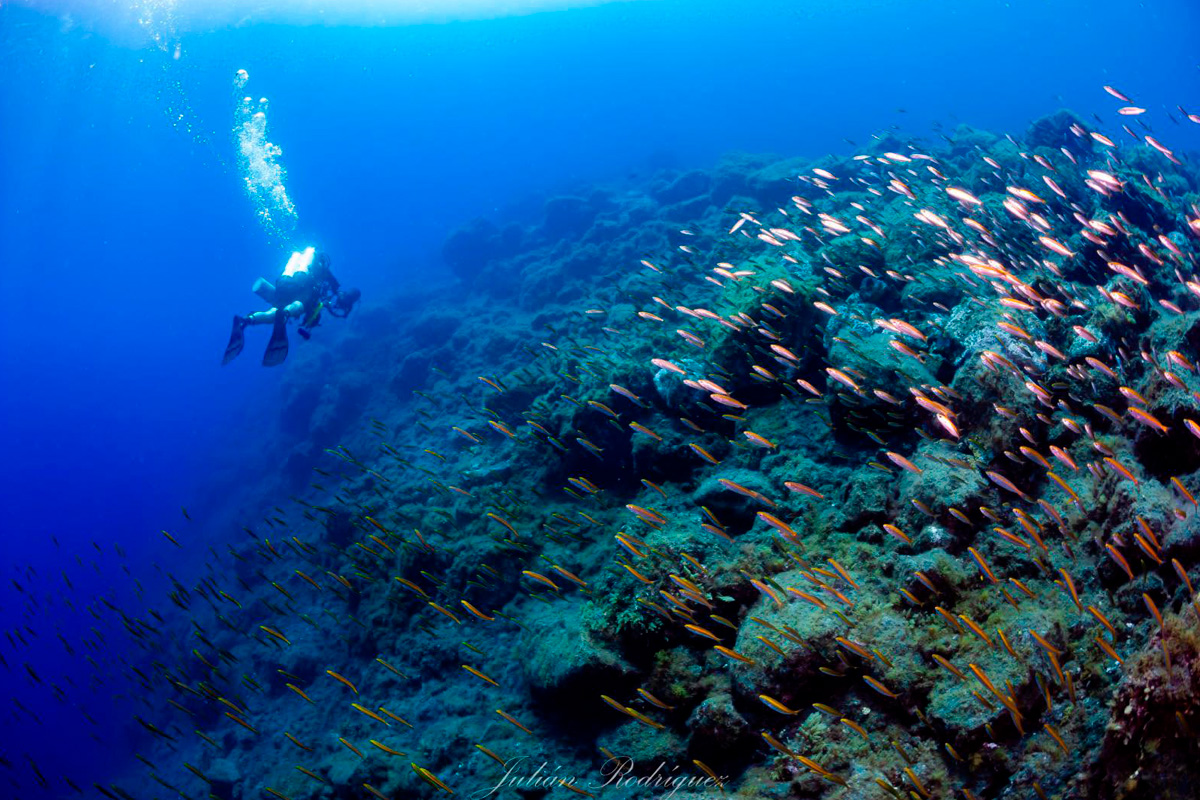
Researchers from Marine Botany Research Group Researchers from the University of La Laguna reconstruct the changes in marine biodiversity in the Tajogaite volcano deltas during its first 26 months. published work recently in the specialized magazine Marine Pollution Bulletin It demonstrates the high resilience of the Canary Islands' marine ecosystems after the catastrophe.
During these first few months, researchers have conducted regular sampling using visual censuses to gather data on changes in the abundance and size of different species. The researchers used a control area, the San Juan volcano lava delta (1949), as a reference point to compare the evolution of the new habitat in real time with an unaffected area. In an earlier study, these same researchers described the rapid colonization of these new habitats by fish. From the outset, thanks to the presence of nearby adjacent areas unaffected by the volcano and the fish's high mobility, their populations matured rapidly, at a rate far exceeding that of other organisms in the benthic ecosystem, such as algae and invertebrates.
The researchers indicate that after two years there are practically no significant differences in the overall fish communities between the affected and control areas. From the outset, the species that dominated in the deltas are the same as those that predominated in the control area. This demonstrates that these species are resilient and highly adaptable to catastrophic natural events, which are frequent in island territories with volcanic origins, such as La Palma. Only a few species, generally not very abundant in an undisturbed ecosystem, have not yet been detected in the area.
The results also reveal curious patterns in reef colonization. Initially, in the first few months, the fish populations consisted solely of adults and juveniles, generations that clearly migrated from outside the affected area inward. After the initial arrival of these individuals, there was no significant transshipment of adults or juveniles, and the populations increased in size thanks to the incorporation of new individuals via larvae from the water column.
The introduction of fish through this method could not have occurred earlier, experts say, because in the initial months after the eruption the number of fish larvae in the water column is low. Researchers were able to classify the fish into two life forms, based on their biological and ecological characteristics, and have shown that the sedentary and territorial species took a little longer to colonize the lava deltas.
Also during this time, massive recruitment events have been recorded, the most surprising being that of Sparisoma cretense (the old woman), whose populations in the lava deltas have been much higher throughout the study period. One of the main hypotheses put forward by this work suggests that this population explosion could have been due to low levels of predation, especially during the first year when populations of some piscivorous fish such as Aulostomus strigosus (trumpetfish) was not very abundant.
It should also be remembered that fishing has been prohibited in the area, due to the establishment of an exclusion zone for safety reasons, and that this may have helped accelerate the recovery of some fish populations, especially those of fishing interest.
This study represents a significant advance in understanding marine ecological succession following volcanic eruptions and provides a solid scientific basis for future conservation policies in volcanic archipelagos such as the Canary Islands. Its development was made possible thanks to competitive funding obtained by the research team within the Knowledge Generation program of the Ministry of Science, Innovation and Universities, the support of the Island Council of La Palma, and the Oceanic Platform of the Canary Islands.

 Spanish
 English
 French