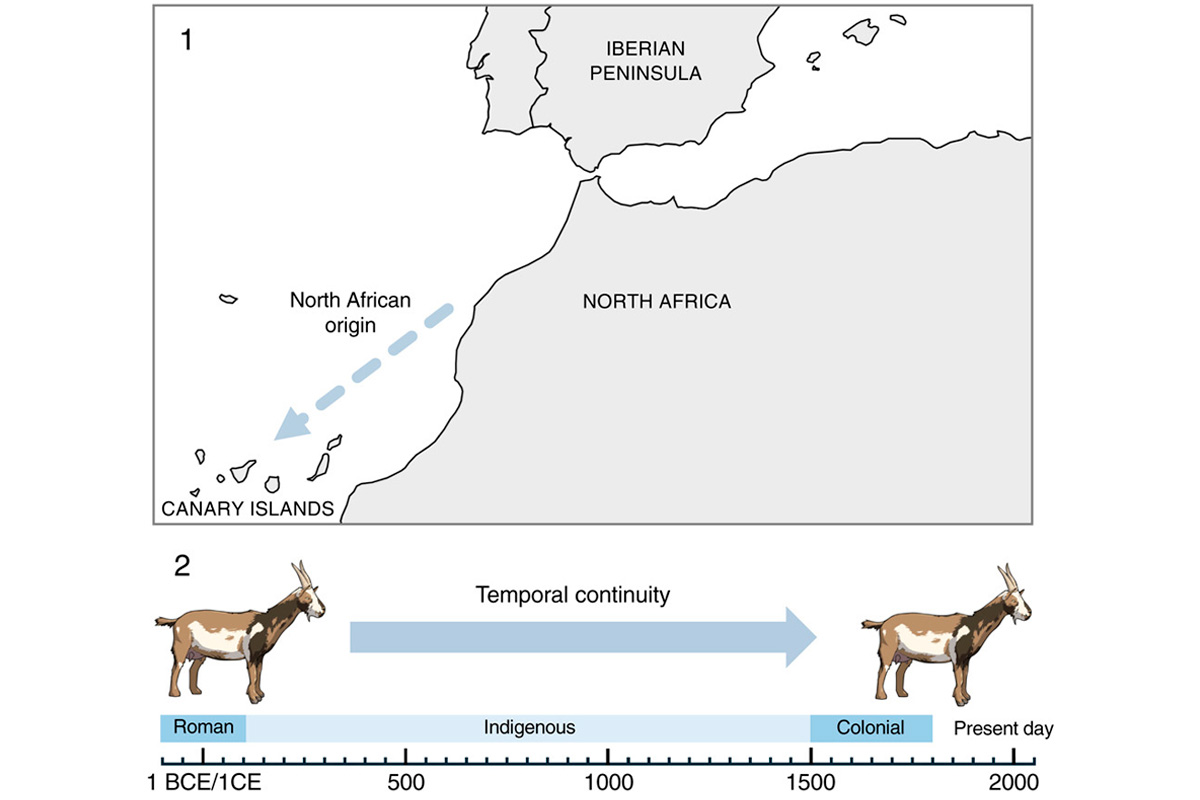
Archaeological, linguistic, and paleogenomic studies of the human populations of the Canary Islands have demonstrated that their geographic origin lies in North Africa. Now, an international investigation led by the Canary Islands universities has revealed that the archipelago's current goats are also direct descendants of those brought by the first settlers.
The work, published in the scientific journal iScience, has analyzed 52 complete mitochondrial genomes of ancient goats from sites across all the islands, including the islet of Lobos (temporarily occupied by the Romans), indigenous and post-conquest contexts.
Carbon-14 dating indicates that, excluding the Roman occupation of Lobos Island between the 1st century BC and the 1st century AD, the archipelago was permanently settled by Berber communities from the 2nd and 3rd centuries AD onwards. Later, during the Age of Exploration in the 14th century, the islands were rediscovered by European navigators and subsequently conquered by the Crown of Castile in the 15th century. Following the conquest, the colonial phase began, in which the surviving indigenous population mixed with European settlers and other population groups, such as Africans, due to the slave trade, and Amerindians, due to trade with the Americas.
According to the results of this study, the genetic lineages of the aboriginal goats coincide with those of populations from North Africa and the Middle East, confirming a common origin with the archipelago's first Amazigh inhabitants. Furthermore, the study demonstrates that these animals maintained remarkable genetic continuity over time, being exploited by European settlers after the conquest.
One of the most striking findings comes from the islet of Lobos, where researchers discovered that the goats consumed by the Romans shared the same DNA as the indigenous goats. This suggests a brief overlap between the two occupations and that the animals used in the Roman purple dye workshop came from the neighboring islands.
Clara Díaz-Pérez, the study's first author, adds: “The genetic analysis shows that the goats from Lobos and the indigenous goats share the same mitochondrial DNA. It is most likely that the Romans obtained the animals from Fuerteventura or Lanzarote, suggesting direct contact between the two occupations. We also cannot rule out the possibility that the Romans obtained these goats in North Africa, as a result of contact with the populations that inhabited the continent's coast.”.
Paleogenomic data also reveal low genetic diversity in the aboriginal goats, reflecting the geographic isolation characteristic of island life. Furthermore, the distribution of mitochondrial DNA types across the archipelago, with basal lineages shared by most islands and derived lineages present in only one island population, is consistent with an absence of inter-island migration, with the exception of Lanzarote and Fuerteventura.
Jonathan Santana, from the University of Las Palmas de Gran Canaria, professor of prehistory and co-author of the study, emphasizes that goats were a central element of the indigenous economy and daily life. “Their study not only tells us about livestock farming, but also about how the indigenous communities of the Canary Islands managed resources and maintained stability in an island environment with limited resources.” In this sense, goats were not only animals that provided food, but also raw materials for making clothing and everyday tools, he explains.
Rosa Fregel, The lead researcher from the University of La Laguna argues that these animals were essential for human adaptation to an environment without large mammals. “Our study demonstrates that indigenous livestock farming was very resilient, and that Canary Island goats were especially well adapted to living on these islands, so much so that after the European conquest, the same goat populations continued to be used for centuries.”.
The research team, made up of specialists from the University of La Laguna, the University of Las Palmas de Gran Canaria, and collaborators from the universities of Burgos, Trinity College Dublin, Uppsala and Ludwig-Maximilians-Universität, as well as from the island museums and archaeology companies, emphasizes the importance of this type of project being led from the Canary Islands.
Fregel emphasizes that conducting this type of study not only expands our knowledge of the aboriginal inhabitants of the Canary Islands, but also improves human resources and local scientific infrastructure, and fosters outreach activities for the general public. The study was funded by the PALEUCOL and EXPOBIM projects of the Ministry of Science and Innovation (ULL) and by the IsoCAN project of the European Research Council (ULPGC).

 Spanish
 English
 French