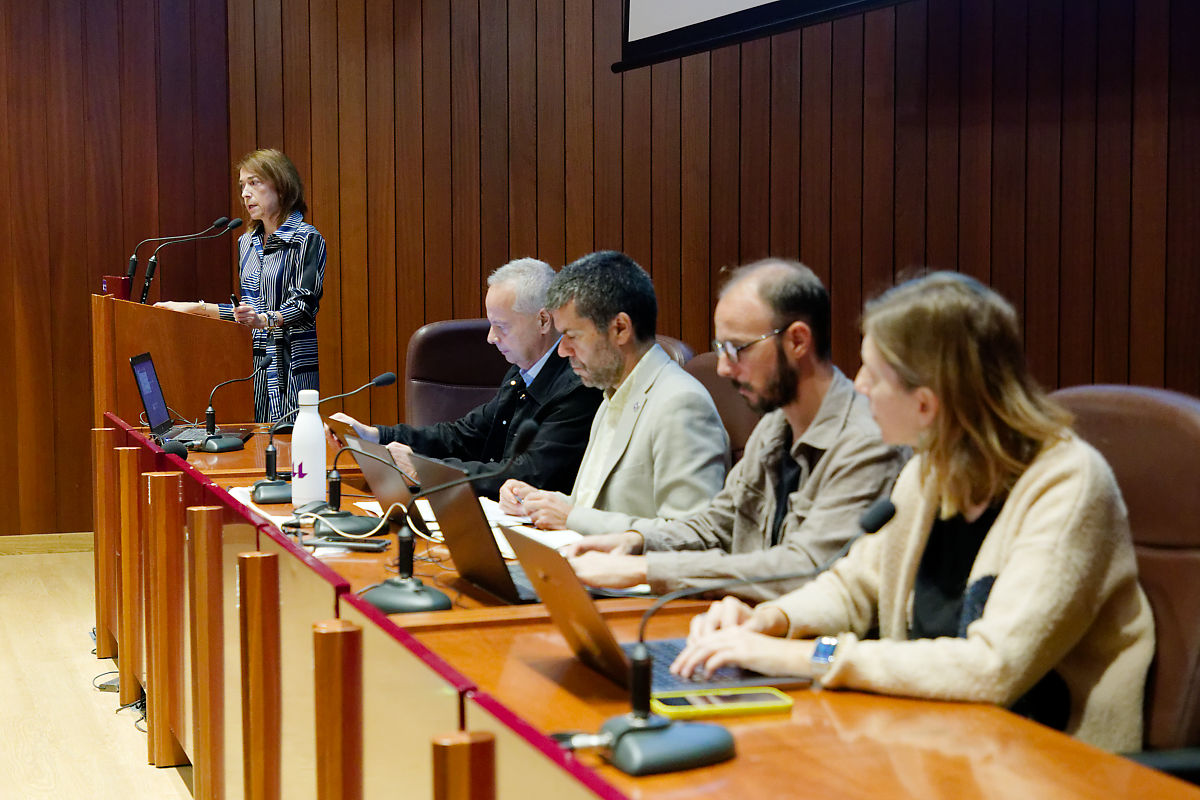
The University of La Laguna's governing body today, November 24, reviewed the institution's proposed budget for 2026, valued at €181 million, representing a 41% increase. The document must now be ratified by the Governing Council and subsequently by the Social Council for final approval and implementation.
The text that will govern the execution of income and expenses for the next fiscal year is based on already approved budgetary guidelines and previous reports from the collegiate bodies of the academic institution, and also incorporates the gender impact and environmental impact reports.
Lidia Pereira, the university's manager, presented the report to the governing body, explaining that following the 2020 health crisis, the incorporation of treasury surpluses into the budget was permitted for several years, while fiscal rules were suspended. Normalcy returns in 2024, the year in which the extension of the national budget begins, which also prevents long-term planning. The objective of the Canary Islands' public universities must be to receive resources equivalent to 11% of the regional GDP, as established by the Organic Law of the Education System (LOSU) for 2030 as a commitment to investment in public universities.
In summary, the regional government's spending ceiling has been set at 3.31% of the total (TP3T), and, following the same criteria, the University of La Laguna (ULL) will receive €200,911,988.64 in 2026, while the budget figure is set at €181,516,000. The increase compared to the previous year, which stood at €171 million, is explained by the incorporation of earmarked funds, the transfer of amounts from other programs, the addition of the Social Council's budget increase, the increase in faculty salaries and operating expenses, as well as the corresponding funds from the María Goyri program for recruiting new research talent. All of this results in an actual increase in funding from the Government of the Canary Islands of only 1.561% of the total (TP3T) compared to 2025.
 The manager explained that in the lead-up to drafting this document, the public universities sent a letter to the regional government in July requesting 25 million euros to cover all their needs, of which 13.7 million euros corresponded to the University of La Laguna (ULL). Ultimately, 4.3 million euros were allocated to both institutions, leaving a significant gap to be filled, Pereira pointed out. Nevertheless, Lidia Pereira emphasized the crucial need for a multi-year, sustainable funding mechanism, something that public higher education institutions repeatedly stress in every forum.
Interventions
Following the explanation by the Head of Management, it was the turn of the spokespeople for the university council groups, as is customary. The representative from the PTGAS Group pointed out that the document lacks administrative specificity and should address issues such as the increasing segmentation between civil servants and contract workers, with a greater female presence but not in management positions, as well as the aging of the workforce and the need for a comprehensive training plan.
For her part, the COMPAS spokesperson said that it is essential to strive for 1.1% of GDP to be invested in higher education. She noted the lack of new funding for student housing construction and the absence of specific policies promoting equality. She also questioned the increased funding for the Social Council and its presidency.
On behalf of the student body, ACE stated that the limited resources provided by the regional government make it very difficult to create an efficient budget. They also complained about the increased funding allocated to the Social Council and the meager allocations for student accommodation. They emphasized the limited role of the University Senate in influencing the budget process, beyond simply being informed.
The Avanza group, representing the teaching staff, labeled the document as more of the same and criticized the lack of management in some areas, especially personnel. The Alternative Program for Teachers expressed its agreement with the document, which it believes marks a change of direction for the institution. It stated that the budget is sound and coherent, but clearly insufficient due to the scarcity of resources from the Regional Government.
The manager concluded the discussion by clarifying that the budget has an organizational, budgetary, and economic classification, and that some aspects of organizational planning do not fit within this structure. She stated that the Human Resources Department will be expanded, and that a Human Resources Management Plan will be implemented in the next fiscal year to provide a clear roadmap in this area.
He also argued that current funding would need to be doubled to address the university's main challenges. Rector Francisco García echoed this sentiment, stating that the budget has simply incorporated and consolidated previously allocated funds, resulting in a real increase of barely two million euros. He indicated that they are working on securing additional resources, pending parliamentary approval during the legislative process, but the objective, as already emphasized in the session, should be an investment of 1.1% of GDP across the two public universities in the Canary Islands.
Spaces for knowledge and memory
As he did at the opening session of the academic year, the rector reiterated the role of universities as spaces for knowledge and memory, in the face of those who want to distort it.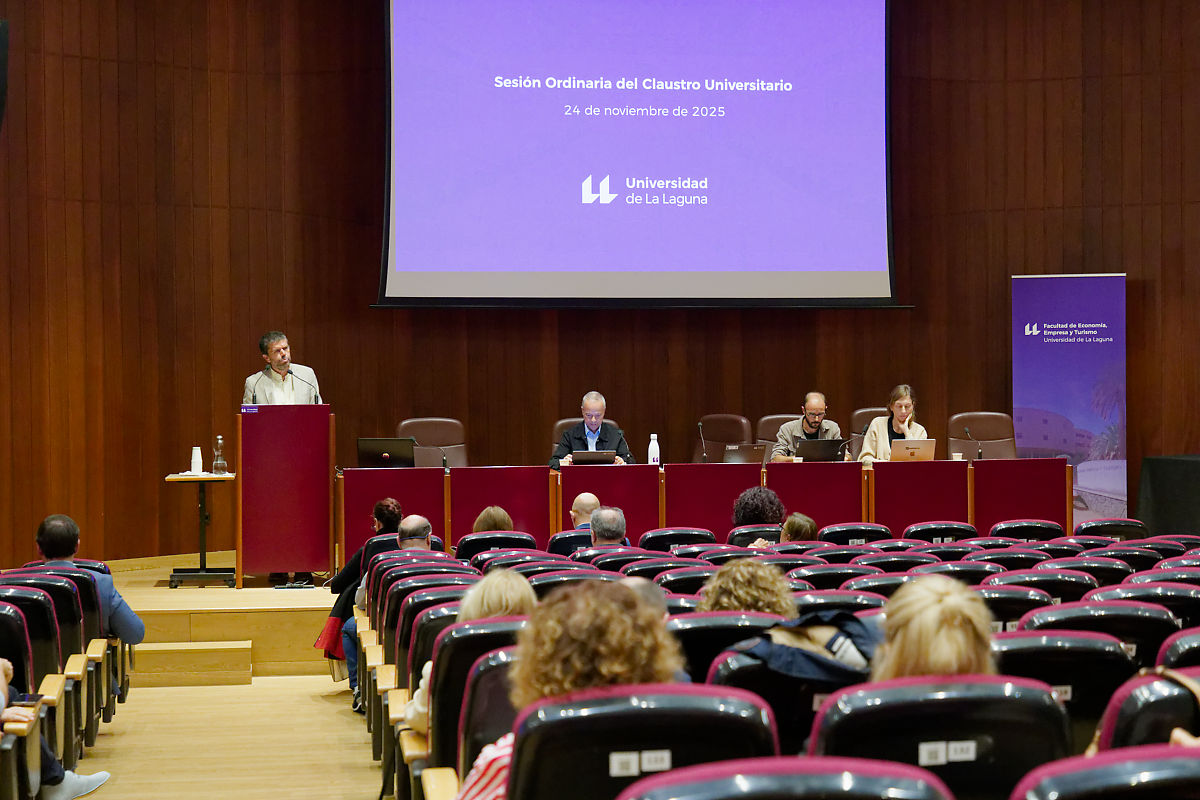 The truth and the creation of hate speech. All of this is related to the recent visit to the ULL by the agitator Vito Quiles, in a sort of Spanish university tour, despite the express refusal of the ULL itself to grant him any space.
The rector recalled the series of events that culminated on November 14th outside the Faculties of Law and Social Sciences and Communication, which resulted in an altercation and a police charge that the university considered disproportionate and unjust. The rector stated that freedom of expression does not imply its mandatory exercise if it infringes upon human rights, equality, and equity, or if it jeopardizes university life and the normal functioning of the institution.
Despite everything, the normal development of academic activity was ensured, Francisco García indicated, but those demonstrating at the protest against the far-right figure's presence were not adequately protected, effectively trapping their movement and resulting in a police intervention that left several people injured. Unauthorized activities were not hindered, the rector added, and the figure was even escorted and protected, despite the university's refusal to allow this event to take place.
The unauthorized organizer used university equipment to carry out their activity and, in fact, distributed xenophobic information within the university grounds, again without any record of measures taken to prevent its authorization. The rector stated in the University Senate that this constituted a selective use of force, leading him to conclude that the police action was disproportionate. For this reason, a report has been requested from the Government Delegation regarding the planning and operational decisions of the deployment on the Guajara campus. "We are awaiting the report," he announced, adding that an internal investigation has been launched to prevent similar incidents from recurring. This does not preclude taking appropriate legal action if deemed necessary.
“The public university must be a bastion and driving force of truth, a guarantee of coexistence and pluralism, in the face of the temptation of fear and hatred, two sides of the same coin,” the rector argued. All the university council groups lamented and condemned what had happened. The rector insisted that responsibilities be assumed, while acknowledging the need to improve internal coordination to address similar situations that might arise in the future. The University of La Laguna's governing body ultimately approved a statement denouncing these events and the police actions, urging the institution and the rector's office to prepare a rigorous, comprehensive, and public report on the events, and requesting the Government Delegation to conduct an evaluation of the operation in order to clarify administrative and legal responsibilities.

 Spanish
 English
 French