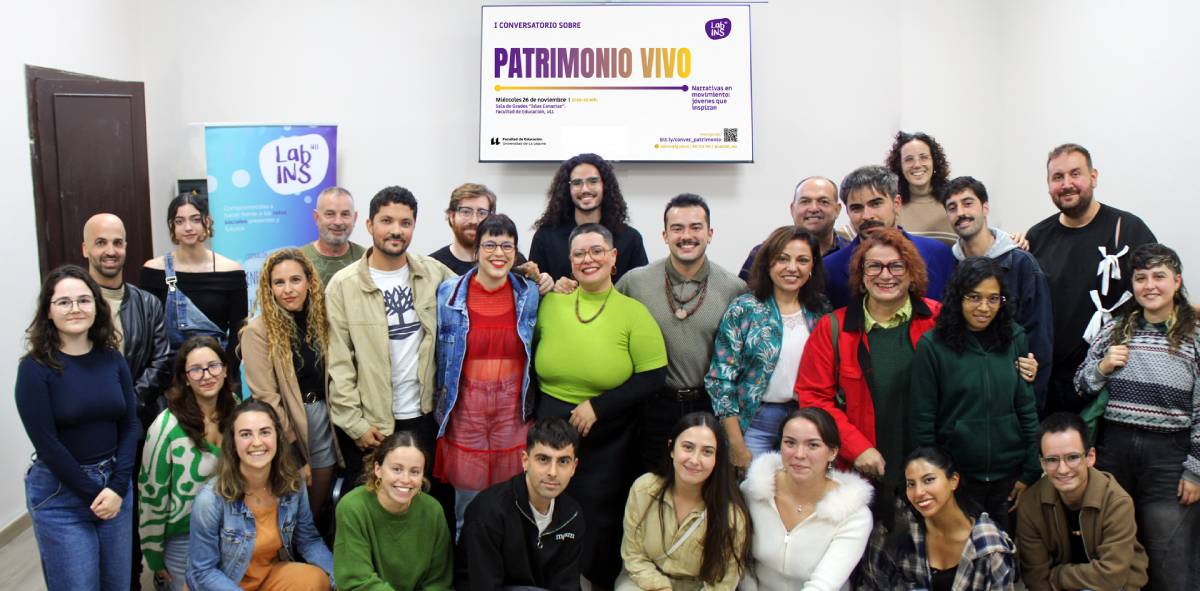
The University of La Laguna hosted the 1st Conversation on Living Heritage: “Narratives in motion, young people who inspire” last Wednesday, November 26th, an event promoted by the Social Innovation Laboratory of the University of La Laguna (LabINS ULL) which has the collaboration of the Faculty of Education, conceived as a space for collective reflection on the importance of reinterpreting, communicating and caring for the Canary Islands heritage from new perspectives.
The event took place in the Islas Canarias Lecture Hall and brought together young professionals who, from disciplines such as music, crafts, biology and audiovisual communication, are contributing to bringing cultural and natural heritage closer to the general public through contemporary formats and, especially, through social networks.
The opening of the meeting was led by Esperanza Ceballos Vacas, dean of the Faculty of Education, who highlighted the fundamental role of education in the transmission and appreciation of heritage: “Understanding where we come from is essential to building a fairer and more conscious future for the Canary Islands.”.
The discussion, presented by Robin Naples Martinez, a graduate in Spanish: Language and Literature and a research fellow at LabINS ULL, was moderated by Mónica Dios Rodríguez, pedagogical director of the laboratory and professor in the Department of History and Philosophy of Science, Education and Language. During her speech, she emphasized that heritage is not just a legacy: “It is a living space that builds community, strengthens bonds and helps us to recognize one another. For it to remain meaningful, it must be shared, narrated, cared for, reinterpreted and taught.”,
Four views
During the meeting, Cristina Regalado Ramos, a textile artist and promoter of artisanal heritage, spoke. Her work, focused on women, the land, and textile traditions, highlighted the importance of intangible heritage. She emphasized that intangible heritage is also about struggle: “the workers” struggle, the struggle that has sustained this land and that forms part of our identity.”.
Pablo Martín Pestano, a marine biologist and content creator who uses his social media to connect biodiversity, landscape, and Canarian identity, emphasized in the discussion that ecosystems are also emotional and cultural spaces: “Ponds are not just ecosystems; they are part of our lives and our memories.”.
Cristina Mahelo (@cristinamahelo), a singer, journalist, and “artivist,” presents an artistic proposal that combines traditional sounds with contemporary trends to address social issues in the Canary Islands. She celebrated that the discussion gave prominence to those who experience heritage in their daily lives: “Living heritage is sustained by people, the streets, those who practice it and share it.”.
Finally, Raúl Guanche Rosa (@wanamenzazAn audiovisual communicator specializing in screenwriting and historical outreach, he explores myths, memory, and territory, recovering narratives with creativity and rigor. He warned about the circulation of distorted narratives: “We continue to repeat legends and unfounded stories; disseminating information responsibly is also about protecting our heritage.”.
The event concluded with a dialogue with the public, where reflections emerged on the current challenges facing the Canary Islands' heritage: touristification, the loss of community memory, the need for responsible dissemination, and the role of youth in creating new narratives.
As a final touch, Mónica Dios quoted the Canarian writer María Rosa Alonso: “Culture is the root that sustains a people; if we nurture it, there will always be fruit.” A phrase that encapsulated the meaning of the gathering: understanding heritage as a living fabric that is strengthened when it is shared, questioned, and collectively reimagined.
This first Conversation on Living Heritage is part of the action plan of the Social Innovation Lab at the University of La Laguna, which since 2022 has been developing a series of meetings aimed at promoting a more equitable, collaborative university committed to the common good. Through these initiatives, LabINS ULL reaffirms its commitment to an education that connects disciplines, regions, and generations to build more sustainable and conscious futures.

 Spanish
 English
 French