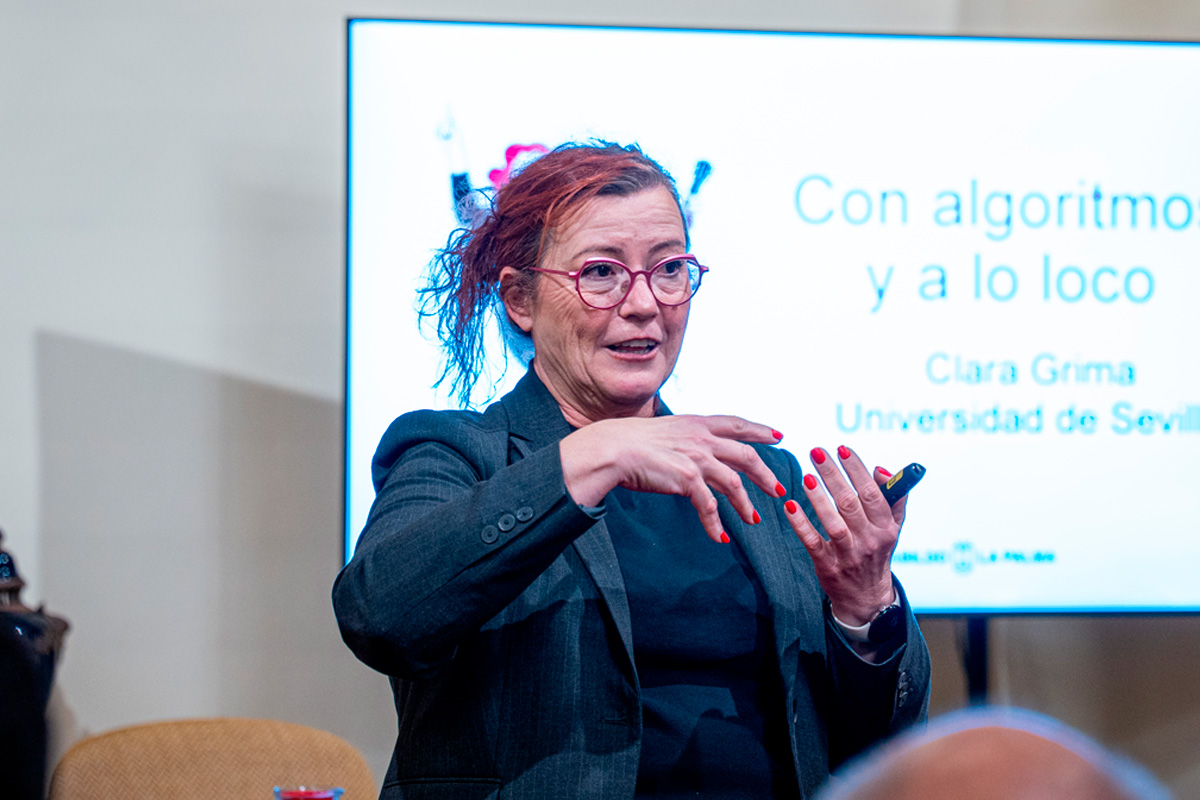
The Autumn University of La Palma It came to an end on Friday, December 12th with the conference With algorithms, it's already crazy by university professor and mathematics popularizer Clara Grima. With her, the speaker defined this concept that has been increasingly “demonized” in recent years and marked A historical overview of the most representative figures in the field, compiled in his latest book of the same name. The venue chosen for the event was the emblematic Salazar Palace, which dates from the first half of the 17th century.
Jesús María Armas, Councilor for Culture and Education of the La Palma Island Council, introduced the closing ceremony, highlighting the success of the organization and participation. She expressed her gratitude for the previous work of the councilor for the area, Pablo Díaz, the Vice-Rectorate for Culture and University Extension at the University of La Laguna (ULL), led by Isabel León Pérez, along with the Director of the University Extension Secretariat, Abel López, and the management carried out through the General Foundation of the academic center, directed by Julio Brito. “Clara Grima puts the finishing touch on this latest edition, serving as an example of the quality and care that has been put into these courses to adapt the offerings to the people of La Palma,” concluded the councilor, adding that work is already underway on the next edition.
As a result of the shared commitment between the University and the Island Council of La Palma, Isabel León emphasized their joint service to the public, to whom they are accountable as public institutions: “We must be useful and be present wherever we are needed, and education is perhaps the most powerful transformative tool and must be available everywhere.” She concluded by paying tribute to the science communicator, underscoring the need to “discover the spectacular beauty that mathematics holds, without which we should not be able to live.”.
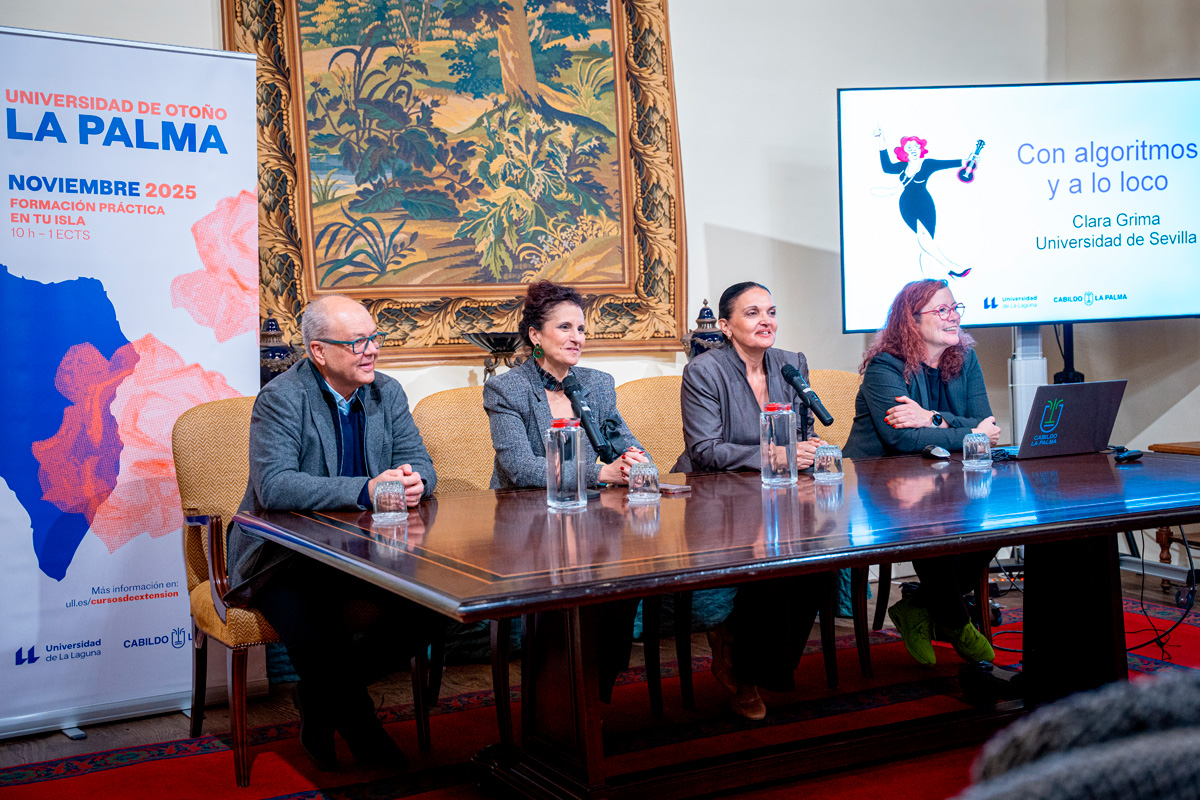
(From left to right) Julio Brito, manager of the General Foundation of the ULL; Isabel León, vice-rector of Culture and University Extension of the ULL; Jesús María Armas, councilor of Culture and Education of the Cabildo of La Palma; and Clara Grima, speaker.
Julio Brito emphasized the support of the island institution, “which always shows its affection for the University of La Laguna to have a presence here, just as many residents of La Palma have a presence at our University during their youth.” He considered the talk an event he couldn't miss and one he would greatly enjoy, given that Grima is an expert in her field of knowledge: mathematics.
Abel López presented a profile of the speaker, who, as a professor at the University of Seville, is one of the most prominent figures in science communication in Spain, specializing in mathematics. “This is a discipline that, now more than ever, needs to be made understandable and accessible to the public. Grima is a recipient of the National Science Communication Award and has a highly distinguished research career,” the academic director emphasized. He also noted that she has published numerous books, the most recent of which, With algorithms, it's already crazy, "The presentation was structured around this point, and I gratefully acknowledged that the protagonist of the event had "committed from the very beginning to coming to the Autumn University of La Palma," she concluded.
Clara Grima expressed her gratitude for the invitation, noting that it was her first time on La Palma, whose capital city had pleasantly surprised her. Awarded the Medal of the Royal Spanish Mathematical Society (RSME) in 2024 for her significant contributions to the field, the university professor lamented that "the word 'algorithm' is now synonymous with everything bad; algorithms are neither good nor bad." She began her presentation with a touch of humor, projecting quotes from social media that confused algorithms with the mathematical function of logarithms.
She confessed that the reason Planeta publishing house contacted her to write the book was to dispel that bad reputation. She defined them as “tools, a sequence of steps, instructions, like a cooking recipe that tells you what to do, only there are mathematicians, computer scientists, and others from everyday life; they have existed since the beginning of humanity, dating back to the time of Babylon, and there isn't just one, there are hundreds of thousands.”.
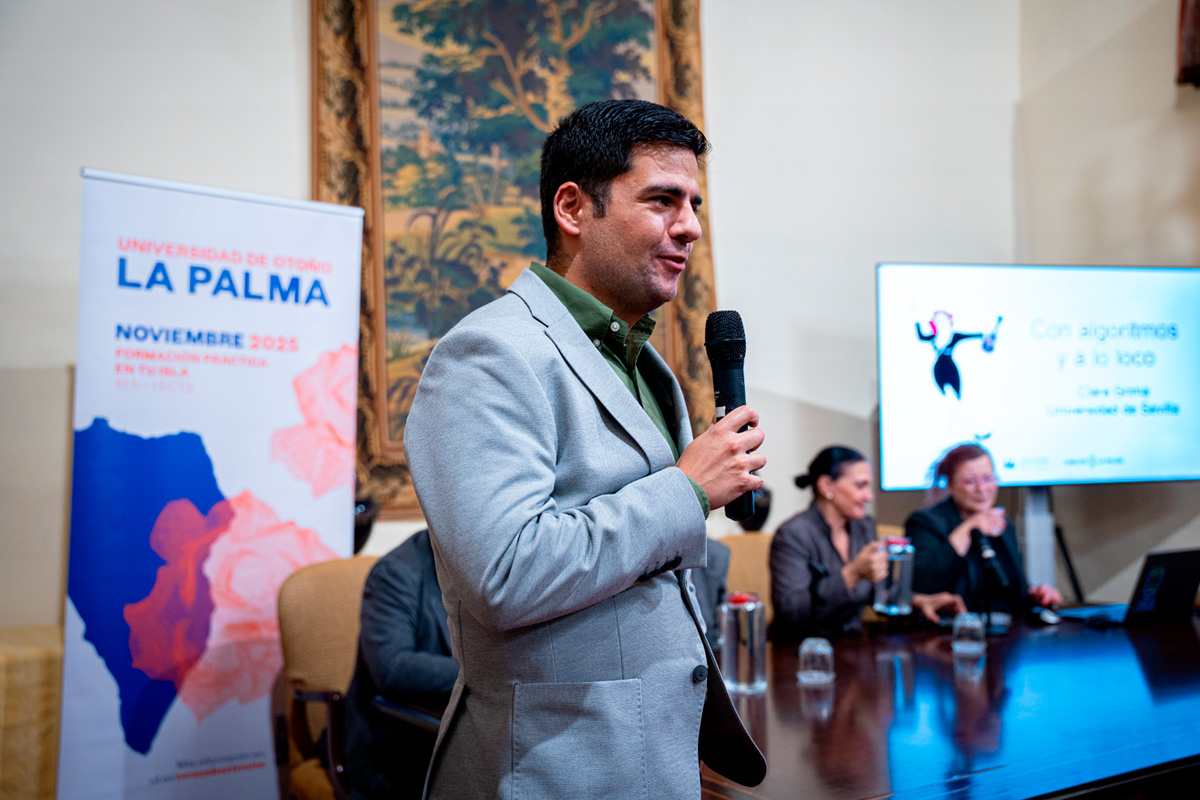
Abel López, director of the secretariat of University Extension at ULL.
The history of algorithms
Grima described her book as “an excuse to talk about mathematics, a poem to its beauty, and the stories of the men and women who made algorithms possible.” Illustrated by Raquel Garcia i Ulldemolins, the book features a cover inspired by the film. With skirts, it's already crazy, referencing a classic film in the title of each chapter.
In the first of these, linked to Goose soup, The author alludes to the Persian mathematician Muhammad Ibn Musa Al-Khwarizmi, who compiled a compendium in Arabic in the 9th century from which the concept of algebra originates. Algebra is a method for solving equations through step-by-step procedures, and the term "algorithm" itself derives from it, also in reference to the thinker's name. This chapter is also dedicated to the Scottish mathematician Ada Lovelace, who in the 19th century wrote "the first algorithm for machines to work on their own," devising an early programming language.
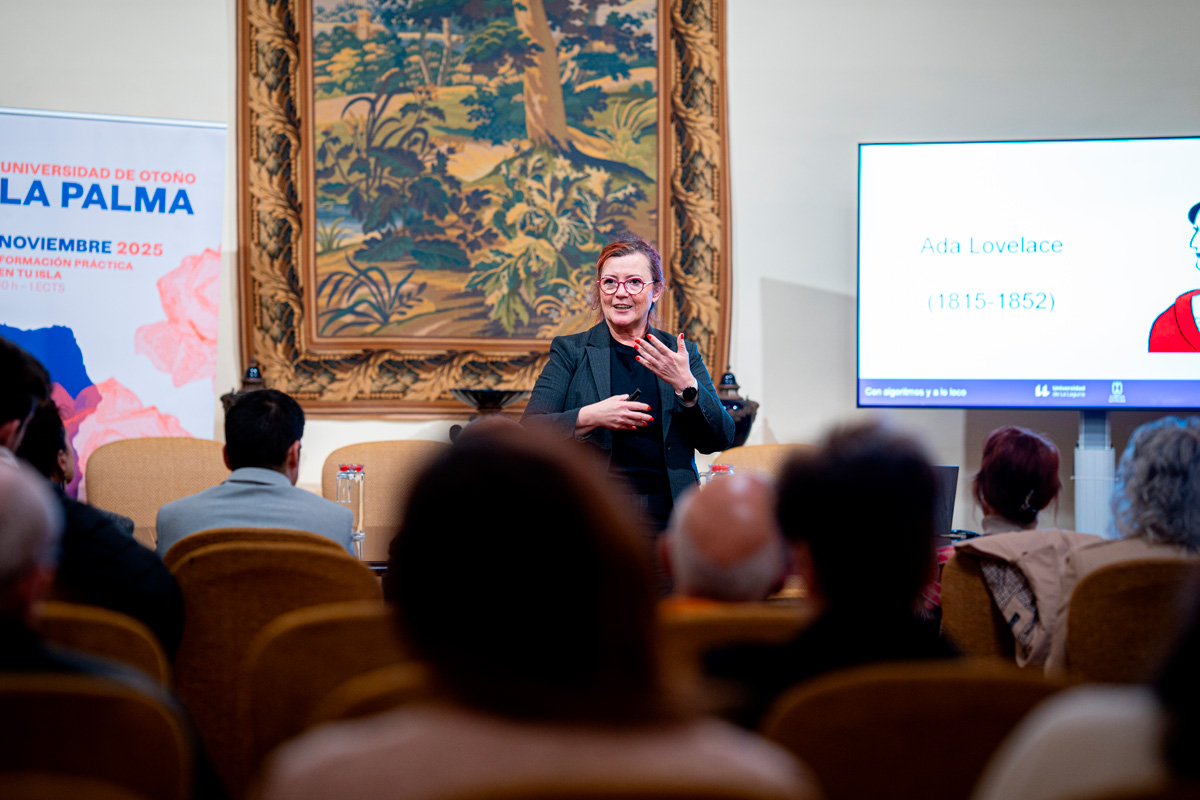 In this historical overview, another figure highlighted by the speaker was the German mathematician and physicist Carl Friedrich Gauss, who, in the 18th century, developed the method of least squares, the algorithm most widely used in everyday life. “It's used to identify trends and make predictions; for big data, everything is done with this type of algorithm. That's why I say he was the first data scientist in history,” Grima summarized.
The speaker lamented that Lovelace's pioneering model contrasts so sharply with the present day: "very few women are studying computer science and mathematics; women will be left out of the world's elite, which is currently linked to technology, and not all sensibilities can be represented in the design of AI in the future.".
In addition, there are some moral dilemmas surrounding how algorithms are currently being used by large technology companies. “There is an elite that controls the world, and they do so because they control mathematics better than you do. Therefore, we will need a strong foundation in the humanities, for the development of ethics and philosophy, as the path toward a new humanity and the advancement of human thought,” concludes Clara Grima.
Isabel León thanked the nearly 200 people, ranging in age from 11 to over 80, who attended the ten courses and two workshops that made up the diverse range of training offered. specialized and of quality, hoping to even increase attendance in the next edition. The final session covered topics such as artificial intelligence, video games, astrotourism, drones, and archaeology, among others. In addition, two meetings were held at the facilities and vineyards of Bodegas Acero, where participants were able to practically apply the knowledge acquired in the Deductive Sensory Analysis and Regenerative Viticulture course.

 Spanish
 English
 French