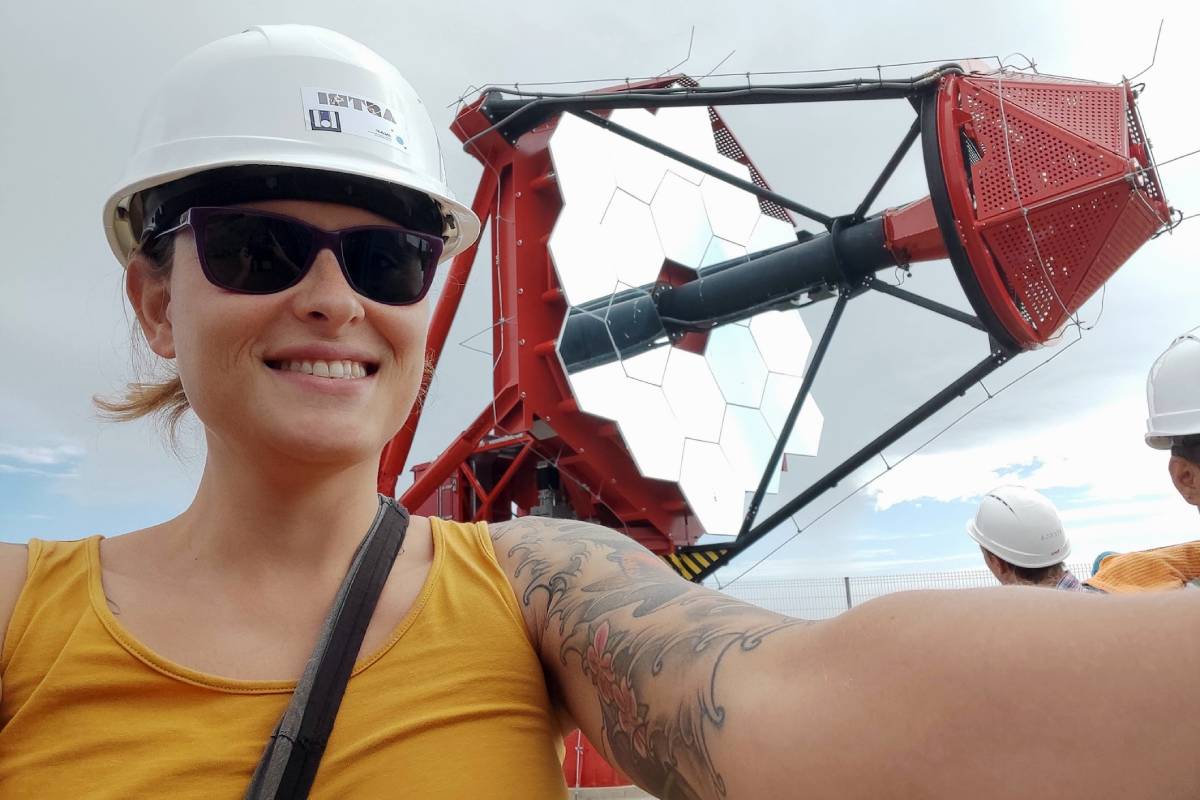
The researcher Mireia Nievas Rosillo, Nievas Rosillo, who is currently at the University of La Laguna thanks to a Viera y Clavijo 2025 postdoctoral contract, has been selected to receive a prestigious Canon Foundation grant. This grant, aimed at European researchers, allows them to undertake research stays in Japan and recognizes high-level scientists in various disciplines. Thanks to this grant, Nievas Rosillo will carry out a research stay at the Institute for Cosmic Ray Research (ICRR) from the University of Tokyo, where he is collaborating with leading experts on research projects as part of the MAGIC and LST consortia.
During her three-and-a-half-month stay, beginning in September 2026, the postdoctoral researcher in astroparticle physics will pursue two lines of research of particular relevance to high-energy astrophysics. Firstly, she will focus her research on flat-spectrum radio quasars (FSRQs) in the very high energy range (teraelectronvolts). These are likely the most powerful active galactic nuclei known to date, whose non-thermal emission can completely eclipse the brightness of the host galaxy. For these analyses, she will use data from the MAGIC and CTAO LST-1 telescopes, complemented by multifrequency observations in radio, optical, X-ray, and lower-energy gamma rays.
On the other hand, Nievas Rosillo aims to advance the study of the so-called extragalactic cosmic background (EBL), considered the second most intense diffuse background in the universe after the cosmic microwave background. However, its direct observation is extremely complex, since it lies in a frequency range where multiple sources emit intensely, such as stars, galaxies, solar system dust, or the airglow atmospheric.
The researcher points out that in recent years an indirect approach to studying dark matter has emerged, based on the absorption these photons produce in spectra observed with Cherenkov telescopes at very high energies through pair creation processes. Furthermore, she emphasizes that this approach offers a particularly interesting opportunity to explore fundamental physics phenomena, such as a possible violation of Lorentz invariance or the nature of some dark matter candidates, such as axion-like particles or axion-like particles.
Mireia Nievas Rosillo is confident that this stay will be highly fruitful and will contribute to consolidating and expanding existing scientific collaborations, as well as promoting the development of new joint projects in current lines of research, with an eye towards the future launch of the CTAO observatory.

 Spanish
 English
 French