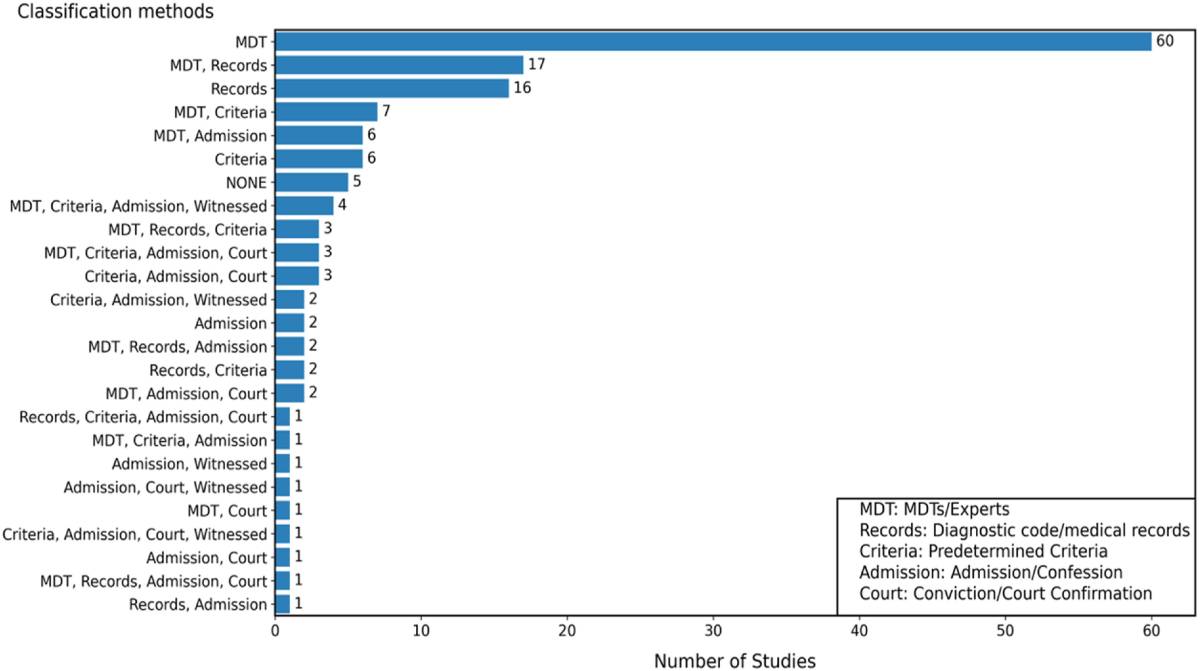
Chart of classification methods, including combinations of methods, used in the 149 primary research studies cited in the AAP technical report.
An international team of researchers coordinated from the University of La Laguna has published in the journal Forensic Science International: Synergy a study This article analyzes and questions the scientific validity of the diagnostic basis for Abusive Head Trauma (AHT), the widely used medical framework for diagnosing Shaken Baby Syndrome (SBS). It critically evaluates the research cited in the 2025 American Academy of Pediatrics (AAP) Technical Report, the most influential global guideline for the diagnosis of AHT/SBS.
The authors conclude that the evidence base used to support current diagnostic practices for this syndrome is much weaker than commonly believed and that the cited studies suffer from serious methodological flaws, such as circular reasoning and incorporation bias. “What is presented as scientific evidence for diagnosing Shaken Baby Syndrome is a recycling of the same unproven assumptions,” states the lead author., Chris Brook, tenured professor at the University of La Laguna.
The specialist cites as an example the recent case of influencer Anabel Pantoja and her partner, David Rodríguez, were accused of shaking their daughter in Gran Canaria when the child was hospitalized. Although that case was eventually closed, several cases of Shaken Baby Syndrome in recent years in Spain have resulted in prison sentences for the parents. “Cases like that show how quickly a suspicion can arise, based purely on medical interpretation,” Brook comments. “Our findings indicate that such interpretations lack reliable scientific support.”
The study identifies multiple problems in the research commonly used to support the clinical diagnosis of SBS. Specifically, the 71% studies cited by the AAP classify cases of eating disorders/SBS based on the opinion of experts or multidisciplinary teams, not on validated scientific criteria. According to the authors of this paper, no study adequately avoids circular reasoning: the same clinical findings used to diagnose SBS are then used to 'validate' those diagnoses.
Therefore, studies based on “confessions” involve accounts made after medical accusations, introducing a strong selection bias. And regarding shaking events documented by independent eyewitnesses or video, these are rare, but when documented, they do not produce the injuries attributed to SBS.
The authors of this study warn that unvalidated diagnostic assumptions put families and children at risk, including the removal of babies from non-abusive families, unjust criminal accusations or convictions, misdiagnosis of medical conditions such as “shaken baby syndrome,” and long-term psychological trauma for parents and children. “A suspected Shaken Baby Syndrome is one of the most serious accusations a family can face,” Brook emphasizes. “It must be based on robust evidence, and currently, it is not.”
Therefore, the research team advocates for an independent scientific review of the foundations of the diagnosis of SBS/TCA, with transparent diagnostic criteria supported by validated evidence so that diagnostic uncertainties are clearly explained and judicial and clinical training is aware of the limitations of current research on this syndrome.
This work was authored by researchers from Griffith University (Australia), University College London (UK), Umeå University (Sweden), Otago University (New Zealand), and Western University (USA), as well as the University of La Laguna. This international team includes a neuroscientist, a neuropathologist, a pathologist, and a pediatrician, while Brook's role as lead author has been to provide the systematic rigor necessary for a robust methodological evaluation.

 Spanish
 English
 French