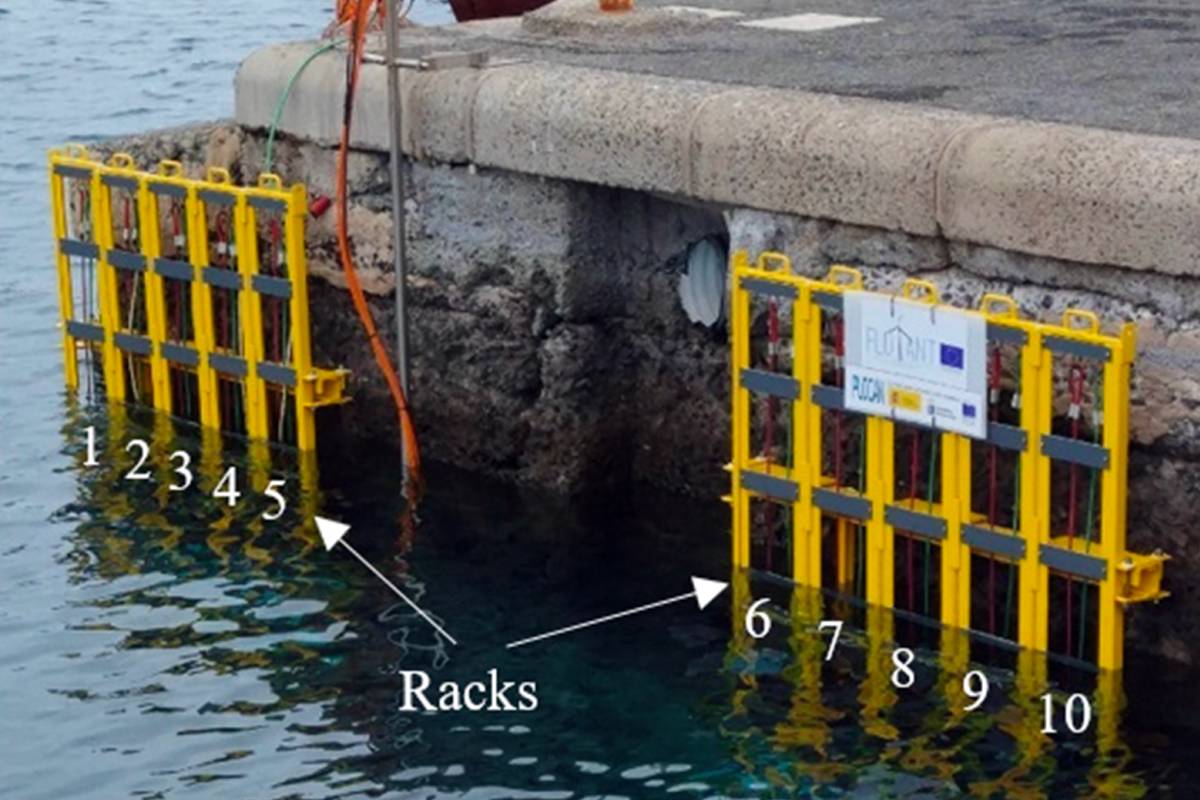
A study from the University of La Laguna presents the development of a new anti-corrosion coating system that utilizes waste generated in groundwater treatment. job, published in the scientific journal Journal of Environmental Management, This shows that the sludge produced during electrocoagulation can be recycled and converted into mesoporous alumina particles. The material is capable of reinforcing the corrosion protection of metallic structures in marine environments.
The advance, developed by Abenchara María Betancor, Raquel Rodríguez, Javier Izquierdo y Ricardo Souto, Researchers from the Department of Chemistry at the University of La Laguna are gaining importance in a territory like the Canary Islands, where water management, dependence on marine infrastructure and limited capacity for waste treatment demand the search for alternatives for sustainable development.
Sludge generated in electrocoagulation systems often poses a challenge for treatment plants. Its disposal involves costs and difficulties in storage and transport. In this regard, the research team has demonstrated that the sludge can be calcined to obtain mesoporous alumina, a material that, once treated, can incorporate corrosion inhibitors, such as benzotriazole (BTA) and 8-hydroxyquinoline (8HQ), and release them in a controlled manner when the metal begins to degrade.
With the particles now optimized, the team incorporated them into a commercial epoxy resin used to protect the steel of ships, marine structures, etc. The coating was applied to mild steel parts that had been previously scratched to reproduce the damage that commonly appears on structures exposed to the sea.
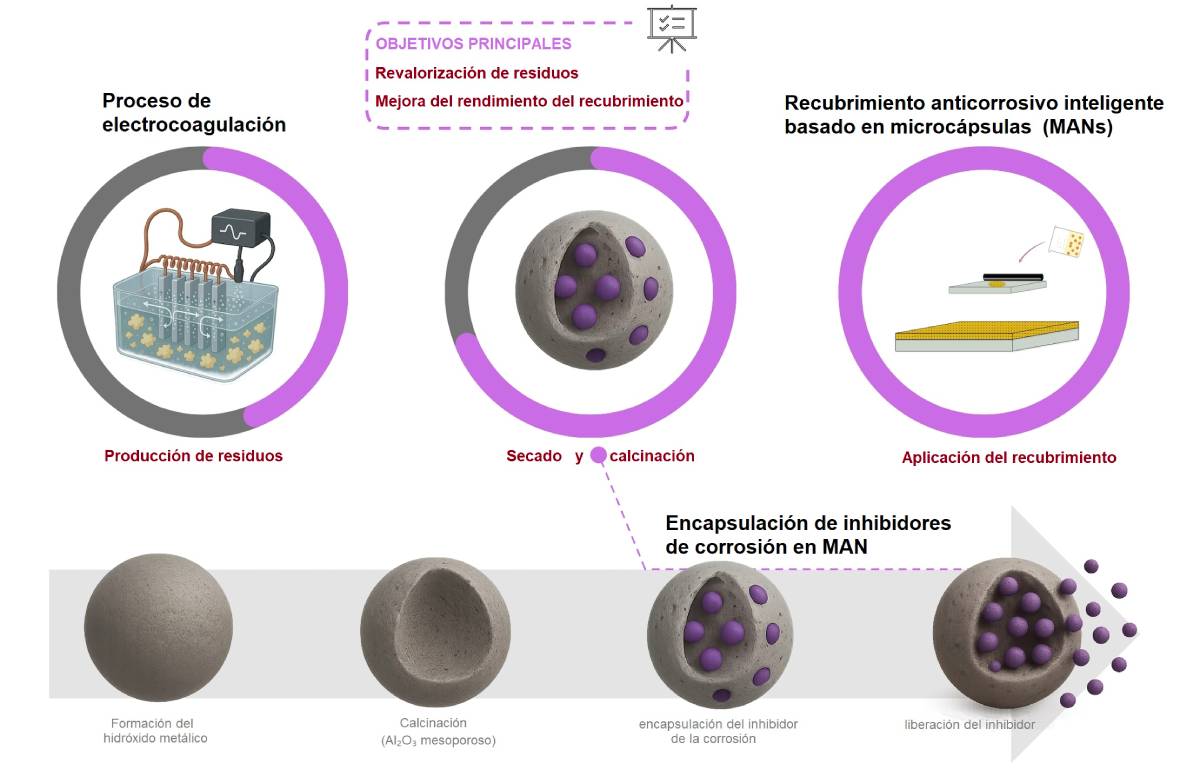
Research outline.
Electrochemical tests revealed that the particles improve the material's resistance to corrosion, even when the coating is damaged. Analyses using techniques such as electrochemical impedance spectroscopy (EIS), vibrating scanning electrode (SVET), and scanning electrochemical microscopy (SECM) showed that the coating incorporating BTA not only reduces the initial electrochemical activity in the defective area but also tends to restore equilibrium after a few hours.
This effectiveness is related to the high inhibitor loading that the material can incorporate. Thermogravimetric analysis revealed that the particles with BTA reach an inhibitor loading of 36.61 TP3T, compared to 25.41 TP3T obtained with 8HQ, suggesting a stronger interaction between BTA and the alumina matrix.
The results confirm that BTA is an efficient corrosion inhibitor in organic coatings. Furthermore, they show that utilizing waste generated in electrocoagulation processes is a viable way to obtain materials with new applications.
The research, which also involves Juan José Santana, a researcher at the University of Las Palmas de Gran Canaria, exemplifies a circular economy and cooperation between sectors such as water treatment, materials engineering, and corrosion protection. Furthermore, this model was designed specifically for the Canary Islands, which face water constraints, a significant industrial base related to the shipbuilding sector, and challenges in waste management. Therefore, the study presents a model that can be replicated in other island territories.

 Spanish
 English
 French