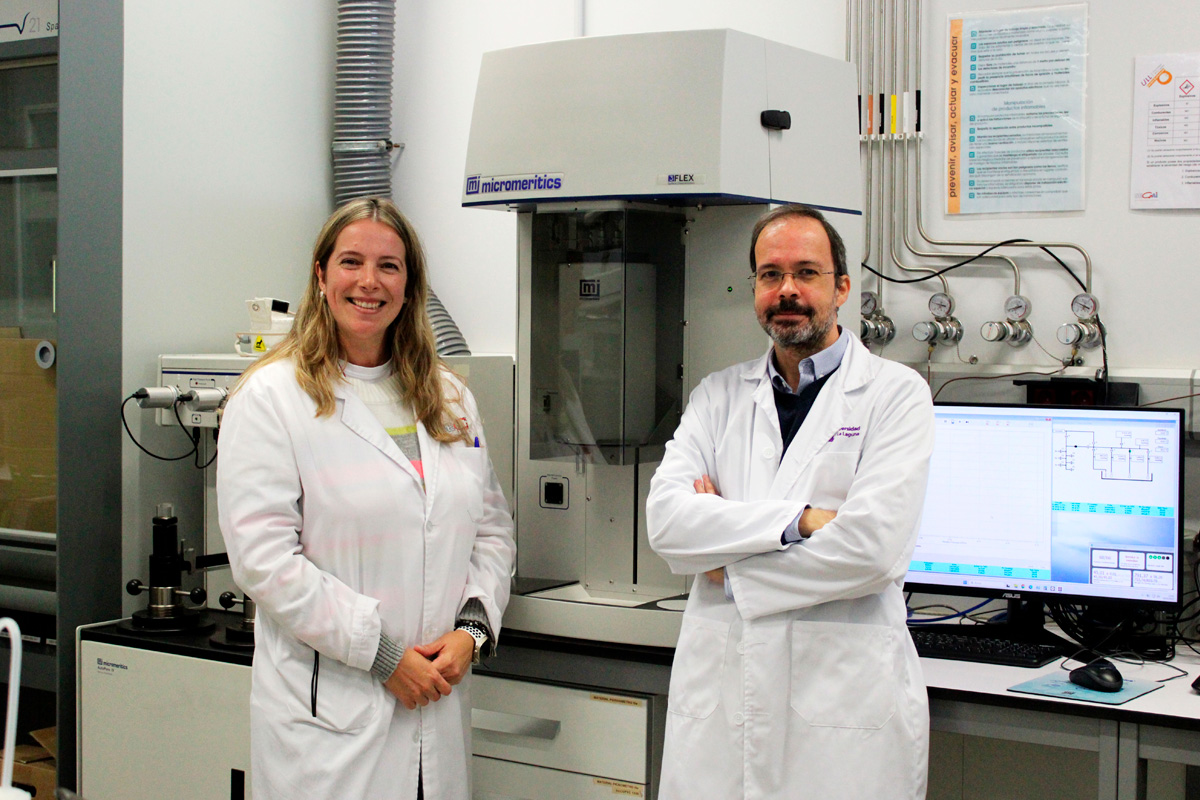
The General Research Support Service (SEGAIThe University of La Laguna's research center offers scientific, technical, and infrastructure support to research groups within the university, public entities, and private companies. Its services include: Laboratory for the Characterization of Particles and Microsurfaces (LCPM), which in 2024 exceeded 3,500 samples analyzed and which, thanks to the versatility of its equipment and the variety of techniques available, allows the study of physical properties of materials such as particle size distribution, surface area, density or porosity, among others.
The head of the laboratory, Enrique González Cabrera, Professor [Name], a senior lecturer in the Chemical Engineering department at the University of La Laguna, explains what this scientific infrastructure is dedicated to: “Here we carry out surface characterization tests using nitrogen adsorption and mercury porosimetry, which allows us to know what the active surface of materials used, for example, in wastewater treatment, in chemical reactions or as absorbents of contaminants is.”.
This SEGAI service also has specific equipment for the analysis of emulsions and suspensions, a particularly relevant line of work in Biomedicine and the Pharmaceutical Industry. “We have equipment that can characterize the size of particles or colloids, with applications in pharmaceutical technology and drug delivery systems,” says González Cabrera. Thus, the study of particle size is key to determining the most appropriate treatment in different research projects.
The laboratory's versatility is one of its main strengths. "It's a very multi-purpose service, since we analyze everything from pharmaceuticals to construction materials," explains laboratory technician Judith Rodríguez Díaz. Furthermore, the LCPM works with both solid and liquid samples, which allows it to undertake a wide range of studies, from wastewater treatment to biomedical applications.
Among the research areas supported by the laboratory are studies on diseases such as osteoporosis, Parkinson's, Crohn's disease, and various types of tumors. "There are research groups using nanoparticle characterization in projects that are already in very advanced stages," says Rodríguez Díaz.
The laboratory maintains collaborations with other scientific and technological institutions, such as the Institute of Natural Products and Agrobiology, the Technological Institute of the Canary Islands, the University of Las Palmas de Gran Canaria, and the Canary Islands Institute of Agricultural Research. It also supports applied research in areas such as soil studies, the identification of pine wood, and the characterization of volcanic ash. In the latter case, the analyses carried out to explore new applications for these materials are particularly noteworthy. “With volcanic ash, we have conducted numerous studies to evaluate potential uses, including its incorporation into cement,” the technician points out.
Equipment
The laboratory's activity is particularly intense. In 2024, more than 3,500 samples were analyzed, making it one of the busiest in SEGAI and one of those with the widest variety of equipment.
The LCPM's infrastructure includes three gas physisorption analyzers: Gemini V, ASAP 2020, and 3Flex, all from Micromeritics. The 3Flex analyzer allows for three simultaneous analyses. "The turnaround times are much faster, the software is more precise in data processing, and it has very interesting advanced analysis parameters," explains Rodríguez Díaz. In addition, the laboratory has particle size analyzers (for nano- and microparticles) and zeta potential analyzers, as well as a gas pycnometer, which significantly expands its characterization capabilities.
Beyond conducting tests, the laboratory staff collaborates in the training of students and researchers and offers scientific advice for the development of research projects. The LCPM hosts students for research stays, educational visits, undergraduate and master's theses, as well as external internships. "We also receive vocational training students related to the field of quality, so they can learn how a laboratory is managed," they emphasize.
The laboratory infrastructure has been partially financed by the European Regional Development Fund (ERDF), as well as by the Government of the Canary Islands through the Canary Islands Development Fund (FDCAN), within the framework of the Minerva 2024 Project. The FDCAN also finances the hiring of the service's technical staff.

 Spanish
 English
 French