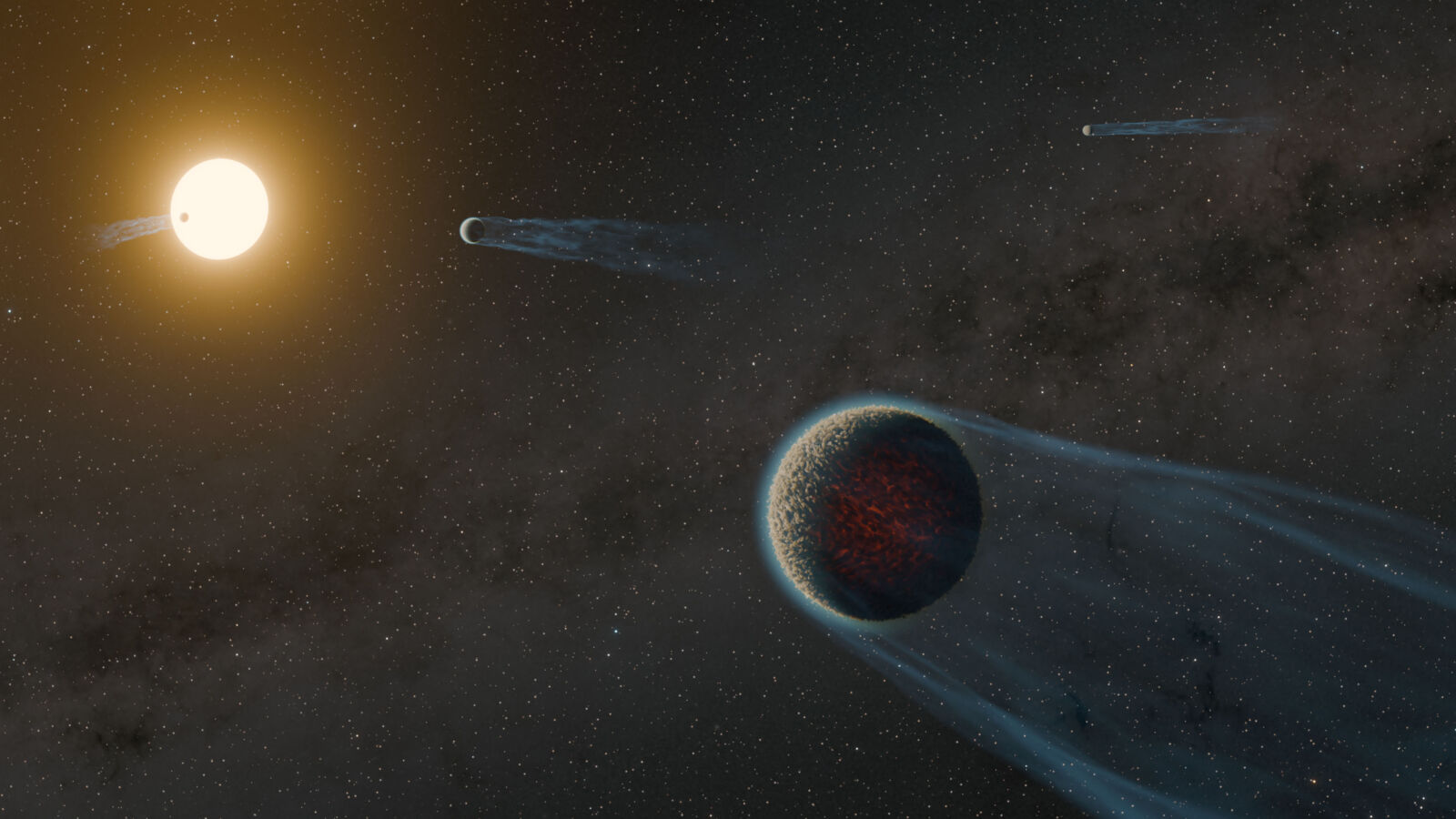
Recent astrophysical research has revealed that most stars similar to the Sun host planets with a size between that of Earth and Neptune. In fact, these 'super-Earths' and 'sub-Neptunes' are the most common planets in the galaxy, although curiously, they do not exist in our Solar System. Despite this abundance, and due to their absence in our 'neighborhood,' their formation mechanisms still have many gaps in our understanding. In particular, it has been determined that these planets could lose much of their atmosphere during their early years and transition from giant planets, like those in our Solar System, to sub-Neptunes.
Now, an international team of astronomers, including researchers Enric Pallé and Felipe Murgas from the Canary Islands Institute of Astrophysics (IAC), and Hannu Parviainen from the University of La Laguna, has found a key link in determining how this process occurs. By studying four newborn planets in the V1298 Tau system, this team has managed to capture a snapshot of these objects in the midst of their transformation into the most common types of planets in the galaxy.
“All young stars are intrinsically active, which until now had prevented us from accurately measuring the masses of their forming planets. This study overcomes that obstacle by employing an ingenious technique based on the mutual gravity between planets,” says IAC researcher Enric Pallé. “Confirming that these worlds are extraordinarily inflated gives us a fundamental piece for reconstructing the evolutionary history of the most common planetary systems in the galaxy, and will help us understand why ours is an exception,” he adds.
“What’s so exciting is that we’re seeing a preview of what will become a very normal planetary system,” says John Livingston, lead author of the study. Astrobiology Center in Tokyo, Japan. “The four planets we studied will likely shrink into 'super-Earths' and 'sub-Neptunes'. We have never had such a clear picture of young planets in their early years of formation,‘ he remarks.
A young cosmic laboratory
This study focuses on V1298 Tau, a star only about 20 million years old—a blink of an eye in cosmic time compared to our 4.5-billion-year-old Sun. Orbiting this young, active star are four giant planets, all between the sizes of Neptune and Jupiter, caught in a fleeting and turbulent phase of rapid evolution. Based on its circumstances, this system appears to be a direct ancestor of the compact, multi-planet systems found throughout the galaxy.
For a decade, the team has used an array of ground-based and space-based telescopes to precisely measure when each planet passed in front of the star, an event known as a transit. By timing these transits, the researchers have detected that the orbits were not perfectly regular.
This is because orbital configuration and gravity cause planets to attract each other, periodically accelerating or slightly slowing their motion. These tiny changes, called Transit Time Variations (TTVs), allowed the team to reliably measure the planets' masses for the first time.
“For astronomers, our usual 'Doppler' method for studying planets involves measuring the speed of the star as it is eclipsed by its planets,‘ explains Erik Petigura, co-author of the study and researcher at UCLA. “But young stars are so active and temperamental that the Doppler method is impractical. By using TTVs, we use the planets” own gravity relative to each other to calculate their masses,” he says.
Planets like cotton candy clouds
The results of this monitoring were surprising. Despite having radii between 5 and 10 times that of Earth, the planets were found to have masses only 5 to 15 times that of our planet Earth. This makes them incredibly low in density: more like planet-sized cotton candy than rocky worlds like our Earth.
“It was suspected that young planets had very low densities, but this had never been measured,” says Felipe Murgas, co-author from the IAC, who adds that “by comparing their masses with their radii, we have provided the first observational measurement of their average densities, and we have determined that they are exceptionally spongy and that in the next few million years they will lose much of their atmosphere to space due to the intense radiation from their star.”.
This feature helps solve a historical puzzle. Analysis of this system reveals that, in general, sub-Neptune planets undergo a very radical transformation early in their lives, losing much of their initial atmospheres and cooling rapidly as the gas disk surrounding their star disappears.
This feature helps solve a historical puzzle. Analysis of this system reveals that, in general, sub-Neptune planets undergo a very radical transformation early in their lives, losing much of their initial atmospheres and cooling rapidly as the gas disk surrounding their star disappears.
“It reminds me of the famous 'Lucy' fossil, one of our hominid ancestors who lived 3 million years ago and was one of the key missing links between apes and humans,‘ Petigura adds. ’V1298 Tau is a critical link between the star-forming nebulae we see all over the sky and the mature planetary systems we have discovered by the thousands,” he adds.
Understanding systems like V1298 Tau may also help explain why our own solar system lacks the super-Earths and sub-Neptunes that are so abundant elsewhere in the galaxy.
(Note and image provided).

 Spanish
 English
 French