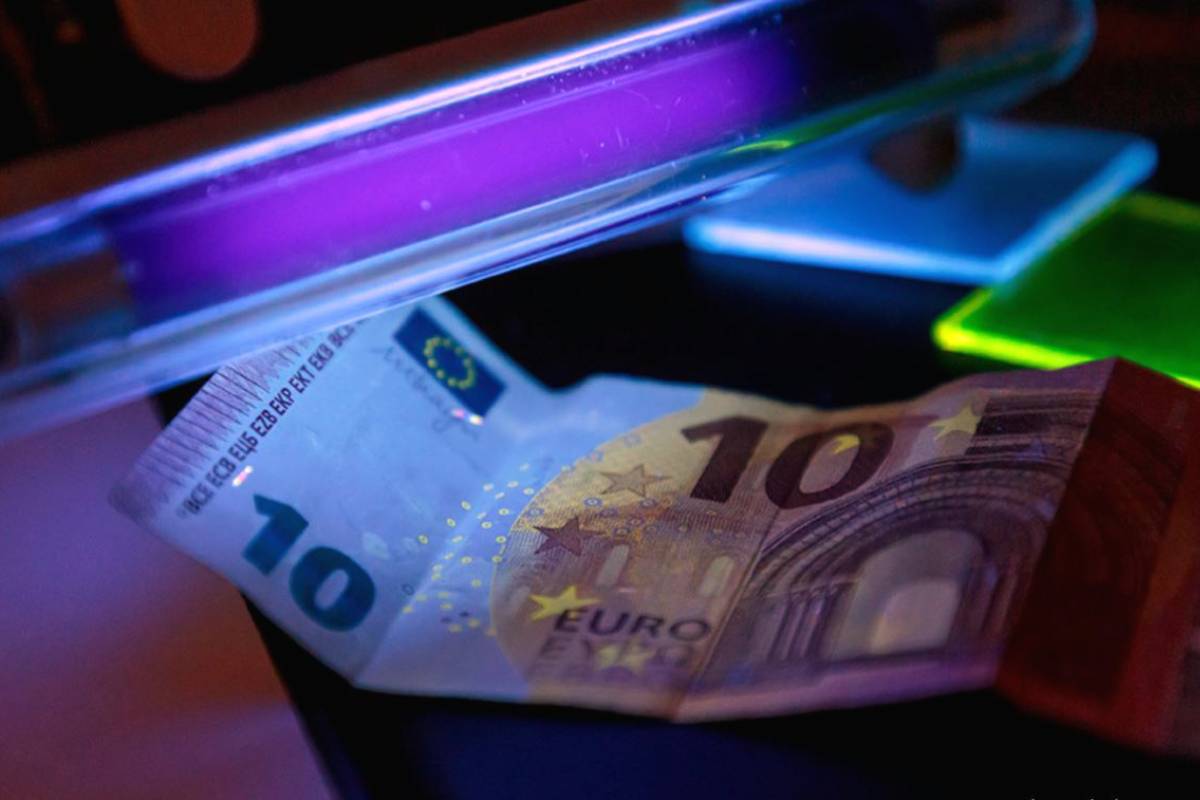
The Spanish Patent and Trademark Office (OEPM) has recently published the patent application The patent is for a luminescent inorganic material developed at the University of La Laguna, which can be used as an anti-counterfeiting security ink for printing on textiles, stationery, smart labels, signage, printed circuits, and banknotes such as euro banknotes, among other applications. The Spanish Patent and Trademark Office (OEPM) has included a report on the state of the art that confirms the "novelty and inventive step" in all the claims submitted and, therefore, their patentability.
The invention falls within the field of anti-counterfeiting technologies (anti-counterfeiting) in the area of specialization related to photonics and nanotechnology, and has been directed by the Professor of Applied Physics of the Department of Physics of the University of La Laguna Jorge Méndez along with his team, among whom are listed as authors of the patent the doctor Pablo Acosta Mora and the doctoral student Francisco Miguel Medina Alayón.
The advancement of anti-counterfeiting technologies has become a priority in the face of the global rise of increasingly sophisticated criminal networks. Banknotes, official documents, certificates, technological products, and industrial components face a constant risk of being illegally reproduced, compromising the integrity of strategic sectors and critical infrastructure such as healthcare, banking, defense, and aerospace.
Patent details
The patent, published on November 19, 2025, under number ES3042333A1, describes a process for obtaining a luminescent inorganic material with multiple combinations of rare-earth ions in different micro- and nanostructured phases. This allows the material to generate a luminescence pattern with simultaneous emission in the near-infrared and visible spectrum, enabling its application in anti-counterfeiting security devices as a "light key.".
The technology stems from the research trajectory of the group coordinated by Professor Méndez and has been under development since 2021 with collaborations Among them, the one held with the Innovation and Cash Technology Division of the Bank of Spain in the field of banknote technology stands out, together with the head of this Division, Fernando León.
This research is supported by several publications international publications in the specialized magazine Ceramics International, published by Elsevier, in 2023 and 2025, with the rest of the team made up of professors Pedro Esparza y Javier del Castillo In addition to doctoral candidate Sheila Torres, along with the collaboration initiated with Zaida Curbelo-Cano from the IMDEA Nanoscience Institute in Madrid and Ester Palmero, currently at the Institute of Micro and Nanotechnology of the CSIC in Madrid.
Dissemination and exploitation
This is the technology will be presented, along with others from the University of La Laguna, through the Vice-Rectorate for Research and Transfer, at the Science for Industry Fair (S4i) in Madrid on January 28 and 29 under the prototype category with the name “TENET Lightkey”.
A spin-off company based on this discovery is currently being established under the direction of Professors Jorge Méndez and Pablo Acosta, with funding from the Government of the Canary Islands and support from the Knowledge Transfer Office from the University of La Laguna.

 Spanish
 English
 French