The General Research Support Service (SEGAIThe University of La Laguna offers scientific, technical, and infrastructure support to research groups within the university itself, public entities, and private companies. The recently incorporated Biological Safety Laboratory Level 2+ It constitutes a strategic infrastructure that allows research and health activities involving the study of viral pathogens and the handling of affected human samples.
This infrastructure guarantees the protection of personnel, the environment, and the samples themselves by complying with national and international regulations for the safe handling of biological agents, especially viruses belonging to risk groups 1, 2, and 3 (including modified GR3), as well as viral and lentiviral vectors used in gene therapy and gene transfer. It is, therefore, a highly controlled environment for working with moderate-risk infectious agents that require strict biosafety conditions.
The facility features a reinforced air extraction system, exceeding standard requirements, enabling complex research with pathogenic viruses without risk of leakage. It comprises an anteroom, a changing room, and a cleanroom equipped with a Class II biological safety cabinet and a CO₂ cell incubator.2.
It also has the support of Research Laboratory 3 of the Pharmacology Unit at the Faculty of Medicine, which has advanced equipment for activities in Molecular Biology, Biochemistry, Molecular Virology, and Cell Biology. This support allows samples, previously processed under maximum safety conditions in the Level 2+ Biological Safety Laboratory, to be analyzed subsequently without risk, thus expanding the scientific and technical capabilities of the service.
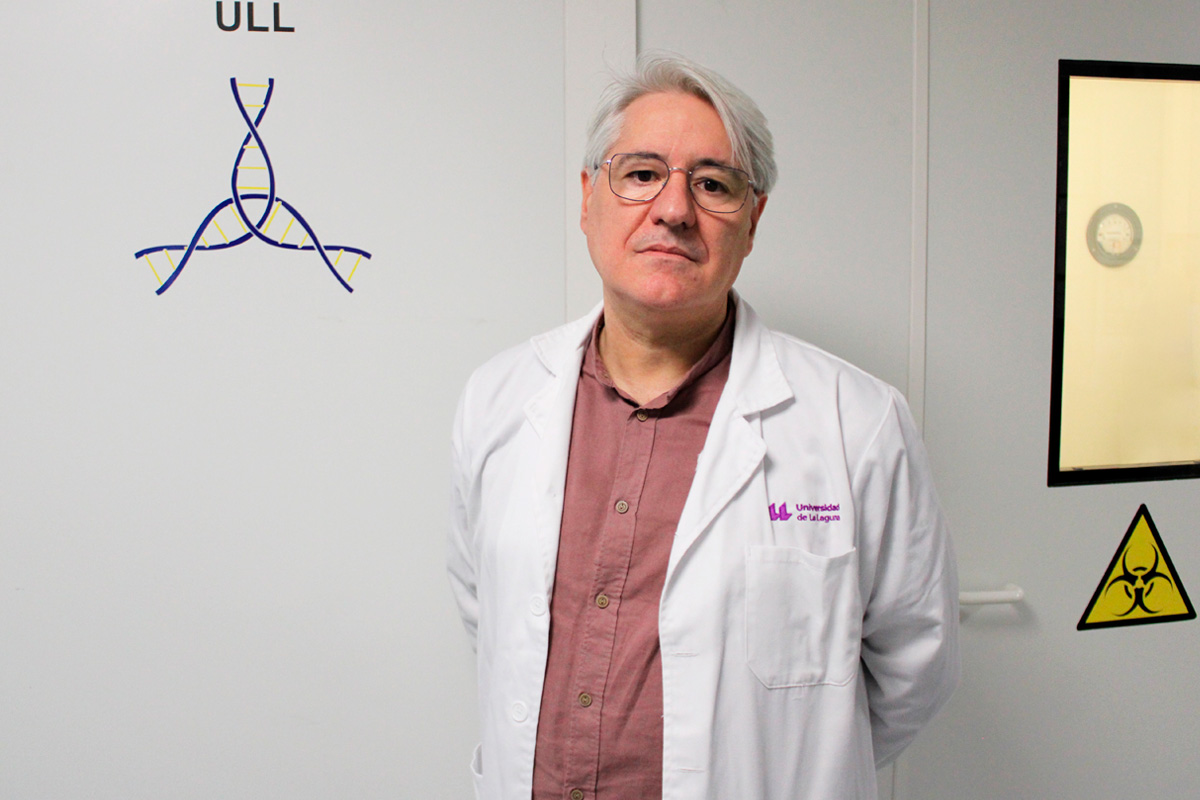
At the front is Agustín Valenzuela, Professor of Pharmacology and a researcher with extensive experience in virology and immunology, particularly in HIV research, explains that this infrastructure addresses a regulatory and scientific need: “To work with viral pathogens, it is essential to have certified spaces that allow us to do so under safe conditions. European and international regulations are very clear on this point, and without these types of facilities, it is not possible to conduct research with viruses from patients or at the molecular level.” The facility is certified by the Canary Islands Health Service (SCS) as a C3/U76 Biosafety Unit and is associated with the Microbiology Department of the Nuestra Señora de Candelaria University Hospital (HUNSC).
Virology, although traditionally integrated within the field of infectious diseases in medicine, constitutes a field of knowledge with specific needs. In this sense, the laboratory has allowed for the consolidation of research lines focused on the mechanisms of HIV infection, as well as on other viruses such as Zika, hepatitis C, coronaviruses, and various alphaviruses. Part of this activity has been developed in close collaboration with public hospitals in the Canary Islands, especially with the HUNSC, as mentioned previously.
It also offers scientific and technical advice and issues reports on the feasibility of research projects and healthcare activities involving the handling of biological samples and pathogens. These reports are essential for both competitive national and European projects and for technology transfer agreements with companies and public entities, as they certify compliance with current biosafety regulations. The group is also part of the Canary Islands Health Service's Working Committee for the drafting of the new Royal Decree on the handling of biological samples, which the Ministry of Health is currently preparing.
Applications
The facility's main applications include the cultivation and manipulation of human cells and tissues infected with viruses from risk groups 1, 2, and 3 (and modified 3), as well as with emerging viruses not transmitted through the air. The laboratory is specifically dedicated to working with viruses, excluding bacteria, fungi, and parasites to avoid the risk of cross-contamination. It also allows the use of single-cycle, non-integrative lentiviral vectors, employed in both virological studies and gene transfer and gene therapy for various diseases.
In the healthcare sector, the laboratory performs functions such as analyzing clinical samples to support disease diagnosis, developing biosafety protocols, and identifying emerging viruses in patient samples. It also develops complementary techniques such as quantifying viral components, safely applying genetic engineering, and supporting pharmaceutical research.
It also collaborates with the Human Reproduction Unit (URH) of the University Hospital of the Canary Islands (HUC), allowing the safe processing of seminal material for in vitro fertilization, in cases of discordant couples, in which one of the members is infected by an integrative virus such as HIV or hepatitis B.
Equipment
The laboratory equipment includes a level II biological safety cabinet for cell culture with two simultaneous workstations, an inverted microscope with phase contrast and fluorescence per fiber optic unit, a CO₂ incubator, a thermostatically controlled water bath with agitation, a centrifuge and biosafety mini-pipe, a 4D-Nucleofector® nucleofection system, and a technical unit for pressure control, filtration, and air cooling. This system combines positive and negative pressure zones with precise digital control, ensuring pathogen containment and environmental safety. In addition, the laboratory is supported by a flow cytometer located in the associated Laboratory 3.
The infrastructure has been certified by the Canary Islands Health Service, as required by current legislation, and its maintenance and use strictly adhere to the purposes for which it has been authorized. As its manager emphasizes, “a facility may technically allow for different uses, but it must be certified for a specific purpose. In this case, the laboratory was established with the sole purpose of working with viruses.”.
The financing of this infrastructure has been made possible thanks to the European Regional Development Fund (ERDF), through the UNLL10-3E-783 grant from the then Ministry of Economy and Competitiveness, with co-financing from the CajaCanarias Foundation, thus consolidating a reference facility in biosafety and virology in the regional area.

 Spanish
 English
 French