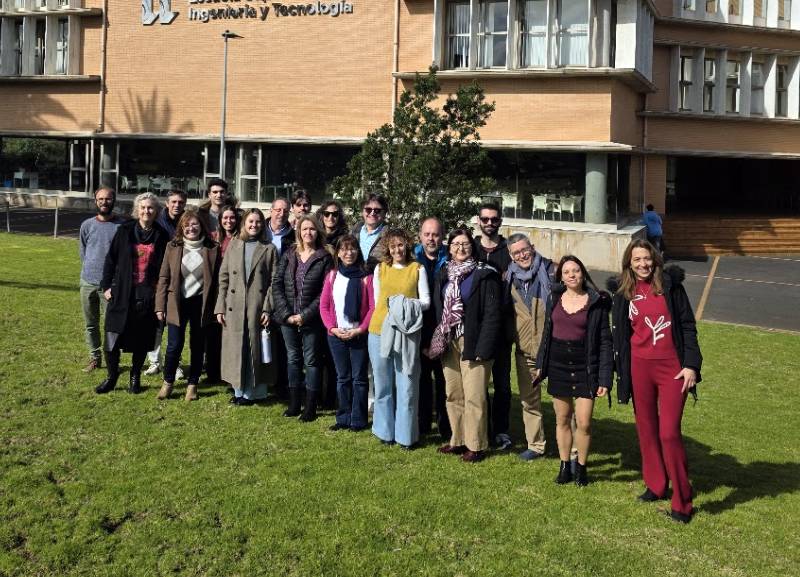
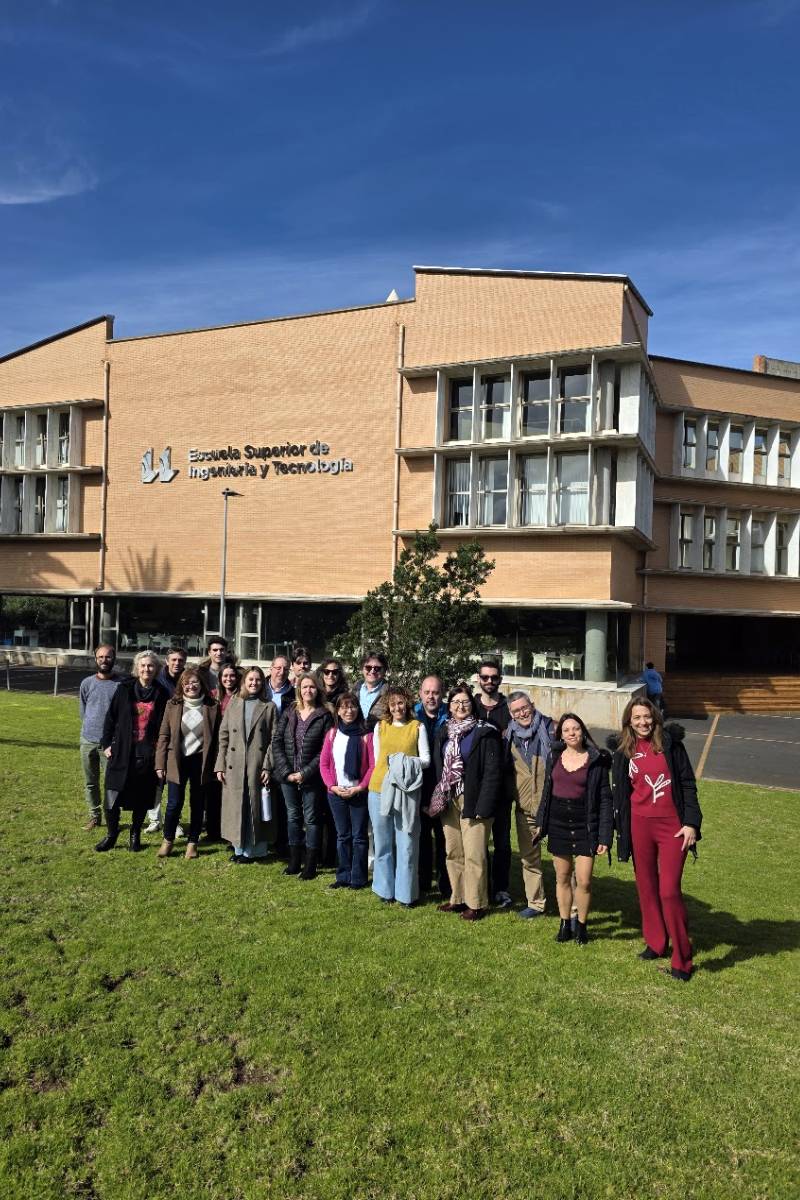
Group photo of the PLEISAR research project meeting at ULL.
The University of La Laguna hosted a scientific meeting this week for the coordinated project PLEISAR (Playful Experiences with Interactive Social Agents and Robots), This research initiative explores how social robots and intelligent agents can improve people's emotional, social, and cognitive well-being in their daily lives from an ethical, inclusive, and human-centered perspective. Funded by the Ministry of Science, Innovation and Universities, it brings together teams from the universities of Zaragoza, the Balearic Islands, Granada, Barcelona, and La Laguna, and is structured around three complementary sub-projects, each with a specific focus but integrated into a common vision.
The meeting provided an opportunity to share progress, coordinate results, and plan new joint publications with the aim of expanding ongoing studies and strengthening their social impact. A new research proposal was also presented, which will continue this collaborative work.
Intergenerational experiences
The subproject led by the University of Zaragoza focuses on designing playful and intergenerational experiences mediated by social robots and virtual agents. Their work explores how these technologies can foster communication, social cohesion, and emotional connection between generations, especially between older adults, children, and families.
To achieve this, the team develops experiences based on play, storytelling, and community participation, using co-creation and participatory design methodologies. The results are validated in real-world contexts such as educational and community spaces, allowing for the identification of best practices for reducing age and gender barriers in technology use.
Affective artificial intelligence
The subproject coordinated by the University of the Balearic Islands addresses one of the major current challenges in artificial intelligence: ensuring that systems are understandable, transparent, and fair. Its research focuses on developing affective AI models capable of recognizing emotions, for example, from facial expressions, and simultaneously explaining how they make decisions.
This explainable approach to artificial intelligence is key to building trust, especially when technology interacts with older adults, people with disabilities, or vulnerable groups. The team also analyzes potential biases related to age, gender, or functional diversity, contributing to the design of more inclusive and ethically responsible systems.
Everyday environments
Meanwhile, the joint subproject of the Universities of Granada and La Laguna focuses on the practical application of social robots and intelligent agents in everyday environments such as homes, schools, residences, and community spaces. The team is working on designing engaging and persuasive experiences that promote social participation, learning, autonomy, and emotional well-being.
Case studies include robots that assist elderly people with daily activities, intelligent systems that support digital literacy and computational thinking in children and young people, and immersive experiences aimed at emotional regulation and stress reduction. All of these solutions are developed with a strong emphasis on user experience, ethics, and a gender perspective.
People-centered technologies
In the field of research on human-centered technologies, the contribution of ITED research group (Interaction, ICT and Education) of the University of La Laguna, who actively participates in high-impact scientific and social projects. The group is led by Professor Carina González and the research team made up of Jezabel Molina Gil, Vanesa Muñoz Cruz, Bernardo Candela Sanjuan, José María del Castillo-Olivares, Silvana Aciar, Eduardo Nacimiento, Andrea Cotino y Holi Díaz, among other members, has held meetings during these days to work on the progress of the project PLEISAR and to present new research proposals.
The ITED group develops a consolidated line of research in human-computer interaction, ethical and explainable artificial intelligence, social robotics, inclusive design, and technologies for well-being, with a special focus on real-world contexts and diverse communities. Their work is characterized by an interdisciplinary approach that integrates engineering, social sciences, and education, as well as by the use of participatory and co-creation methodologies, in which users actively participate in the design and evaluation of technological solutions.

 Spanish
 English
 French