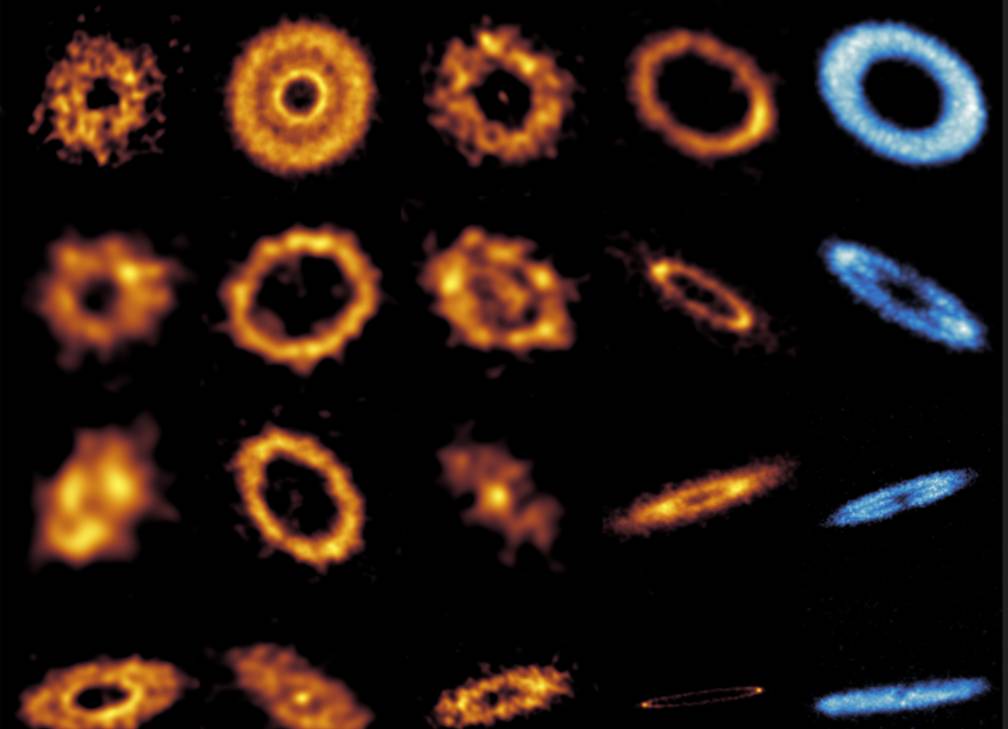
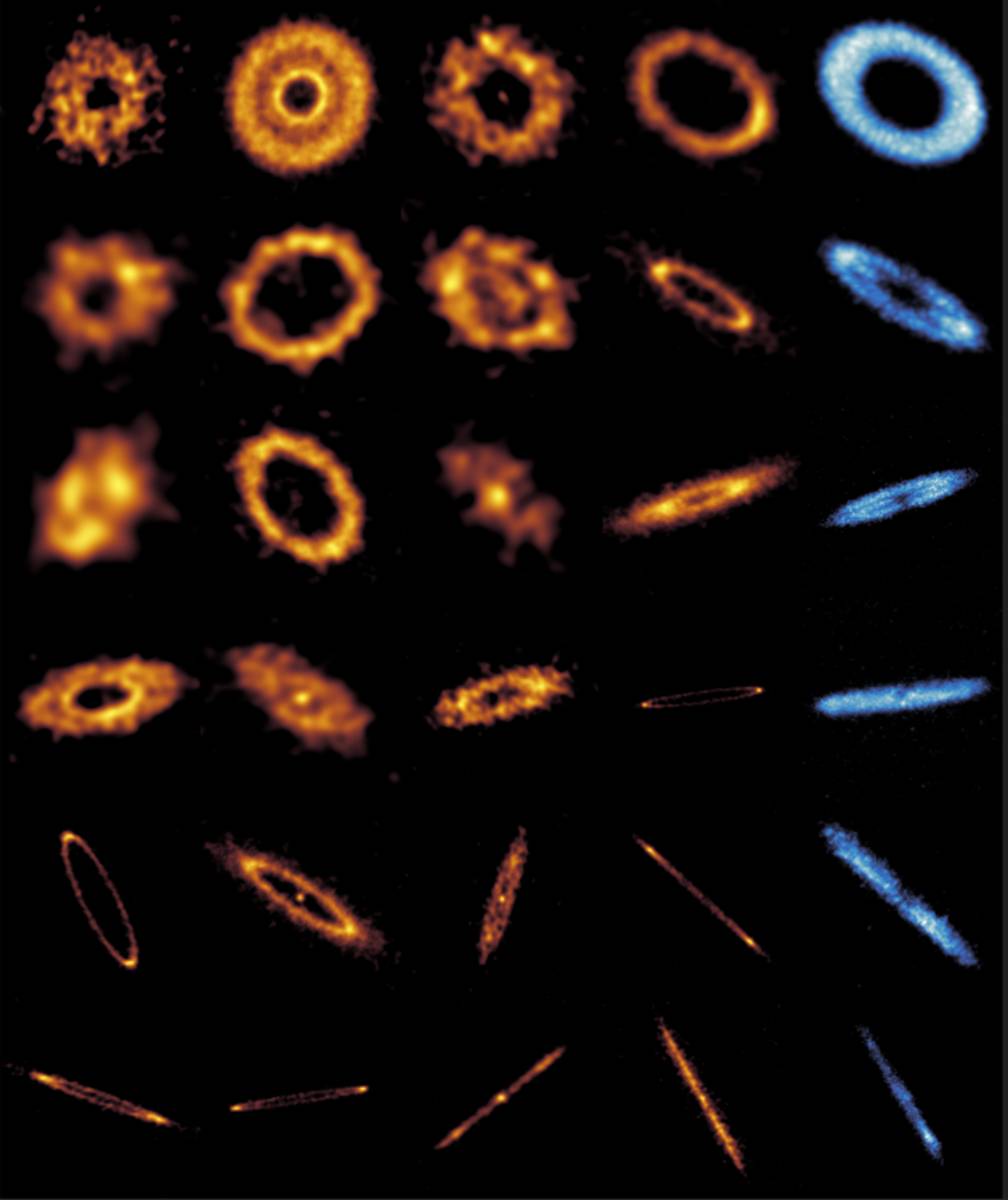
This ARKS gallery of faint debris disks reveals details about their morphology: multi-ringed belts, wide, smooth halos, sharp edges, and unexpected arcs and clumps, all suggesting the presence of planets shaping these disks. Furthermore, it reveals their chemical composition: amber colors highlight the location and abundance of dust in the 24 disks studied, while blue indicates the location and abundance of carbon monoxide in the six gas-rich disks.
An international team of astronomers, including researchers from the University of La Laguna (ULL) and the Canary Islands Institute of Astrophysics (IAC), has captured, for the first time, details of planetary systems from an era long shrouded in mystery. The study, entitled ALMA survey to Resolve exoKuiper belt Substructures (ARKS) and made with the Atacama Large Millimeter/submillimeter Array (ALMA), has produced the sharpest images to date of 24 debris disks, the dust belts left over after the formation of planets.
These disks are the cosmic equivalent of a planetary system's adolescence: somewhat more developed than planet-forming disks, but not yet mature. These findings from the ARKS project are invaluable for the search for young planets and for understanding how they form and reorganize into families, like the planets in our Solar System.
In this sense, Carlos del Burgo, A researcher at the University of La Laguna (ULL) and the Institute of Astrophysics of Cantabria (IAC), and a member of the ARKS project, highlights ALMA's potential to reveal structures in disks: “ALMA continues to revolutionize our view of young planetary systems, revealing complex structures that are potentially sculpted by planets. These increasingly sharp observations can be combined with radial velocity curves and light curves (for systems with planets that intercept the light from their stars for a given observer) to significantly improve the characterization of these emerging worlds.”.
Meredith Hughes, associate professor of astronomy at Wesleyan University (USA) and co-leader of this study, emphasizes the importance of the project: “We’ve often seen pictures of the early stages of planet formation, but until now, their adolescence was a missing link.” She adds, “This project gives us a new perspective for interpreting the craters on the Moon, the dynamics of the Kuiper Belt, and the growth of planets large and small. It’s like adding the missing pages to the family album of the Solar System.”.
The counterpart to this evolutionary phase in our Solar System is the Kuiper Belt, a ring of icy debris beyond Neptune that preserves a record of massive collisions and planetary migrations that occurred billions of years ago. With this new study of 24 exoplanetary debris belts, the ARKS team is gaining a better understanding of what the Solar System experienced while the Moon was forming and the planets were making their way to their final positions.
“Teen” albums”
Debris disks are faint, hundreds or even thousands of times fainter than the bright, gas-rich disks where planets form. The ARKS team overcame the challenge to produce images of these disks in unprecedented detail. Like teenagers avoiding being in the picture, these faint disks have managed to hide from astronomers for years, but thanks to ALMA, it is now possible to admire their complex structures: multi-ringed belts, wide, smooth halos, sharp edges, and even unexpected arcs and features. “We are observing a great diversity: not just single rings, but multi-ringed belts, halos, and strong asymmetries, revealing a dynamic and complex chapter in planetary history,” adds Sebastian Marino, ARKS program leader and associate professor at the University of Exeter (UK).
ARKS represents the largest and highest-resolution survey of debris disks to date, revealing that approximately one-third of the observed disks exhibit distinct substructures (multiple rings or voids) that may have formed in earlier stages of planetary formation or were sculpted by planets over much longer timescales. While some disks inherit intricate structures, others are smoothed out and spread into broad belts, similar to how we expect the Solar System to have developed.
Furthermore, many disks show evidence of zones of calm and chaos, with vertically "bulged" regions, similar to the mixture of classic Kuiper Belt objects from our Solar System and those scattered by Neptune's past migration. Several disks retain gas for much longer than expected. In some systems, the remnant gas can influence the chemical composition of growing planets, or even displace dust into broad halos. ARKS has shared this wealth of data with the entire community.
Implications
The ARKS results show that this adolescent stage is a period of transition and upheaval. "These disks have recorded a period in which planetary orbits were perturbed and large impacts, such as the one that forged the Moon, shaped young solar systems," says Luca Matrà, co-leader of the study and associate professor at Trinity College Dublin (Ireland).
The project ARKS It is the work of an international team of approximately 60 scientists, led by the University of Exeter, Trinity College Dublin and Wesleyan University, with participation from ULL and IAC.
(This information has been adapted from a press release issued by the National Radio Astronomy Observatory (from the US).

 Spanish
 English
 French