
The University of La Laguna celebrated today, February 9, the launch day of the Ecotúnidos_2CAP project, an initiative that seeks to reinforce the consumption of local artisanal fish in school cafeterias in the Canary Islands and transfer this model to Madeira and Cape Verde, within the territorial cooperation program Interreg.
The meeting, held at the Faculty of Social Sciences and Communication, brought together research staff, institutional representatives, fishing sector organizations and professionals from the educational and food fields to analyze the possibilities of transforming the artisanal fishing value chain in Macaronesia.
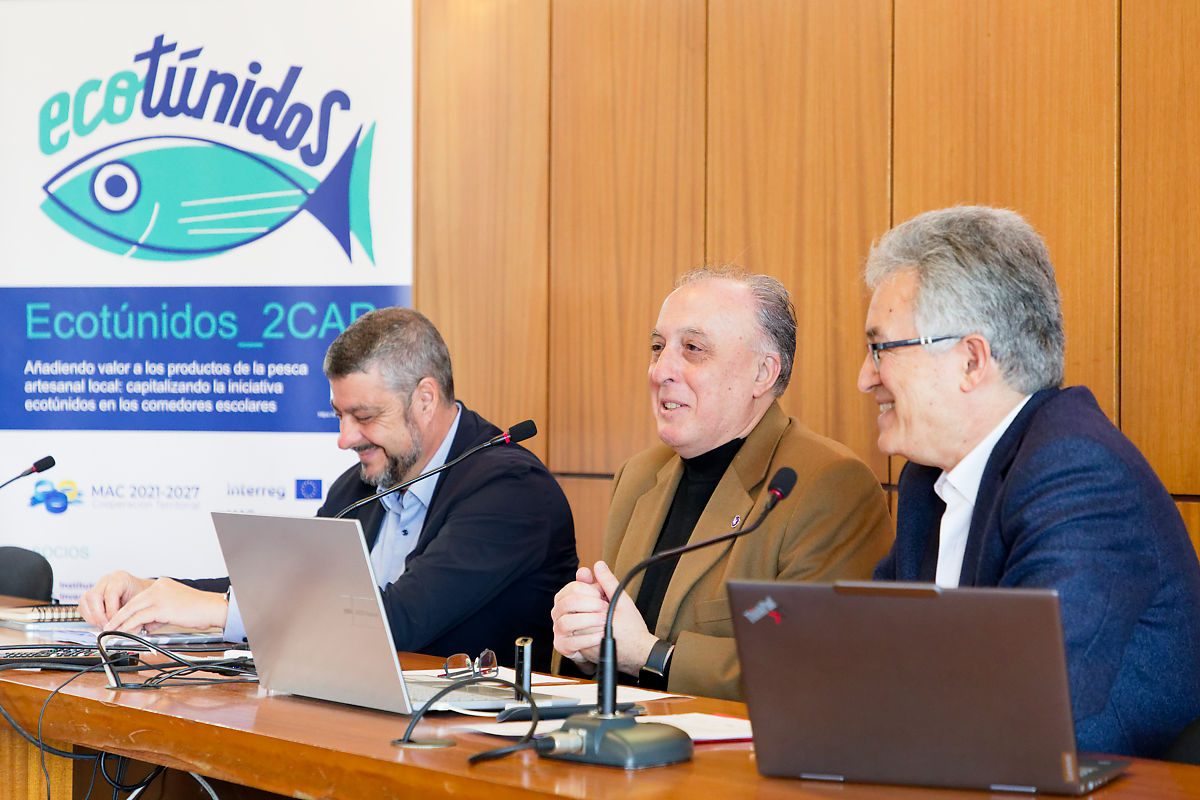
The Director General of Fisheries, Esteban Reyes (left); the Vice-Rector for Research and Transfer, Antonio Aparicio, and the PI of the project (right).
During the opening of the day, the Vice-Rector for Research and Transfer of the academic institution, Antonio Aparicio Juan, He emphasized that knowledge transfer is a fundamental mission of the university and praised the work of the institution's research staff for transforming scientific results into "real actions for the advancement and improvement of society." In this regard, he noted that Ecotúnidos_2CAP is "an excellent example of knowledge transfer" and expressly thanked the project's principal investigator for his support., José Pascual Fernández, as well as the involvement of associated public institutions, which allow the initiative to reach its final recipients: school cafeterias.
For his part, the Director General of Fisheries of the Government of the Canary Islands, Esteban Reyes Hernández, thanked the University of La Laguna and the University Institute for Social Research and Tourism (ISTUR) Reyes Hernández extended an invitation to participate in the event, highlighting that it is “an initiative originating from the university and easily understood,” as it stems from a clear question: how to make better use of existing resources. She emphasized that the project is based on a pilot program developed in Tenerife and on solid prior work with the sector.
The project was presented by José Pascual, Professor of Social Anthropology at the academic institution and principal investigator, who expressed his gratitude for the support of the university and collaborating institutions, without which, he affirmed, the initiative would not be possible. The project's central objective is to increase the visibility and recognition of artisanal fishing in Europe and contribute to shifting investment priorities in the sector.
Pascual contextualized the project within a research trajectory initiated in 2012, focused on analyzing the marketing of artisanal fishing products in the Canary Islands. After an initial qualitative phase in Tenerife and a subsequent quantitative analysis at a macro scale, the results showed that, although fishing in the Canary Islands and Macaronesia is predominantly artisanal, around 851 metric tons of tuna catches are destined for export and processing outside the archipelago, while local consumption relies on imported frozen fish.
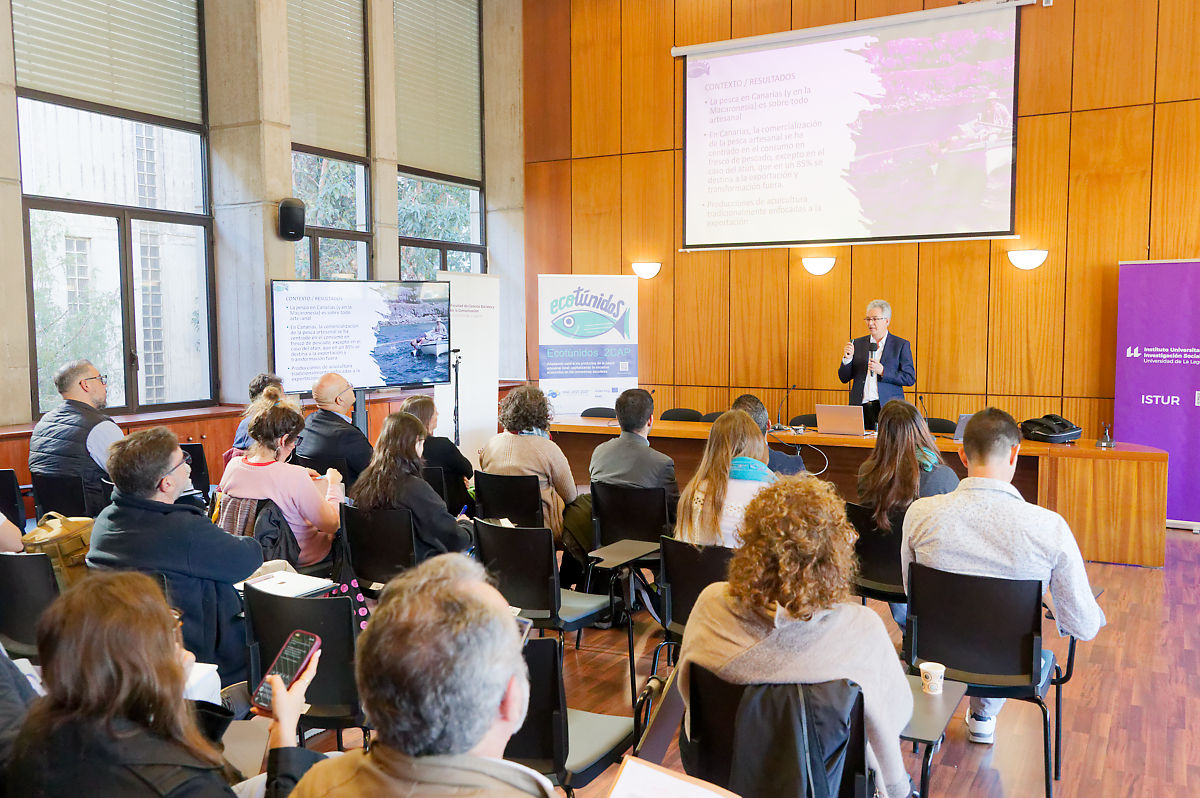 The researcher also warned of changes in consumption habits, with a growing shift towards frozen fish and other processed options, as well as the disappearance of traditional processing in fishing communities due to a lack of infrastructure adapted to current health requirements. “We are surrounded by the sea, but we consume little fresh fish and increasingly more frozen,” he noted, pointing to the need to move towards new ways of presenting artisanal fishing products.
Pilot results and future directions
In this context, a pilot project developed in 2018 in a dozen schools in Tenerife introduced processed and deep-frozen small tuna species—such as skipjack tuna, albacore, and wahoo—as a replacement for imported products like cod, hake, and squid. This experience demonstrated the viability of deep freezing as a key element in the value chain and its contribution to reducing the environmental footprint of school meals.
Pascual highlighted the significant generational gap in per capita fish consumption in Spain, noting that those over 65 consume up to five times more fish than those under 35. This makes school cafeterias a strategic space for promoting healthy habits from an early age. The project's vision for the future involves developing processing facilities on the islands, capable of adding value to local catches, responding to new consumer demands, and fully utilizing fish, including byproducts with potential for other uses, such as aquaculture or biotechnology.
The day's program also included presentations on the nutritional importance of fish in children's diets, food safety and the experience of the Ecocomedores de Canarias program, as well as a round table with fishing organizations and educational centers participating in the original pilot.
The session concluded with an analysis of the local circumstances for transferring the model to Madeira and Cape Verde, a phase that includes territorial diagnoses, co-creation processes with local actors, adaptation of distribution tools, and training and support actions to activate the initiative in each territory.

 Spanish
 English
 French