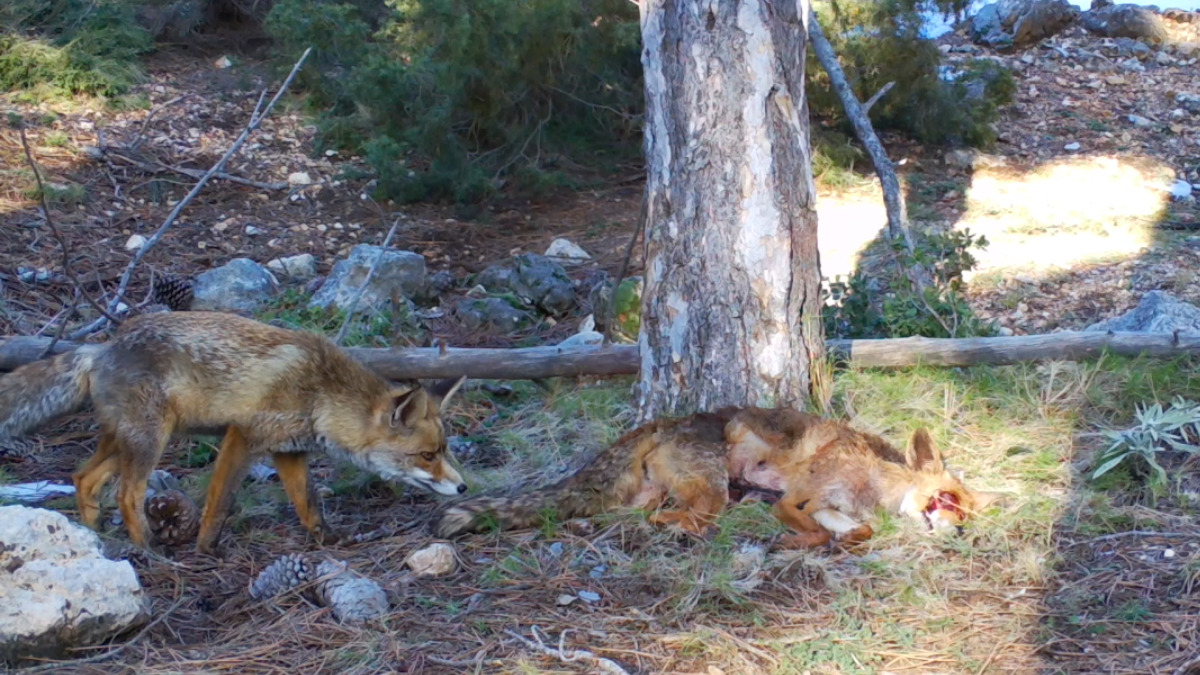
In arid and semi-arid ecosystems, where water and nutrients are scarce, the death of an animal is not an end, but the beginning of a vital process for the environment. A team led by the Miguel Hernández and Alicante universities, with participation from the University of La Laguna, has discovered that not all carcasses contribute equally to soil fertility: the identity of the dead animal determines the chemical signature it will leave in the soil.
The work, published in the scientific journal Journal of Animal Ecology, The study was conducted in the Sierra Espuña Regional Park (Murcia). To understand how organic matter is recycled in these environments, the research team monitored carrion from two very different species: 20 red foxes (mesocarnivores) and 19 Barbary sheep (large herbivores). Using camera traps and laboratory analysis, they compared how both the scavenging animals and the soil properties (pH, nutrients, microbial activity) responded to these two types of organic matter inputs.
«At first glance, these deaths might seem ecologically equivalent,» explains Adrián Colino, a predoctoral researcher and lead author of the study. “Animal remains provide a surge of organic matter and nutrients that triggers significant changes in soil properties,” he adds. The presence of carrion in the soil increased microbial activity and the concentration of phosphorus, a limiting factor for plant growth. “However, we discovered that who dies matters. The carcasses of carnivores and herbivores tell very different stories.».
One of the most surprising findings contradicts intuition: although Barbary sheep are much larger and contribute more biomass, their effect on soil biochemistry is more ephemeral. The reason has much to do with scavengers, the animals that consume these carcasses. Previous studies by the research group have observed that scavengers show a preference for consuming the carcasses of herbivores over those of carnivores.
This consumption pattern has a significant effect on how long carcasses remain in the environment. Large herbivores are consumed quickly, depleting the resource in a short time. In contrast, fox carcasses, although smaller, are consumed more slowly and persist longer in the environment, prolonging the interaction between the carcass and the soil.
The study also highlights the crucial role of the community of living animals that feed on these remains. The study's findings point to scavengers as generally overlooked regulators of geological processes. Carnivores exert a disproportionate influence on the ecosystem, even underground and after their death.
This work was partially funded by the Ministry of Science, Innovation and Universities. The co-authors of this work received funding from the Valencian Regional Government and the European Social Fund Plus (ESF+), as well as from the Regional Government of Andalusia. In the case of the University of La Laguna, the article is authored by the researcher. Zebensui Morales Reyes, researcher in the area of Animal Biology, Soil Science and Geology.

 Spanish
 English
 French