
A scientific team international, in which the University of La Laguna and the Institute of AstrophysicsíThe Canary Islands Astrophysics Institute (IAC) has identified the cause of an unusually prolonged dimming observed in a distant star. The phenomenon is explained by the passage of a substellar object with a giant ring system, similar to a “saucer cóosmic”, ahead of the host star.
The star, named ASASSN-24fw, is located in the constellation Monoceros, about 3,000 light-years from Earth. The star gradually dimmed for more than nine months, between late 2024 and mid-2025, reaching a low of approximately 97 %, before regaining its usual brightness. These stellar eclipses are extremely rare.ía few of them last only a few días or weeks, but this attenuationn continuó for almost 200 daysíThus, it makes it one of the mostálong jamsáobserved.
ASASSN-24fw is approximately a 50 % máIt is massive than our sun and approximately twice as large. The star in question is known to be...í It is stable and not prone to sudden changes. This rules out internal stellar activity as the cause of the strange dimming. Instead, an anáA recently published detailed analysis of several observations supports the idea that the phenomenon was caused by a large companion object that crossed the line of sight to the star, blocking its light for an exceptionally long period of time.
«"First se detected a sharp drop in the light curve (intensity as a function of time) of ASASSN-24fw obtained with he All-Sky Automated Survey for Supernovae (ASAS-SN). This event caught our attention, and we observed this star with various instruments, in addition to gathering further information. This allowed us to characterize the star and model the transit, which turned out to be extraordinarily long, revealing some hidden "treasures" in the vicinity of this fascinating star," he explains. Carlos del Burgo, researcher at the University of La Laguna and the IAC that participated in the study.
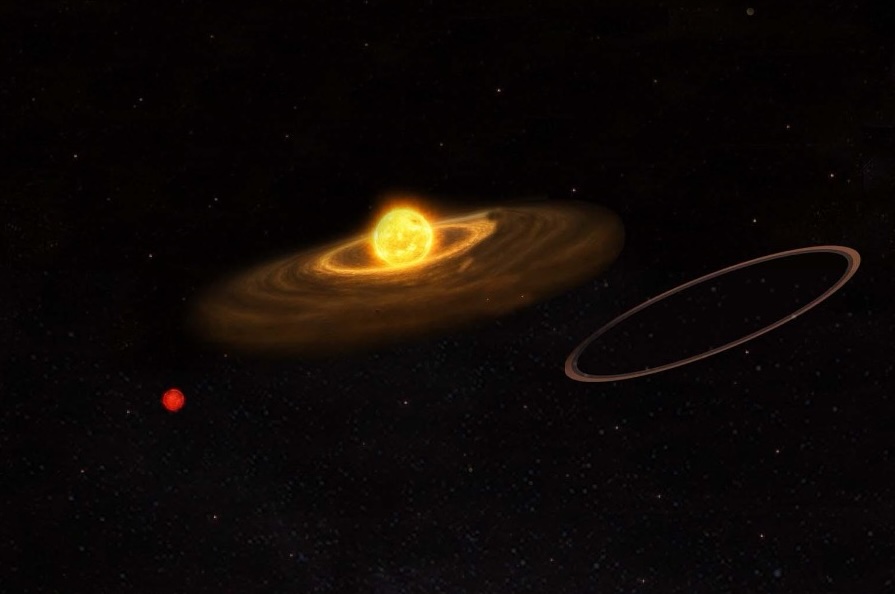
An artist's impression of ASASSN-24fw after the eclipse, showing the star shining unobstructed, with its own debris from possible planetary collisions alongside its red dwarf companion and the dark "saucer." Creatoactive Solutions
«"Several models developed by our group show that the explanationn más likely for attenuation is the crossroads a brown dwarf (an object with a mass intermediate between that of a planet and a star) surrounded by a vast and dense ring system. This brown dwarf with its disk orbits the star.”, points out Sarang Shah, postdoctoral researcher at Inter-University Center for Astronomy and Astrophysics (IUCAA; Pune) who co-led the study. "Cases of such long-lasting dimming are exceptional because they require very precise alignments. The dimming beganó gradually, since the outer parts of the rings are thin, and it only became evident when the regions mádense clouds passed in front of the star.», he adds.
The anáanalysis of photometric studieséTrial and spectroscopic data from the event suggest that the companion object has a mass of más is three times that of JúPeter. Its ring system is remarkably large, extending to approximately 0.17 astronomical units, comparable to half the distance between the Sun and Mercury. The anáAnalysis shows that the ASASSN-24fw itself alsoéIt has material (possibly debris from past or ongoing planetary collisions) very close to it, which is unusual for a star of its age (around a few billion years).you).
«"Large ring systems are expected around massive objects, but they are very different."íeasy to observe directly to determine their characteristicsístics«"explains Jonathan Marshall, an independent researcher affiliated with Academia Sinica (Taiwan) which has co-led the study. «"This rare event allows us to study such a complex system in remarkable detail. In fact, while studying this attenuation, we also..."é"We discovered by chance that ASASSN-24fw has a red dwarf star in its vicinity."», He points out.
Consequently, andThis discovery provides an important opportunity to better understand the buddyñerSubstellar objects, such as brown dwarfs, massive ring systems, and how such structures form and evolve around stars. The team plans to make future observations to study this system in detail using large telescopes such as JWST, ALMA, or VLT, among others.
This work used publicly available data from the All-Sky Automated Survey for Supernovae (ASAS-SN), a global network of robotic telescopes designed to image the entire visible sky each night to detect bright transients and variable stars. It also used data from Asteroid Terrestrial-impact Last Alert System (ATLAS), NASA's robotic asteroid early warning system. In addition, the team also obtained photometric and spectroscopic data from renowned facilities such as the WM Keck Observatory, he Magellan Telescope and the Global Telescope of the Las Cumbres Observatory (LCOGT).

 Spanish
 English
 French