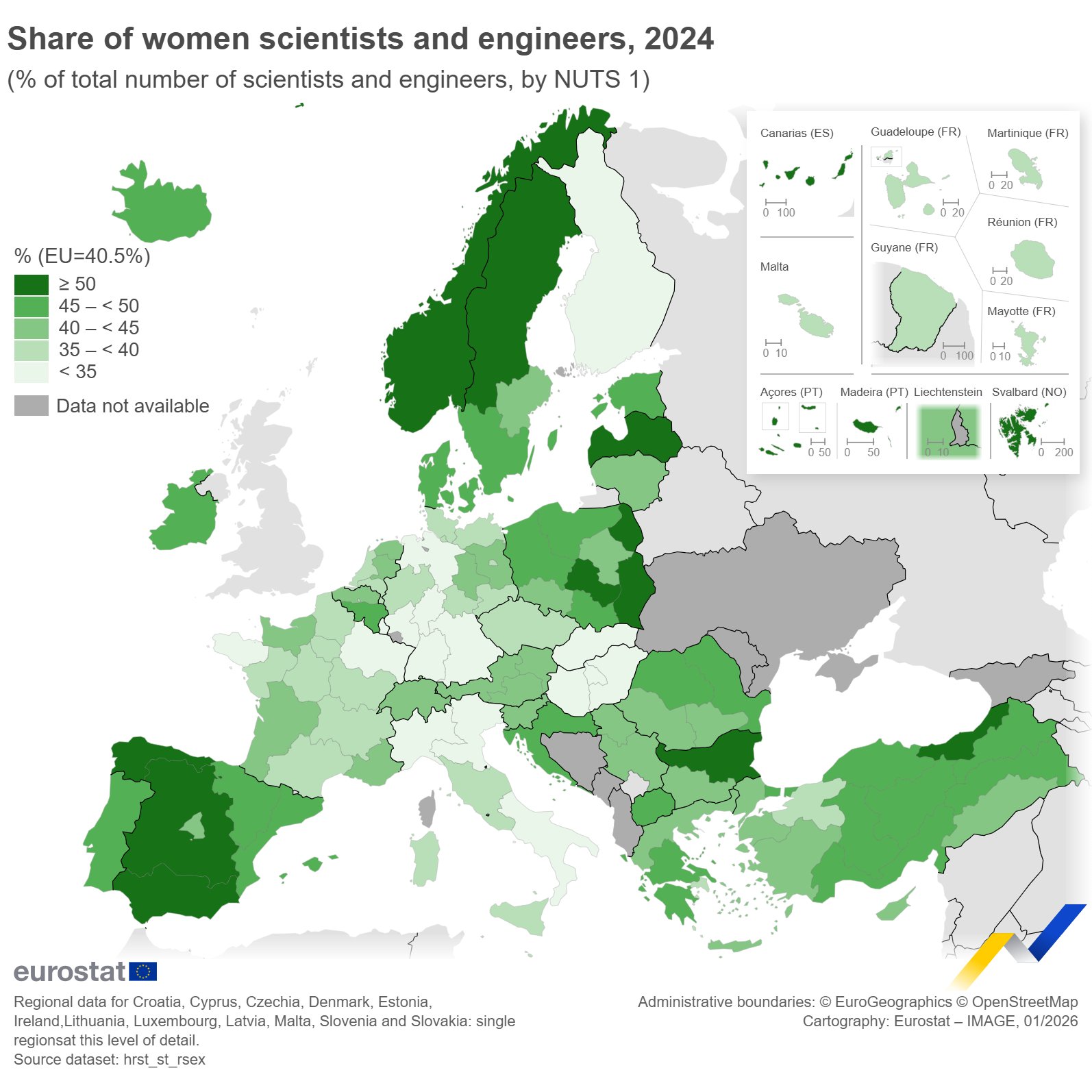
To mark the International Day of Women and Girls in Science, celebrated every February 11, the European Statistical Office (Eurostat) has published a report Regarding the presence of women in science and engineering professions in the European Union, according to 2024 data, the Canary Islands leads Europe in female representation in these fields, with 58.81% of women employed in science and engineering. They are followed by the Azores, with 57.31%, and Madeira, with 56.41%. Thus, the Canary archipelago not only far exceeds the European Union average of 40.51%, but also leads the group of eleven EU regions where women are in the majority in these professional sectors.
At the national level, Spain ranks fourth among Member States with the highest proportion of female scientists and engineers, reaching 47.61%. Ahead of it are Latvia (50.91%), Denmark (48.81%), and Estonia (47.91%). At the other end of the spectrum are Finland (30.71%), Hungary (31.71%), Luxembourg (32.41%), Slovakia (33.61%), and Germany (34.61%), which register the lowest rates of female representation in these fields.
The report from Eurostat, the statistical agency of the European Commission, also shows sustained growth in female employment in science and engineering over the last few decades. The number of women employed in these sectors has risen from 3.4 million in 2008 to 5.2 million in 2014, reaching 7.9 million in 2024, reflecting a consolidated upward trend.
This classification encompasses professionals with training and employment in scientific and technological areas, including activities related to research, engineering, manufacturing, and knowledge-intensive services.
Across the European Union, women represented 40.51% of the science and engineering workforce in 2024. Their presence was highest in knowledge-intensive services (45.11%) and in the services sector as a whole (45.01%). However, their representation remains significantly lower in manufacturing, where women make up 22.41% of all scientists and engineers, and in other industrial and technical activities, where they account for 23.61%.

 Spanish
 English
 French