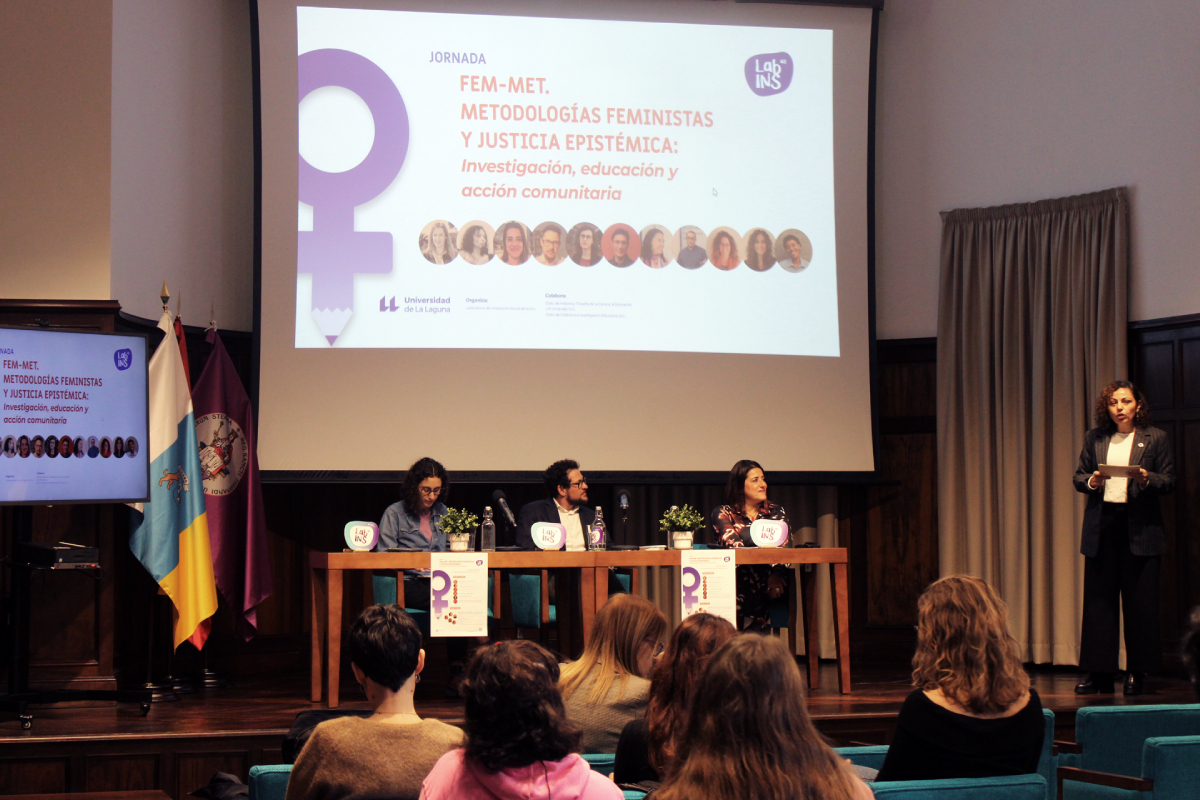
The Aula Magna of the Central Building of the University of La Laguna, better known as the Rectors' Hall, recently hosted the academic conference FEM-MET: Feminist Methodologies and Epistemic Justice, an event that brought together around thirty people between the morning and afternoon sessions. The initiative was developed as a space for critical reflection on how knowledge is produced in research, education, and community action from feminist and intersectional perspectives.
Driven by the Social Innovation Laboratory of the University of La Laguna (LabINS ULL) In collaboration with the Departments of History and Philosophy of Science, Education and Language and of Didactics and Educational Research of the University of La Laguna, the day focused on key issues such as power relations in research processes, reflexivity, epistemic justice, the use of data and the co-production of knowledge with communities and entities of the third sector.
The opening ceremony was led by Esperanza Ceballos Vacas, researcher at the University Institute for Women's Studies, professor in the Department of Didactics and Educational Research and dean of the Faculty of Education, and of Mónica Dios Rodríguez, director of LabINS ULL and professor in the Department of History and Philosophy of Science, Education and Language, who emphasized the importance of rethinking academic methodologies from approaches committed to equality, ethics and social transformation.
During the morning session, three presentations were given by professors from the ULL and the Università di Bologna. Annachiara Del Prete (University of La Laguna) opened the program with the conference «"From where we know. Power, reflexivity and epistemic justice in feminist research"», in which she addressed the need to situate knowledge and recognize the positions from which research is conducted.
Next, Elia Arfini (Università di Bologna) presented «"Asking the other question. Intersectionality as a feminist methodology"», highlighting the potential of intersectionality to challenge singular categories and broaden analytical frameworks. The morning concluded with a presentation by Francesca Tosi (University of Bologna), «"What gets measured is what counts. Data, power, and feminist perspectives in quantitative social research"», focused on the biases and political decisions that permeate data production.
In the afternoon, the discussion "Co-production of Knowledge in Dialogue with the Third Sector" took place, a participatory space that highlighted the exchange between academia and social action. The discussion, moderated by Professor [Name], focused on... Daniel Buraschi, from the Department of History and Philosophy of Science, Education and Language, intervened Natalia Oldano, from Mosaico Acción Social and the Social Action and Research Network (RAIS); José Antonio Díez, from Cáritas Diocesana de Tenerife; Mónica Estévez Afonso, from Doctors of the World; Laura Galdona Fuente, from Pro-vivienda; Rioko Fontabon, activist and expert teacher in anti-racist and queer education; along with Francesca Tosi and Elia Arfini.
The discussion was marked by a high level of engagement from the participants, who actively participated in the debate, sharing experiences, questions, and reflections on the ethical and political challenges of conducting research in collaboration with communities and social organizations. This open dialogue reinforced the collective nature of the event and the need to build knowledge in a situated, pluralistic, and committed way.
With FEM-MET, the Social Innovation Laboratory of the University of La Laguna It reaffirms its commitment to a critical and socially engaged university, which promotes spaces for encounter between research, teaching and community action to advance towards greater epistemic justice.

 Spanish
 English
 French