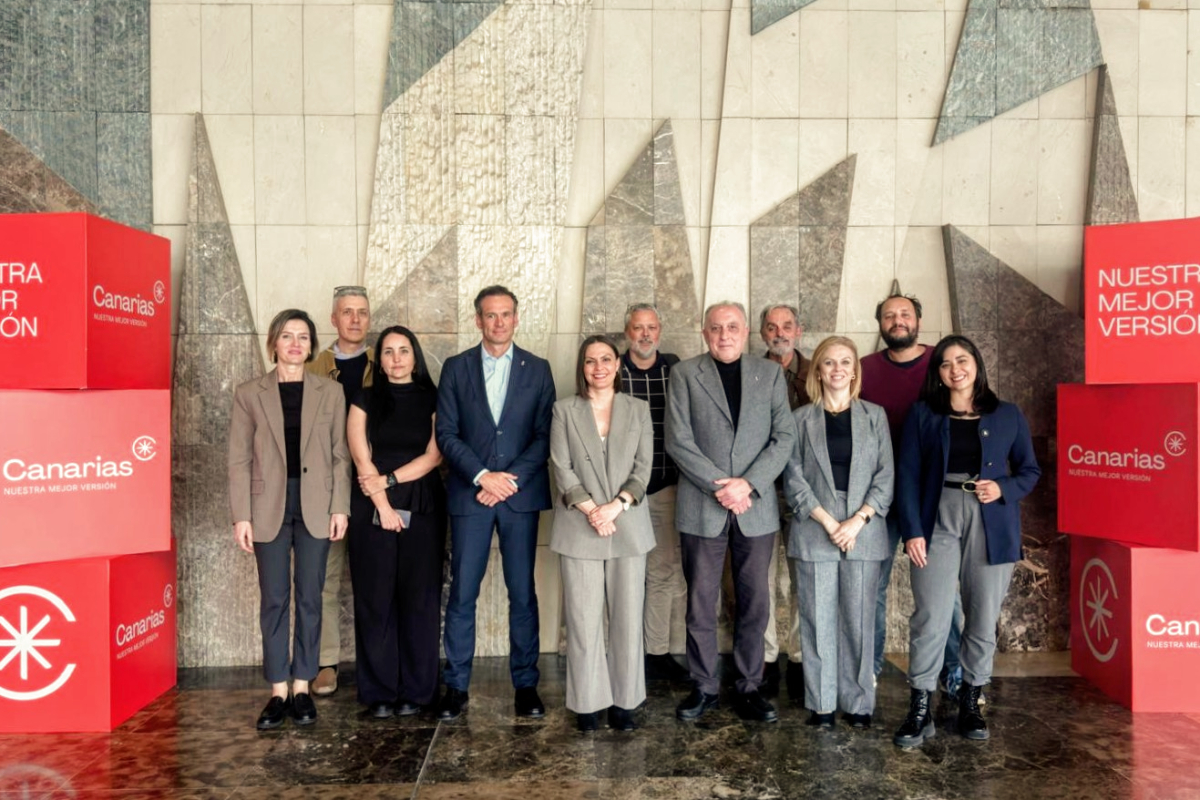
The University of La Laguna is participating this week in the Transfiere Forum, the leading European event dedicated to R&D&I, which is celebrating its 15th edition in Málaga. The Vice-Rector for Research and Transfer, Antonio Aparicio Juan, attended accompanied by a delegation from the University of La Laguna's Knowledge Transfer Office (OTC), headed by its director, Rebeca Baz Dávila, and another from the General Foundation, led by its manager, Julio Brito Santana.
For Aparicio, the Transfiere Forum represents a key space for exploring collaborative strategies with institutions, companies, and consultancies, as well as for strengthening the visibility of the work carried out by the University of La Laguna in the field of technological development and knowledge transfer. He also emphasizes the importance of participating in a cohesive manner under the Canary Islands brand and the institutional umbrella of the regional government.
Within this coordinated ecosystem, the following entities have been present: the Presidency of the Government, the Ministry of Universities, Science and Innovation, the two public universities of the Canary Islands and their respective foundations, the island councils, the Institute of Astrophysics of the Canary Islands, the Technological Institute of the Canary Islands, the public company Proexca, the science and technology parks and representatives of the archipelago's business fabric, forming a joint presence that reinforces the strategic positioning of the Canary Islands in the field of R&D&I.
The Vice-Rector participated in the round table discussion “Geothermal Energy and Space: Innovation, Technology Transfer, and Business Opportunities” alongside the Island Councillor for Research, Innovation, and Development of the Tenerife Island Council, Juan José Martínez Díaz; the Business Development Manager of Telepazio Ibérica, Ignacio Sidrach-Cardona Martínez; and the Director of Disa Renovables, Joaquín Gurriarán Florido. The discussion was moderated by Olga Martín Pascual, Managing Director of the Tenerife Science and Technology Park.
During the debate, various strategies were analyzed to promote the transfer of this interdisciplinary knowledge, encouraging the transformation of technological developments generated in academia into disruptive business solutions. According to Aparicio, these are strategic areas that the Canary Islands should strengthen in close collaboration with public administrations. “It’s a topic that generates great excitement and interest, not only because of the development of aerospace technology, but also because of its connection to renewable energies and the role that geothermal energy can play in our archipelago.”.
ULL Projects
The university is also represented by a team of researchers at various stages of developing innovative initiatives, whether through service-oriented platforms, the creation of startups, or as part of established spin-off companies. Among these projects, Energy RIS stands out, a business initiative specializing in the development of solutions for the management and optimization of renewable energies, led by Professor Ricardo Guerrero Lemus of the Department of Applied Physics.
José Manuel Padrón, Professor of Organic Chemistry and Director of the Antonio González University Institute of Bio-Organic Chemistry (IUBO), is also participating in the Transfiere Forum with the presentation of MIDA (Dynamic Phenotypic Screening Platform with AI for Drug Discovery), a technological solution designed to address one of the main challenges of the preclinical phase: the early identification of the Mechanism of Action (MoA) of candidate compounds. Padrón explains that this proprietary technology integrates high-resolution, label-free microscopy with advanced AI algorithms.
For his part, Professor of Engineering Jonay Toledo Carrillo presented the progress of MIA, a project focused on the intelligent automation of agricultural tasks, particularly on banana plantations. The project is currently developing a functional prototype of an autonomous robot to perform these tasks, which will be tested on farms to validate its performance in the field.
On the other hand, Manuel Rodríguez Díaz, from the Physiology Section of the Department of Basic Medical Sciences and the Institute of Biomedical Technologies, is attending this meeting with a project focused on developing an innovative treatment to slow the progression of neurodegenerative diseases by restoring mitochondrial activity. The research stems from evidence that the deterioration of mitochondria, essential organelles responsible for producing most cellular energy and particularly important in the brain, is one of the key factors associated with aging and the development of neurodegenerative diseases.

 Spanish
 English
 French