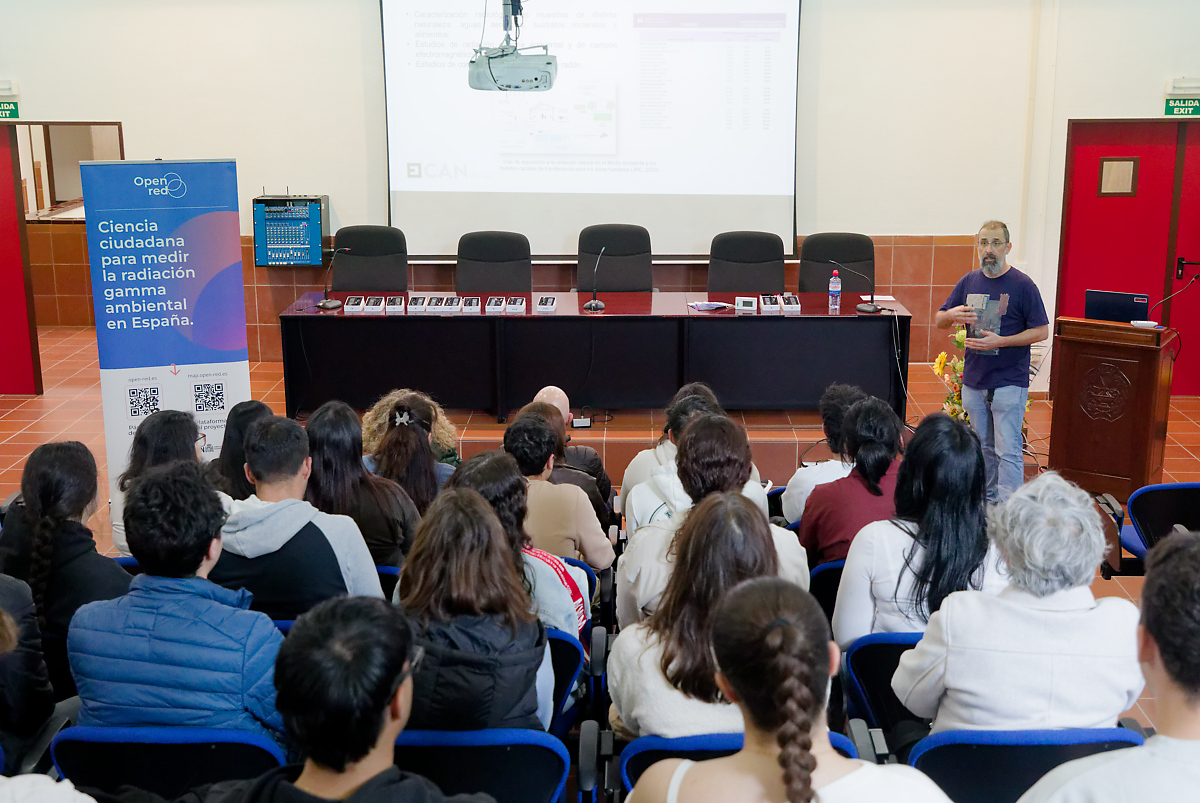
The University of La Laguna hosted the presentation of the measurement campaigns yesterday, February 25th. Openred Tenerife-ULL, an initiative that combines scientific research and citizen participation to measure ambient gamma radiation in everyday environments. The meeting took place in the Lecture Hall of the Chemistry Department at the Faculty of Sciences.
The project is part of “Openred Missions: Canary Islands (Tenerife)” and aims to create a citizen network capable of measuring and sharing data on environmental gamma radioactivity in Spain, while promoting an informed culture around radiological protection.
In the Canary Islands, the project has the logistical and technical support of the Ibercivis Foundation and the Laboratory The Medical Physics and Environmental Radioactivity Department of the General Research Support Service (SEGAI) at the University of La Laguna is the only accredited laboratory in the Canary Islands for radiological measurements. This department performs radiological characterization of samples in various environmental matrices such as water, soil, and air, as well as environmental gamma radiation studies, electromagnetic field analyses, and radon gas concentration determinations.
Pedro Ángel Salazar Carballo, The professor, a tenured lecturer at the University of La Laguna and co-director of the Laboratory of Medical Physics and Environmental Radioactivity, stated that "this is a project for the public, allowing them to see how science is done in real time." He also noted that the devices will allow "anyone interested in radioactivity to carry them and take measurements." A greater number of readings will allow for better radiation assessments.
For his part, Ignacio Sáez Martínez, a researcher at the University of Zaragoza, emphasized that Openred is an example of citizen science that seeks to "unite science and the public" through the generation of high-quality data. He also highlighted that the project has a national scope and that its arrival in the Canary Islands is in response to the objective of completing and updating the map of ambient gamma radiation. "We are creating the national measurement network, and the more people who participate, the greater the coverage and the quality will be," he added.
Gamma radiation is a form of ionizing radiation that occurs naturally, for example, in building materials, and also artificially, resulting from certain human activities. Although we are exposed to it daily, it is often largely unknown. Openred aims precisely to bring scientific knowledge closer to the public, explaining how it is measured and what the data really means.
During the first two years of the project, the team worked on creating the necessary technical infrastructure, from analyzing international experiences to evaluating various low-cost devices to ensure reliable measurements. The Polytechnic University of Catalonia (UPC) carried out the device analyses.
Openred has been inspired by initiatives such as Safecast, which originated in Japan, and OpenRadiation, promoted by the regulatory body ASRN in France, which demonstrated the potential of citizen science to generate collective knowledge about environmental radiation.
In the campaigns The study, which will take place in Tenerife between March and May, will involve participants using the Radiocode 102 detector, a commercially available device that records gamma radiation and provides data such as dose rate, cumulative dose, and energy spectrum. Each user will carry the device in a pocket or backpack and record geolocated measurements using the Openred application or a microcontroller with geolocation capabilities.
The routes and areas of interest will be decided by the participants themselves, who will create a profile on the Openred platform to upload their measurements, including the option to record the energy spectrum. All data will be available on the platform for later analysis.
The initiative is organized by the Ibercivis Foundation and the Nuclear Safety Council, and also involves the Polytechnic University of Catalonia, the University of Zaragoza, the Center for Energy, Environmental and Technological Research and the University of Cantabria.

 Spanish
 English
 French