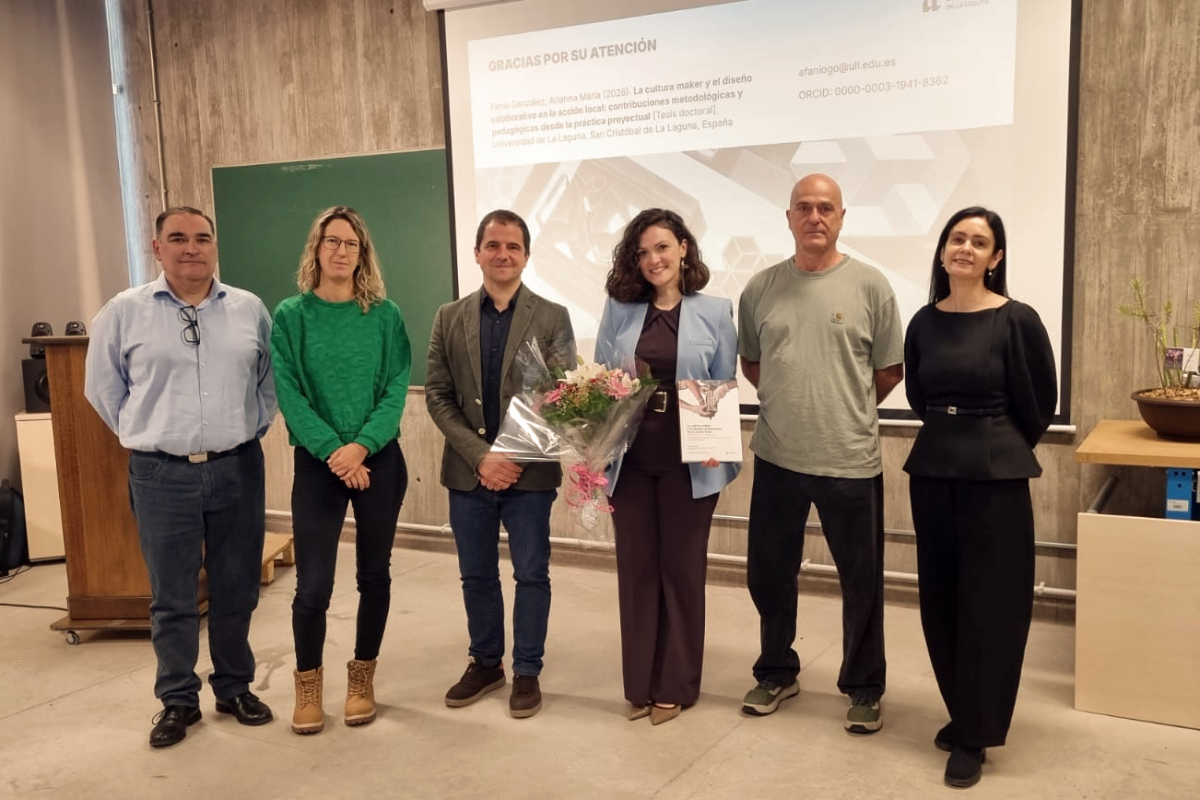
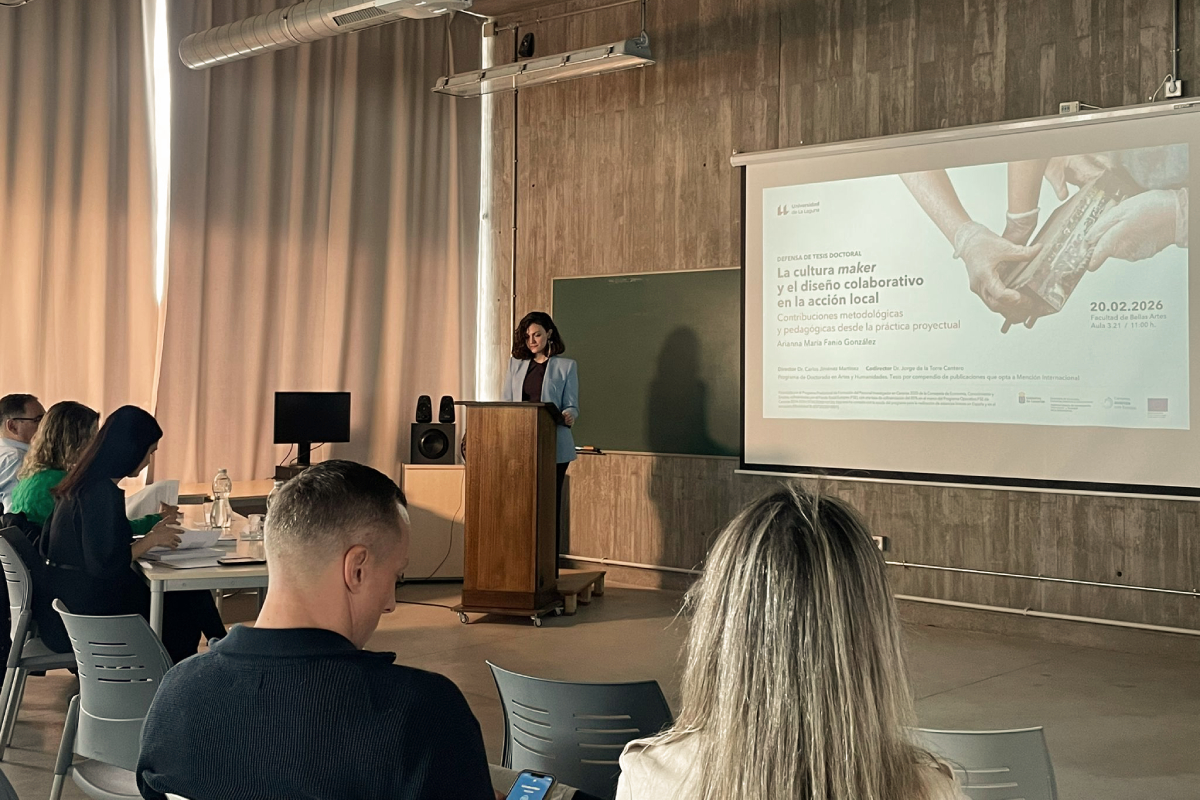
The University of La Laguna recently hosted the doctoral thesis defense of Arianna Mª Fanio González, entitled “The culture maker and collaborative design in local action: methodological and pedagogical contributions from project practice”, carried out in the doctoral program in Arts and Humanities and directed by Carlos Jiménez Martínez, from the Department of Fine Arts, and Jorge de la Torre Cantero, from the Department of Techniques and Projects in Engineering and Architecture, both at the University of La Laguna. The work analyzes the potential of culture maker as a tool to activate design practices with social impact in the Canary Islands, with an approach based on digital fabrication, collaboration and open knowledge
The research suggests that culture maker It can foster the generation of new connections within the social fabric, the readaptation of sociocultural knowledge, and its application in teaching and learning processes. These results are the fruit of applied design research focused on processes, relationships, and territory, which moved beyond exclusively technical perspectives and integrated these approaches into artistic educational practice as an ethical and design framework.
The work was structured in three phases. First, the first map of the ecosystem was created. maker of the archipelago, identifying 38 initiatives, analyzing their socio-technological orientation and organizational structure, as well as four cases social maker in Tenerife. Secondly, a case study was conducted focusing on the neo-artisanal reconversion of hydraulic tiles—a semi-industrial practice that has practically disappeared in the Canary Islands—using digital design and manufacturing technologies. Finally, the integration of cultural principles was explored. maker in university education through teaching interventions in the Bachelor's Degree in Design from the University of La Laguna.
In addition to the aforementioned mapping of the area maker Canarian, another notable result of the thesis has been to demonstrate how the culture maker can act as an ethical and methodological framework in design practices, fostering collaboration between academia and territory.
The research also offers new perspectives on the neo-artisanal reinterpretation of hydraulic tiles from an educational, open, and distributed approach, drawing on local knowledge. The results show that these methodologies can contribute to strengthening the connection between universities, heritage, and local communities, fostering social innovation processes adapted to the archipelago's territorial characteristics.
This doctoral thesis, presented as a compilation of publications, includes five previously published scientific articles and a research chapter dedicated to ecosystem mapping. maker. Furthermore, the process generated open tools, replicable methodologies, and educational experiences that are shared in open access.
 A way of thinking about design
According to the author, “this research shows that culture maker It should not be understood solely as a set of technologies, but as a way of thinking about design from the perspective of collaboration, open knowledge, and connection with the immediate environment.”
The study also highlights the potential of these methodologies in micro-scale contexts, where territorial proximity facilitates the creation of collaborative networks, knowledge transfer, and the activation of social innovation processes.
The thesis provides contributions in four main dimensions —empirical, methodological, theoretical and applied— and opens new lines of research around collaborative design, neo-craftsmanship and knowledge transfer between university and society.
The research was defended on Friday, February 20, 2026, and received the highest distinction, Summa Cum Laude, and an International Mention, following a research stay at the Politecnico di Milano. The examining committee was composed of Jimena Alarcón Castro (University of Bío-Bío, Chile) as president, and Cecile Meier (University of La Laguna) as secretary and Pedro Hernández Castellano (University of Las Palmas de Gran Canaria) as member.
The thesis was a beneficiary of the Predoctoral Program for the Training of Research Personnel in the Canary Islands 2020, financed by the Ministry of Economy, Knowledge and Employment and co-financed by the European Social Fund, which also supported the completion of the international stay.

 Spanish
 English
 French