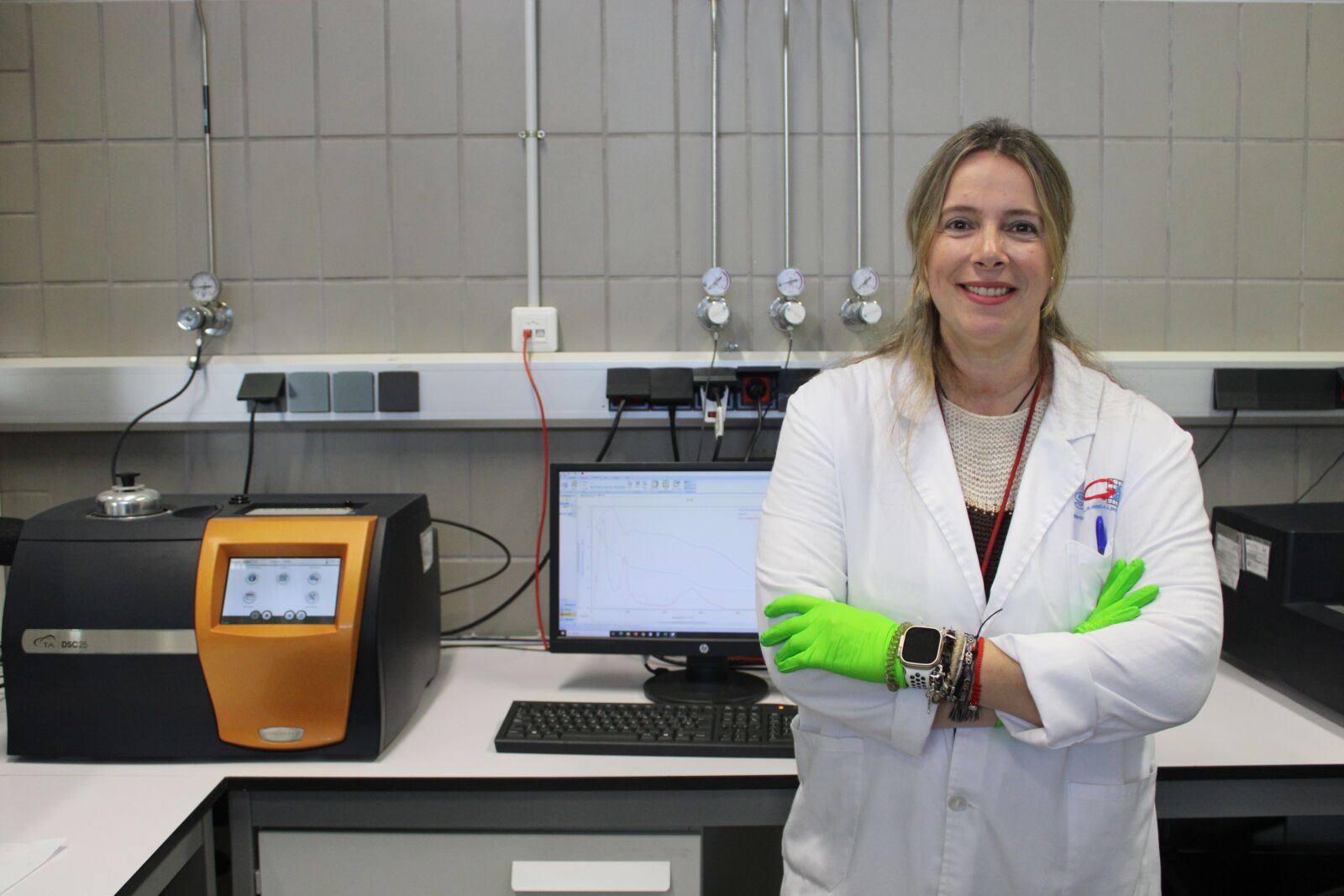
He General Research Support Service (SEGAI) The University of La Laguna has the Thermal Analysis Service (SAT), A unit specializing in the thermoanalytical characterization of materials by studying their behavior under controlled variations in temperature or time. In recent years, it has managed around 500 tests annually, corresponding to approximately 150 analysis requests from university research groups, public research organizations, and private companies.
The SAT (Symbol Analysis Test) encompasses a set of techniques that allow the determination of mass changes, energy variations, and decomposition processes as a function of temperature and time, as well as the identification of gases released during tests using mass spectrometry. Its applications span fields such as the pharmaceutical industry, 3D printing, construction materials, biomass energy recovery, and heritage conservation.
Thermal analysis is a key tool for understanding how materials behave under changing temperature conditions. This information is essential for optimizing industrial processes, improving product quality, and ensuring stability and safety under real-world use. Thanks to a combination of techniques that allow for the simultaneous measurement of mass changes, energy variations, and the identification of gases released during testing, the Thermal Analysis Service (SAT) offers strategic support across a wide range of sectors.
The service features a simultaneous thermal analyzer that allows for the synchronized measurement of mass change (thermogravimetry, TGA) and heat flow (differential scanning calorimetry, DSC), providing complementary information on physical and chemical processes. It also includes a differential scanning calorimeter for the precise study of phase transitions, determination of characteristic temperatures, associated enthalpies, and heat capacity.
The characterization is completed with the SAGI 200 quadrupole mass spectrometer, coupled to the TGA system, which allows real-time analysis of the gases released based on their mass/charge ratio (m/z), during decomposition or thermal reaction processes, providing additional information on the evolved products, says technician Judith R. Díaz.
Furthermore, it indicates that the service's operating range spans from -90°C to 1,500°C, "capable of working in inert, oxidizing, or reducing atmospheres, depending on the study's requirements." The samples, generally in quantities of a few milligrams, require minimal preparation, including the selection of the crucible (aluminum, alumina, or platinum) and the experimental conditions necessary to ensure the reliability and reproducibility of the results.
Applications
In the pharmaceutical field, it facilitates the study of compound purity, detects different crystalline forms (polymorphism), and evaluates their thermal stability. As Judith R. Díaz explains, “The same active ingredient can crystallize in different ways, and each form can exhibit differences in solubility, dissolution rate, or bioavailability. Identifying these variations is key to ensuring the efficacy and safety of the drug.”.
The SAT (Technical Analysis Service) is also used in the field of additive manufacturing and 3D printing. “Accurately determining parameters such as the glass transition, melting, and crystallization of the polymer is essential for correctly adjusting processing conditions,” the technician points out. These studies can prevent structural failures and optimize both the mechanical and thermal performance of printed parts. “Many times, companies use the service to perform material quality control so they can continue developing their prototypes with greater confidence,” says Judith R. Díaz.
It is also very useful for studying materials for energy storage, such as phase-change materials (PCMs) and ionic liquids. “Tests have been carried out with phase-change materials applied to sustainable construction, capable of absorbing and releasing heat through melting and solidification processes, contributing to smart thermal insulation and reduced energy consumption.” Furthermore, studies are being conducted with ionic liquids and other advanced materials aimed at energy storage and pollutant capture, in line with current sustainability challenges.
Furthermore, she participates in research related to energy efficiency and waste valorization. In the field of biomass, thermal tests allow researchers to study how the material decomposes and releases energy. As Judith R. Díaz points out, “parameters such as moisture content, volatile matter, fixed carbon, and ash are determined, which are fundamental for optimizing pyrolysis or combustion processes and improving the production of biochar and other value-added materials.” Biochar, a carbonaceous material produced by the pyrolysis of biomass, is characterized by its high chemical stability and its capacity to retain water and nutrients in the soil, making it a product of interest for both agriculture and climate change mitigation.
The SAT also collaborates on studies related to the conservation of historical and artistic heritage. “Through thermal analysis, it is possible to evaluate the moisture content and stability of materials such as paper or cellulose, which allows us to define optimal conservation conditions and prevent degradation processes,” explains R. Díaz.
The service supports research groups at the University of La Laguna and collaborates with entities such as the Technological Institute of the Canary Islands (ITC), the Institute of Natural Products and Agrobiology (IPNA – CSIC), and the Construction Laboratories and Quality Service. It also receives requests from R&D companies on the Spanish mainland in sectors such as polymers, metal alloys, paints, and pigments. The Thermal Analysis Service has received funding from the Government of the Canary Islands through the Canary Islands Development Fund (FDCAN) in the 2019 and 2024 calls for proposals (Minerva Project), which has enabled the acquisition and upgrading of equipment.l high-level scientific equipment.

 Spanish
 English
 French