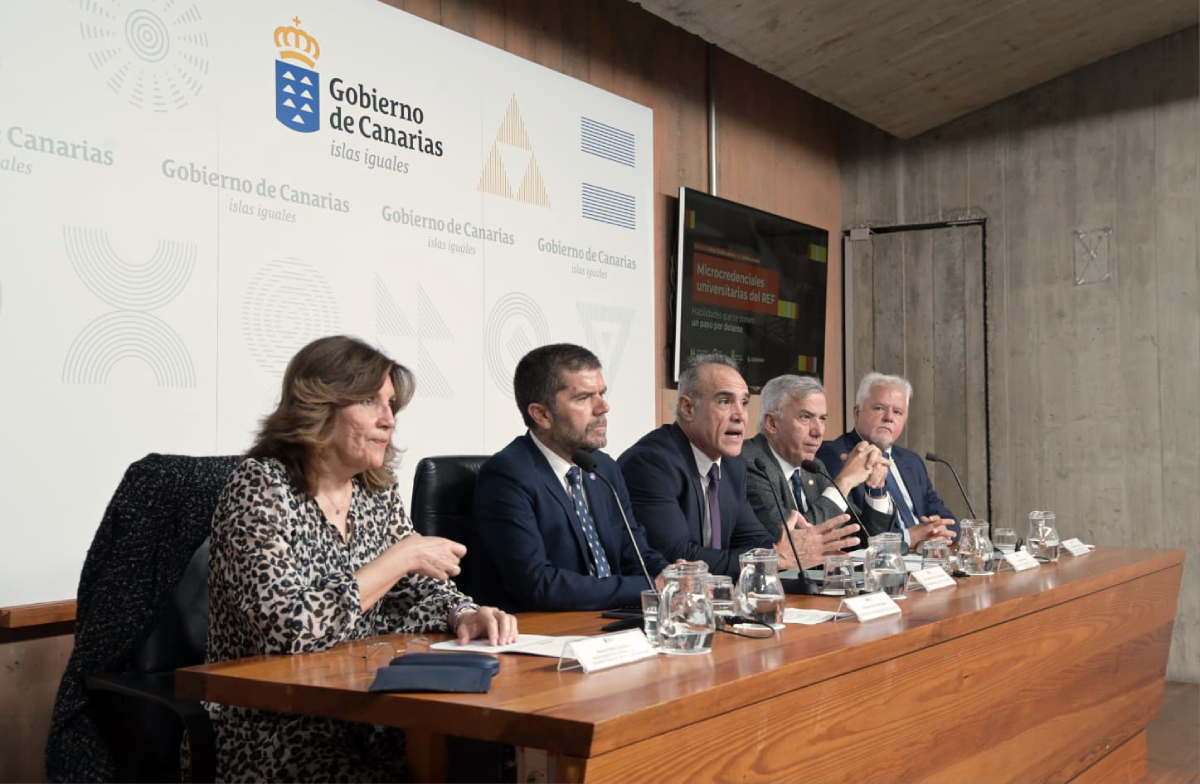
The Government of the Canary Islands, through the Commissioner of the Economic and Fiscal Regime (REF), José Ramón Barrera, has today presented the first specific inter-university training on the island's legal system, which will be taught jointly by the University of La Laguna and the University of Las Palmas de Gran Canaria (ULPGC) starting this academic year.
The REF commissioner was accompanied by the rector of the University of La Laguna, Francisco García, and his counterpart from the University of Las Palmas de Gran Canaria (ULPGC), Lluís Serra. Also participating were the project's academic co-directors: Rocío Peña, professor of Economic Policy at the University of La Laguna, and Andrés Dorta, professor of Financial Economics and Accounting and deputy director of the REF Chair at ULPGC.
During the presentation, everyone agreed that this initiative represents a significant step forward in the shared goal of bringing the REF (Special Economic Regime) closer to society. Barrera emphasized that “it is crucial to ensure that citizens understand their reality, especially at a historical moment like this, marked by uncertainty and the acceleration of economic and geopolitical changes.”.
The commissioner hopes that this new initiative “will allow the REF to move beyond the offices and into university classrooms so that future professionals and workers can understand its operation in depth, appreciate its importance, and take advantage of the tools it offers to strengthen our economy.”.
The Rector of the University of La Laguna (ULL) emphasized that the Canary Islands' Special Economic Zone (REF) is not a gift, but rather a set of economic and fiscal measures aimed at promoting the archipelago's economic and social development to compensate the islands for their structural limitations. "But for its proper use," he said, "it is essential that socioeconomic stakeholders and the general public understand it and use it appropriately." With this initiative, he indicated, "I believe that public universities are taking a major step in that direction, collaborating with the REF Commissioner to ensure that professionals understand the foundations of the Canary Islands' differentiated treatment and are able to integrate this knowledge into their professional practice." He added that with this initiative, "we are also contributing to addressing one of the major challenges facing the Canary Islands' economy: improving its productivity.".
To this end, Francisco García indicated that one of the university microcredentials will be offered, "a powerful tool that takes the form of short-term training courses, adapted to working people, linked to professional skills, and which are cumulative and digitally certifiable." He added: "At the University of La Laguna, we have launched an ambitious microcredential program, which includes the ones we are presenting today, with a public-private partnership model, both in design and delivery. This will allow us to issue more than 2,000 qualifications this year, thanks to the Microcreds Plan, promoted by the Ministry and the Regional Ministry of Universities.".
For his part, the Rector of the University of Las Palmas de Gran Canaria (ULPGC) referred to the “moment of profound transformation of the European model of higher education” currently underway. “Today we talk about lifelong learning, the constant updating of skills, and agile adaptation to changing economic and regulatory environments in order to develop and be trained with the most in-demand skills of our time. In this context, university micro-credentials constitute a strategic tool. They are short, specialized, digital, and flexible courses, designed to respond quickly to specific needs in the professional environment.”.
Serra emphasized that “these first inter-university micro-credentials also represent an example of effective cooperation between public universities in the Canary Islands. The connection with the productive sector is direct and evident. The REF (Special Economic Regime) has an impact on business activity, tax planning, investment, public financing, and the economic development of the archipelago.”.
Both the rectors and the co-directors of the micro-credential program on the island's legal system, Rocío Peña and Andrés Dorta, highlighted the importance of uniting the two public universities of the archipelago in this project with a clear Canarian focus, and doing so to respond to what the productive sector demands, reinforcing training in an area that is increasingly relevant to economic activity and public management in the Canary Islands.
The initiative seeks to disseminate knowledge of the REF in a cross-cutting manner, traditionally present in degrees in Economics, Business Administration and Management (ADE) and Law, so that it reaches university students of all degrees and is also open to public and private sector workers interested in acquiring new skills with real application at the economic, social and institutional level.
The training will be online, with flexible scheduling and structured into seven independent courses called micro-credentials. Each student can personalize their learning path according to their interests. By completing one or more micro-credentials, they can improve their employability, prepare to take on new responsibilities, or redirect their professional profile. If they choose to complete at least 15 of the 17 credits offered—recognized under European quality standards (ECTS)—they will be eligible for a specific qualification, certified by the ULL and the ULPGC.
A prior university degree is not required for admission. It will suffice to have completed high school, hold a higher-level vocational training qualification, or demonstrate work experience in administrative, accounting, tax, or management tasks.
Each micro-credential will have a minimum of 15 places and a maximum of 25. The contents of the micro-credentials will address the origin of the Canary Islands' legal system and its legal regime, the differentiated taxation of the Canary Islands and other special regimes, indirect taxation and its contribution to local financing, the Canary Islands Investment Reserve (RIC), the Canary Islands Special Zone and the contribution of the REF to regional development.
This new training program will not only contribute to improving professional qualifications in areas where knowledge of the Canary Islands Special Regime (REF) is increasingly necessary, but will also empower teachers, especially through a module dedicated to teaching methodology. Teachers are a strategic target audience for this initiative because they are able to ensure that the Canary Islands Special Regime expands and reaches an ever-growing number of people.
The microcredentials model aims to open the university to society by offering training aligned with the demands of the labor market and the need for continuous learning among workers. The knowledge economy requires constant professional development, meaning that the profile of the university student is no longer limited to the 18-24 age range, but extends throughout their entire working life.

 Spanish
 English
 French