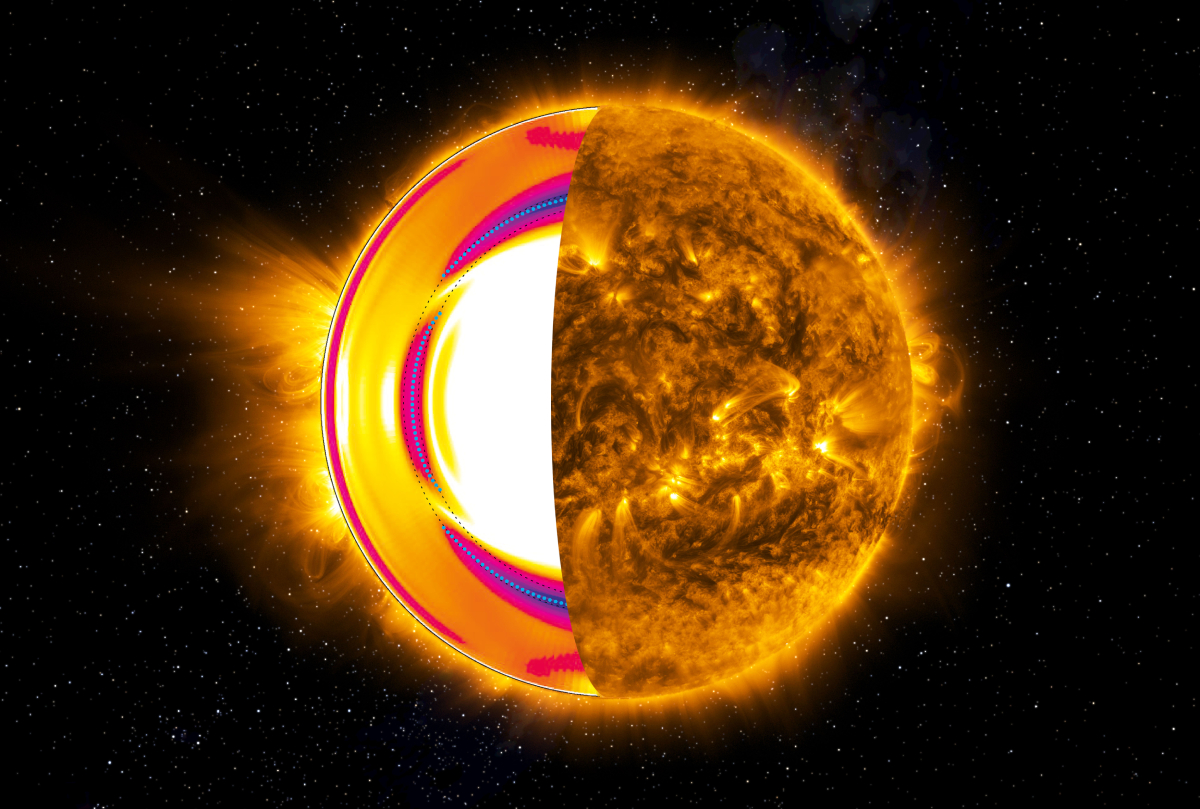
An international team composed of Dr. Sylvain G. Korzennik, from the Center for Astrophysics | Harvard & Smithsonian, and Antonio Eff-Darwich Peña, from the University of La Laguna and the Institute of Astrophysics of the Canary Islands, has published a pioneering study Aimed at improving our understanding of the Sun's internal structure, the work, published in The Astrophysical Journal, is notable for its use of exceptionally long helioseismological time series, exceeding twenty-five years of continuous observations, to analyze the Sun's deepest layers. Helioseismology studies the oscillation patterns on the solar surface over time. Like any musical instrument, the characteristics of these vibrations depend on the physical properties of the Sun's interior.
The work focuses specifically on the solar tachocline, a thin layer located about 200,000 kilometers below the solar surface, where temperatures reach approximately 2 million degrees Celsius. Within this layer, the transition between two distinct rotational regimes takes place, a key phenomenon for understanding fundamental processes such as the generation of the solar magnetic field and the mechanisms that drive the Sun's activity cycle.
By characterizing this transition layer with unprecedented precision, the research addresses one of the classic challenges of solar physics. To achieve this precision, data from three complementary instruments were analyzed: the GONG ground-based network, operated by the National Solar Observatory, which has six instruments, one of which is located at the Teide Observatory; the MDI instrument aboard the ESA/NASA Solar and Heliospheric Observatory (SOHO) space satellite; and the HMI instrument aboard NASA's Solar Dynamics Observatory (SDO) satellite.
Processing this enormous volume of data required the use of innovative numerical techniques specifically designed for this study, including simultaneous algebraic reconstruction and the implementation of computational meshes with a much higher radial density than usual. These methodologies improved the resolution of the results while keeping the amplification of observational noise under control, an essential aspect when studying structures as subtle and deep as the tachocline. Reflecting on the significance of this type of research, Eff-Darwich emphasized: “It still seems incredible to me that we can explore what happens hundreds of thousands of kilometers beneath the surface of the Sun, which is itself about 150 million kilometers from Earth.”.
Beyond its relevance to fundamental physics, studies of this kind are essential for further improving our understanding of space weather—that is, monitoring the impact of the Sun's magnetic activity on Earth. The tachocline is closely linked to the processes responsible for solar magnetism, which, when they reach the surface, give rise to solar storms and coronal mass ejections that can affect our technological infrastructure. Among other things, the study suggests that the tachocline's position shows a discontinuity between low and high latitudes, revealing a more complex internal structure than previously thought. The results of the work also indicate that this layer could be extremely thin, possibly less than one percent of the Sun's radius.
The study also explores possible temporal variations and concludes that, although the available data do not yet allow for the definitive detection of changes associated with solar activity, it is necessary to continue developing these analytical tools to deepen our understanding of the Sun's internal dynamics and improve our ability to understand and, therefore, anticipate the effects of solar activity on Earth. In Korzennik's words: "This new measurement will further puzzle theorists and modelers when they try to explain why the tachocline is the way it is.".

 Spanish
 English
 French