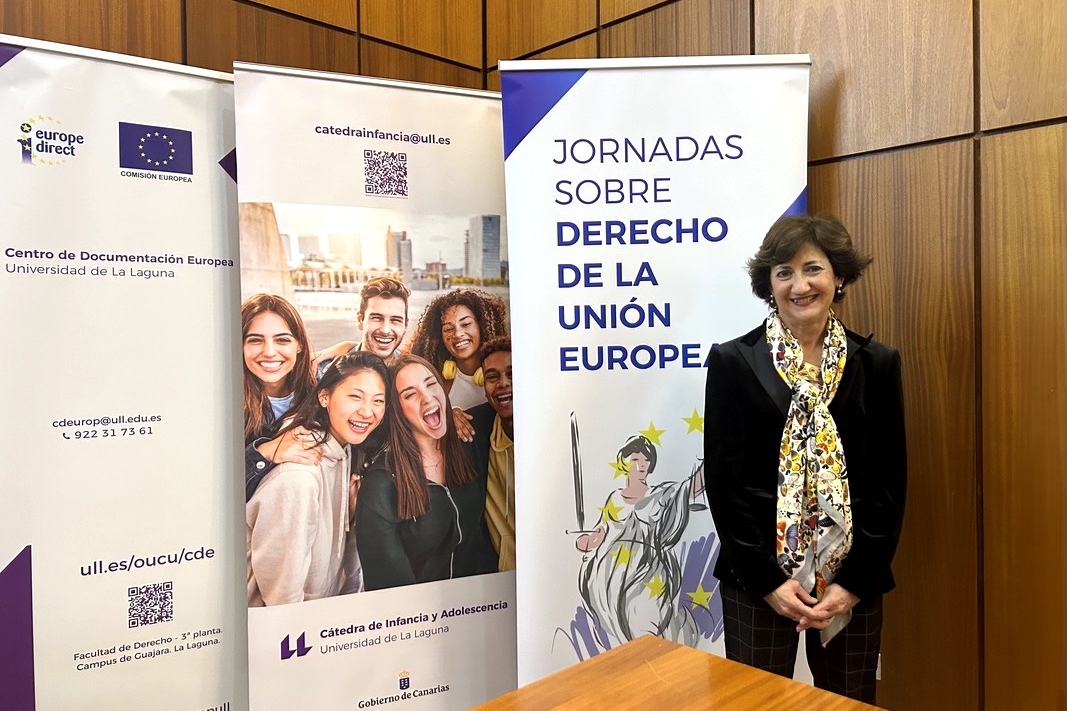
The Francisco Tomás y Valiente Hall of the Faculty of Law of the University of La Laguna hosted last Friday, March 6th the XV Conference on European Union Law, organized by the Law school and the European Documentation Centre, consolidating an academic event that has been held annually since 2010. The event was inaugurated by the Dean of the Faculty of Law, Dulce Cairós Barreto, who highlighted the value of these Conferences and thanked the speakers, moderators and directors for their work.
These events were held in collaboration with Institutional Chair of Childhood and Adolescence at the University of La Laguna which made it possible to deliver the presentation “Identity and non-discrimination: some certainties and many uncertainties in the determination of parentage”, by Roncesvalles Barber Cárcamo, Professor of Civil Law at the University of La Rioja, and moderated by María Aránzazu Cazadilla Medina, in which he brilliantly analyzed the current legal challenges in Spain and for the European Union regarding the right to identity of the person and the determination of parentage.
During her presentation, the professor explained that social changes and the emergence of new family structures have generated legal debates surrounding the determination of parentage. In this regard, she pointed out that family law must adapt to increasingly diverse family models, guaranteeing children's right to their identity and preventing any form of discrimination based on their origin or the type of family they belong to.
The speaker analyzed a regulation currently being drafted in the European Union: the Proposal for a Council Regulation on parentage, published at the end of 2022, which aims to protect children's right to a single identity within Europe. Therefore, it seeks to ensure the recognition in all Member States of parentage established in one of them. While this objective may seem obvious, its proper approach from the necessary legal perspective reveals its complexity, as it is multifaceted and affects one of the few areas of family law where uniform international standards do not exist: parentage by birth.
To provide a proper framework for this project, the most relevant and current issues in determining parentage in Spain were outlined, such as the prevailing concept of recognition, dual maternity, and surrogacy. All of these reveal a tension between the will of the child, as the basis for determining parentage, and the child's right to identity, or more precisely, the child's right to identity.
Finally, Barber Cárcamo emphasized that the right to identity goes beyond simply recognizing the same parentage in all states. She explained that a child knowing who they are, where they come from, and the origin of their birth is fundamental to the development of their personality. In this sense, she argued that it is a matter deeply linked to identity and societal values. The professor expressed confidence in the capacity of legal instruments to address these challenges, although she insisted on the need to approach these issues from a technical and legal perspective, setting aside ideological positions and acting with the sensitivity that such a matter demands.

 Spanish
 English
 French