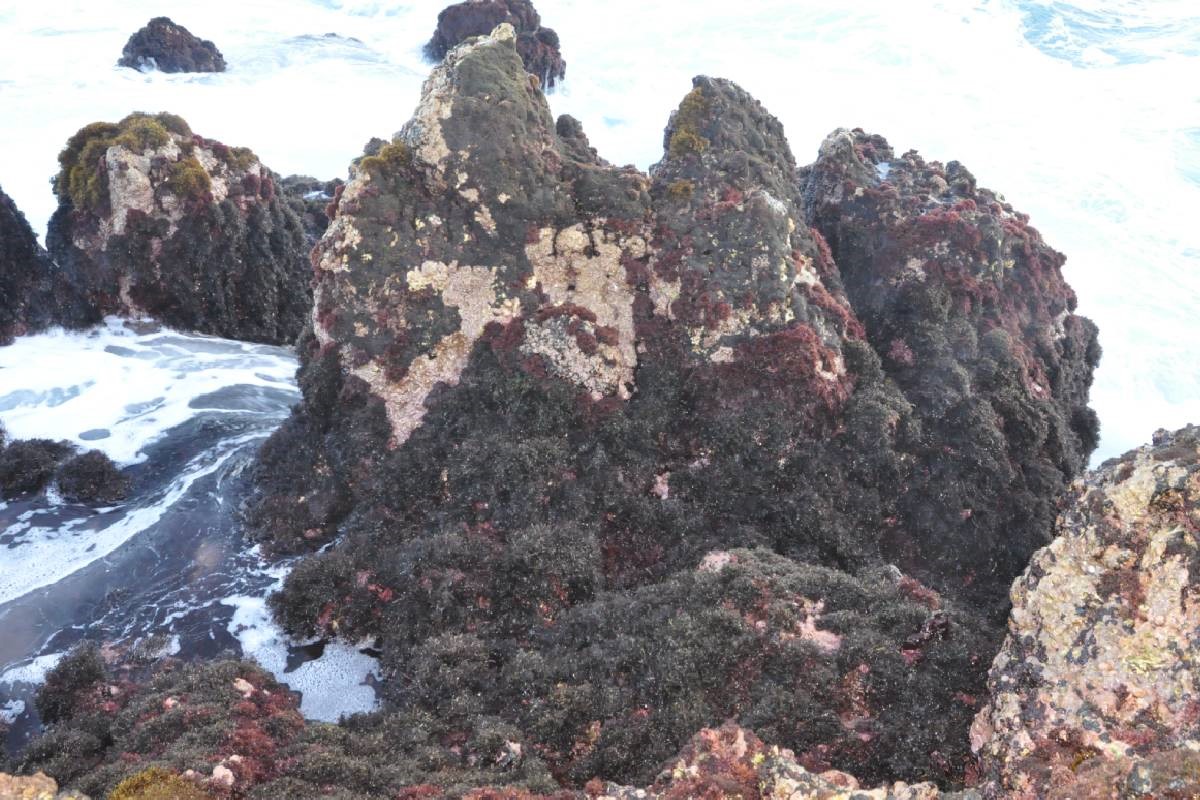
The marine biodiversity of the Canary Islands is at risk due to the sharp decline in gelidial red algae, which are essential for the health of coastal ecosystems and for absorbing carbon, including the Gelidium canariense, It is especially vulnerable. It is the only macroalga endemic to the Canary Islands that is in danger of extinction due to climate change, and is only found in cold and shaded areas of northern La Palma, La Gomera, Tenerife and Gran Canaria.
To halt this loss, the University of La Laguna, with funding from the Biodiversity Foundation and the European Regional Development Fund (ERDF), has launched the Project GELIROCK (Refuges of declining biodiversity: characterization of priority areas for the conservation of the gelidiales community in the Canary Islands), led by the researcher José Carlos Hernández, and which includes the participation of Professor Rocío Pérez, from the University of Barcelona.
This initiative, with a budget of €501,000 and which will be carried out until the end of 2028, aims to assess its current state, map the distribution of the community and its populations and identify priority areas for its conservation and restoration, with the objective of promoting specific protection measures on the Canary coast.
Hernández highlights the historical importance of the Gelidium canariense. “In the north of Tenerife, especially in Puerto de la Cruz, this species was harvested for the extraction of agar because there were large wrack deposits, accumulations of seaweed on the coast, and it has the typical smell that exists in these places,” he points out.
In addition to its cultural value, the algae fulfills a crucial ecological function: “We have located more than 200 species of microinvertebrates living in these areas, spectacular specimens,” including some species new to the Canary Islands that live exclusively in these locations. These algae act as structures that house these small invertebrates, so, the researcher points out, their loss would disrupt the food chain and affect fishing activity and marine biodiversity in various areas of the Canary Islands.
The evolution of the species targeted by the project now underway has been analyzed in recent years by these specialists. A study conducted by researchers from the Marine Community Ecology and Marine Conservation and Botany research groups at the University of La Laguna, published in the journal Regional Environmental Change, confirmed that more than 90% of the populations of Gelidium canariense It has disappeared from the north coast of Tenerife in recent years. The research compared historical data from 1987 with records from 2008 and 2019 and showed that the decline of this species is directly correlated with the increase in sea and air surface temperature and ultraviolet radiation.
The publication also revealed that the areas where the species previously predominated Gelidium canariense, are now affected by the proliferation of Pterocladiella capillacea, a species with a global distribution and more resistant to the new climatic conditions. The researchers also verified that the coverage of Gelidium arbuscula has also decreased significantly, while the community dominated by the endemic Gelidium canariense It has become fragmented, affecting the entire trophic structure that depends on it.
The GELIROCK Project will combine various scientific tools, such as climate maps, satellite data, and oceanographic buoys, to address this crisis and assess the conditions that favor the survival of these algae. Furthermore, using novel population genetics techniques, researchers will study the genetic diversity of Gelidium canariense and the connectivity between populations, thus identifying the most important areas for their conservation.
Hernández compares the disappearance of these algae to what is happening in the Amazon rainforest: “We are not only losing one of the lungs of the planet, species that we have not even discovered are disappearing, and that is happening in the Canary Islands underwater,” he warns.
The project also aims to identify potential climate refuges by analyzing historical environmental conditions in the areas where these communities still survive. This will allow researchers to understand how they have evolved in relation to variables linked to climate change, such as rising temperatures and increased ultraviolet radiation.

 Spanish
 English
 French