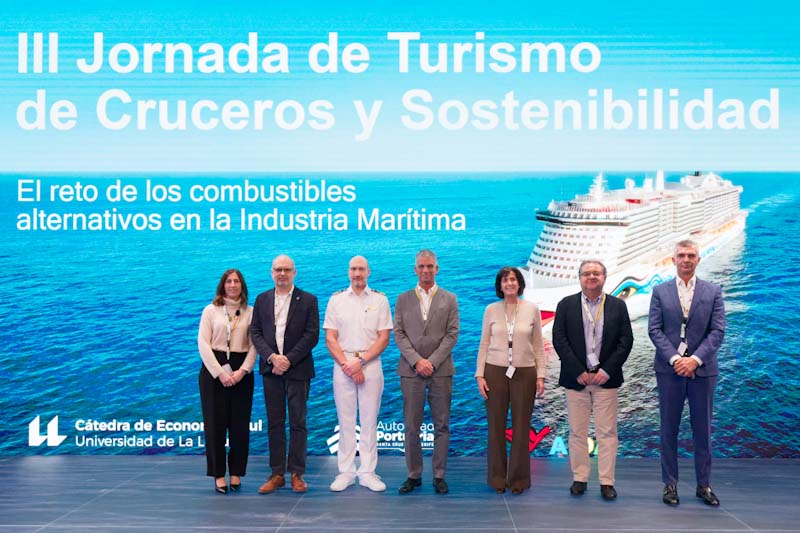
The Blue Economy Chair of the Port Authority of Santa Cruz de Tenerife and the University of La Laguna recently brought together, aboard the ship AIDAcosma, experts, public officials and representatives of the maritime sector in the III Conference on Cruise Tourism and Sustainability, focused in this edition on the challenge of alternative fuels in the maritime industry.
The opening of the event, which was attended by more than 250 people, was led by Pedro Suárez, president of the Port Authority of Santa Cruz de Tenerife, and Isabel Karely León, vice-rector of Culture and University Extension of the University of La Laguna, who offered a preview of the day that addressed one of the great challenges of current maritime transport: moving towards decarbonization without losing sight of the technical, regulatory and energy limitations that uniquely affect island and outermost regions such as the Canary Islands.
Pedro Suárez pointed out that cruise tourism is one of the largest sectors of traffic for the Canary Islands ports. Therefore, “it is important to make students aware of the numerous opportunities available to them in this sector.” In this context, he emphasized that “Ports of Tenerife aims to become the energy hub of the Mid-Atlantic. I believe this is a good starting point,‘ which will be further strengthened by the international forum on supply and sustainability being held this week at the Oceanographic Institute.
In this vein, Isabel Karely stated that this project serves as a bridge for collaboration to diagnose and analyze the challenges of the present and future, words with which Carlos Efrén Mora, director of the Blue Economy Chair, agreed, who addressed the challenge of zero emissions from cruise ships docked in port using OPS systems. “This solution is technologically viable, but in Tenerife its implementation requires a comprehensive vision that combines the electrical grid, renewable generation, storage and demand management.
The technical session began with a presentation by Benito Núñez, Secretary General for Air and Maritime Transport at the Ministry of Transport and Sustainable Mobility, who analyzed the regulatory framework governing the deployment of alternative fuels in the outermost regions. His presentation focused on European standards such as FuelEU Maritime and AFIR, as well as “structural factors that hinder the transition in the Canary Islands, including insularity, territorial fragmentation, external energy dependence, and limitations on deploying new energy and storage infrastructure. For the maritime sector in the outermost regions, the situation is more complex and requires special consideration due to its geographical remoteness,” the Secretary General stated.
Airam Díaz Pastor, Deputy Director of the Port Authority of Santa Cruz de Tenerife, focused his presentation on the role of ports in the face of new marine fuels and the opportunities and challenges Santa Cruz de Tenerife faces in this process. According to Díaz Pastor, “the bunkering service is absolutely strategic. We are focused on an energy transition. There is no debate about the need for future sustainability goals, and the energy mix gives us the opportunity to use different fuels to achieve this transition and reduce emissions in our ports.”
The round table, moderated by Santiago Yanes and featuring representatives from ENAGAS, MOEVE, the Port Authority of Algeciras, and ANAVE, analyzed energy transition pathways for maritime transport, including LNG, biofuels, hydrogen, and synthetic fuels. Participants noted that their development in the Canary Islands is hampered by limited energy and storage capacity and emphasized the need to adapt public policies to isolated island environments.
The day concluded with the presentation «Our Journey Towards Sustainability» by Captain Tommy Möller of the AIDAcosma, who highlighted key milestones such as the introduction of LNG-powered cruise ships, the use of biofuels, and the development of electrification solutions. These include the cruise industry’s largest battery energy storage system, currently 10 MWh in capacity, aboard the AIDAprima, as well as the company’s strong commitment to shore power. AIDA Cruises began using shore power in Europe ten years ago, becoming the first cruise line to do so, and through its ships and technical expertise, actively supports European cruise ports in implementing their shore power systems.
The event concluded with the presentation of a plaque in recognition of the three years of collaboration between AIDA and the crew of the AIDAcosma in initiatives such as this day.

 Spanish
 English
 French