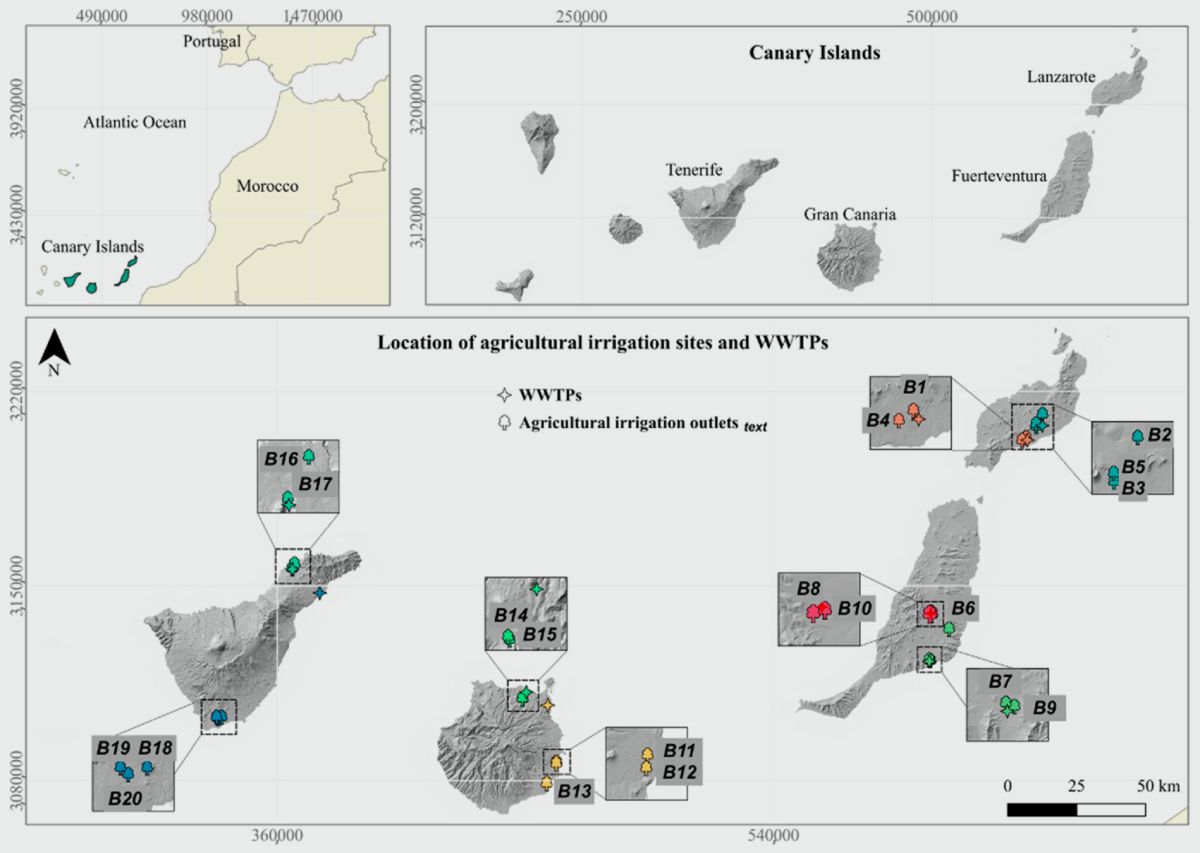
A study with the participation of the University of La Laguna, warns about bacteria resistant to carbapenems, last-line antibiotics, and other emerging pathogens in wastewater recycled for agricultural irrigation in four of the Canary Islands where the research was carried out (Lanzarote, Fuerteventura, Gran Canaria and Tenerife).
Through the approach One Health (comprehensive strategy of human-animal-environmental health interdependence), 69 bacteria were isolated, such as Pseudomonas aeruginosa, Acinetobacter y Enterobacteriaceae, The results showed that the 78% bacteria were Gram-negative and multidrug-resistant. This means they were resistant to at least three different families of antibiotics designed to eliminate them or inhibit their growth.
The sample collected shows that, although the levels of Escherichia coli They complied with the established European regulatory limits, the high presence of other Enterobacteriaceae and the detection of opportunistic pathogens such as Vibrio cholerae, Aeromonas veronii y A. hydrophila They reveal considerable microbial diversity in the reclaimed water used in the Canary Islands. According to the researchers, these findings highlight the problem of E. coli as the only parameter indicating microbiological safety, since it does not reflect the presence of non-fecal environmental pathogens.
He article “”A One Health perspective: Occurrence study of carbapenem-resistant bacteria and other emerging pathogens from recycled wastewater used in agriculture”, A study published in the journal Microbiology Research, with the participation of María Martínez-Ruíz, a researcher in the Department of Obstetrics and Gynecology, Pediatrics, Preventive Medicine and Public Health, Toxicology, Legal and Forensic Medicine, and Parasitology at the University of La Laguna, underscores the need to incorporate complementary monitoring parameters. This entails implementing appropriate post-treatment measures to protect public health and agricultural sustainability on water-scarce islands.
Water stress poses a critical challenge for many countries, but especially for isolated regions such as oceanic islands, like the Canary Islands. Desertification, high population density (278.77 inhabitants/km²), tourism (17.77 million tourists in 2024), insufficient rainfall, water losses in the network, and inadequate management are among the factors contributing to a water demand that exceeds supply. The easternmost Canary Islands experience the greatest water stress, necessitating the use of recycled wastewater in agriculture.
The results of this study demonstrate that agricultural wastewater can act as a reservoir and amplification site for multidrug-resistant bacteria, particularly carbapenemase-producing strains. Storage tanks, through biofilm formation, not only increase the total bacterial load but also promote the transfer of resistance genes. The high proportion of Gram-negative isolates exhibiting carbapenemase-mediated acquired resistance represents a significant public health concern in the context of wastewater reuse.
The researchers highlight the case of Gran Canaria, where the largest number of storage facilities on the island is associated with marked microbiological deterioration and a higher prevalence of carbapenem resistance. This suggests that environmental conditions and management practices may jointly facilitate the spread of resistant microorganisms.
Through the interdependent perspective One Health, The research on which this study is based shows that wastewater reuse in agriculture offers significant benefits in water-scarce regions, but presents interconnected risks when hygiene and sanitation measures are insufficient. This research highlights the potential transfer of antimicrobial resistance genes and underscores the possibility of contamination and entry into the food chain.
The World Health Organization (WHO) considers bacterial resistance one of the main global threats to health due to the alarming increase in infections caused by multidrug-resistant bacteria. Therefore, ensuring safe and sustainable implementation requires strengthening water treatment monitoring and improving storage and management practices. According to the research team, these integrated measures are essential to protect environmental integrity, food safety, and public and animal health.

 Spanish
 English
 French