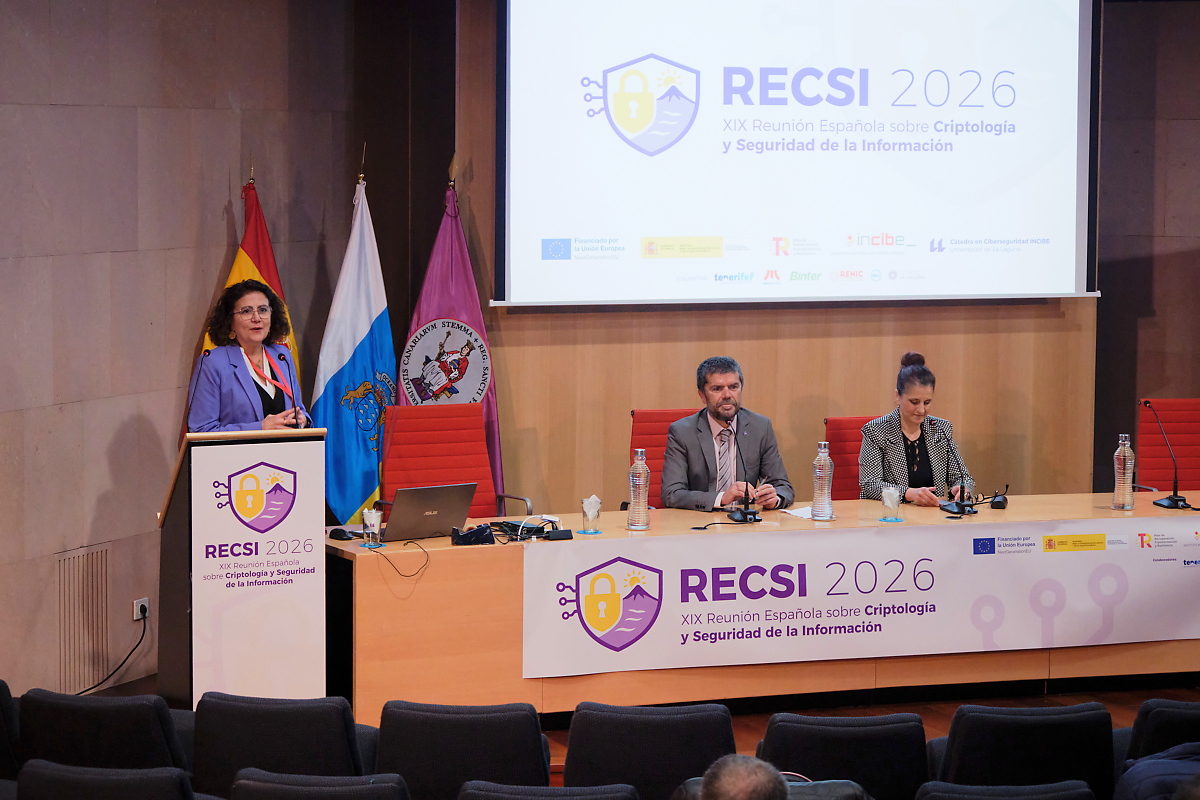
The University of La Laguna inaugurated today, March 18, the XIX edition of the Spanish Meeting on Cryptology and Information Security (RECSI 2026), the leading scientific congress in Spain in these disciplines. The biennial event, held for the second time in Tenerife, will run until March 21 and will bring together more than 180 specialists from universities and research centers, both national and international, from various European countries, as well as from China and the United States.
The opening ceremony took place in the Blas Cabrera Felipe Auditorium of the Faculty of Sciences and included the participation of the rector, Francisco García, who highlighted the current relevance of cybersecurity and the institution's academic commitment in this field: “Our university has a strong presence in cybersecurity, with chairs such as the National Cybersecurity Institute (INCIBE) and Binter Cybersecurity, a master's degree in cybersecurity, computer engineering programs and research groups focused on this area.
For her part, the Vice-Rector for Culture and University Extension, Isabel León, pointed out that the ULL is making its facilities, resources and human capital available to this event, and stressed that the theme of the meeting goes beyond the technical: “It involves the protection of rights, the guarantee of a democratic society and the preservation of trust in an increasingly interconnected world.
Also, the president of the RECSI 2026 organizing committee, the professor of the CryptULL research group: Cryptology Group, Knight Pine, He reviewed the history of the previous 18 editions and highlighted the breadth of the scientific program: “The congress is very intense, with 98 talks distributed in four parallel sessions,” which has motivated its development in different spaces of the Faculty of Sciences and the Higher School of Engineering and Technology.
Caballero also emphasized the importance of the poster sessions as a space for scientific exchange, as well as the five plenary lectures, given by Jintai Ding, dean of the School of Mathematics and Physics at Xi'an Jiaotong-Liverpool University; Paco Martín-Fernández, researcher at IBM Research; Vincent Rijmen, co-author of the international encryption standard AES; Carmela Troncoso, head of the SPRING Laboratory at the University of Lausanne (Switzerland); and Sandra Bardón, hacker and Cybersecurity Officer at the United Nations International Computing Centre.
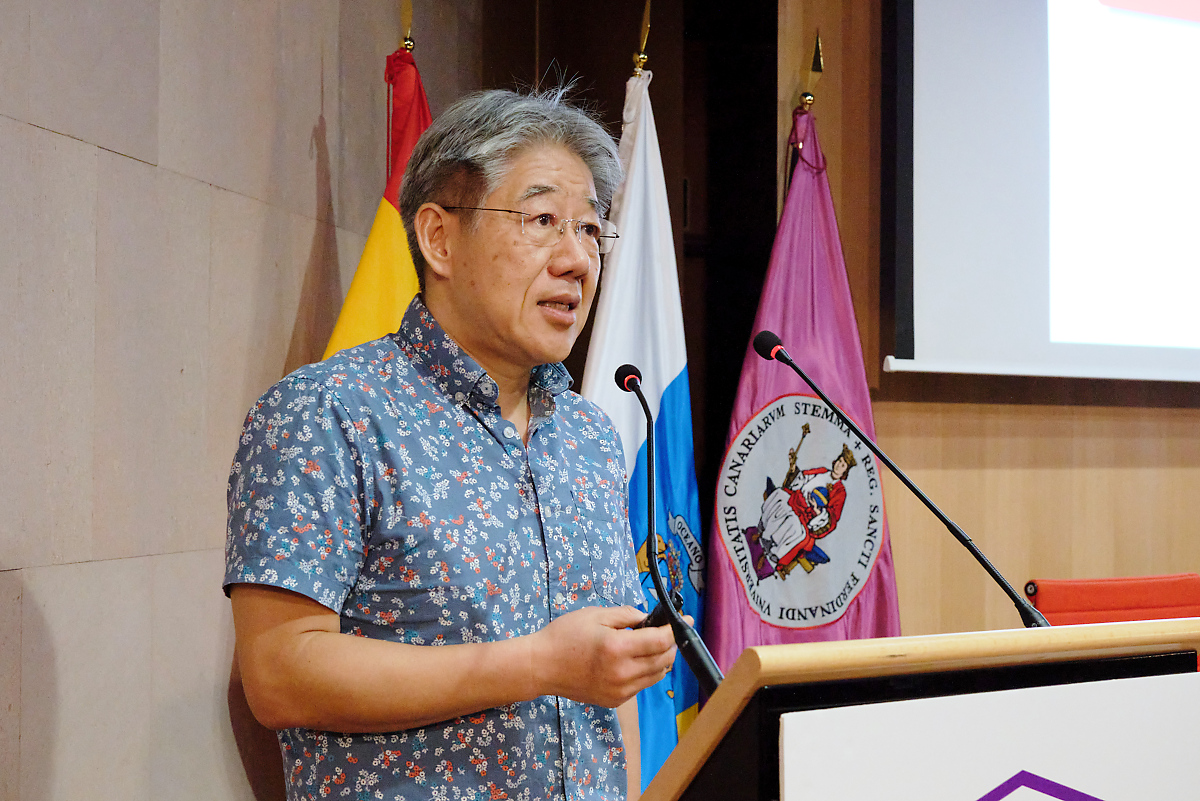
Jintai Ding, dean of the School of Mathematics and Physics at Xi'an Jiaotong-Liverpool University.
Following the opening ceremony, the conference began with a plenary lecture by Jintai Ding, who offered an overview of his career in post-quantum cryptography and explained the evolution of this discipline, from classical systems (such as the Caesar cipher) to modern cryptography based on algorithms. He also addressed current challenges such as key distribution and the impact of quantum computing. “I wanted to tell my story to explain why I work in this field,” he noted.
On the other hand, hacker Sandra Bardón said that in her plenary session on Friday the 20th, she will address the importance of simulation exercises in cybersecurity incident management. She explained that these exercises involve not only technical teams but also senior management, taking into account the strategic, legal, and organizational layers.
Bardón emphasized that these training sessions allow organizations to prepare for any incident, from cyberattacks to complex crises with operational impact, through the use of the latest tactics and techniques employed in cybercrime. “It’s not just about complying with regulations, but about preparing people to adequately handle any incident,” he explained. He also announced that his presentation would include a brief simulation with the attendees.
Apart from the plenary lectures, the congress features scientific sessions focused on the main lines of current research, such as artificial intelligence, security protocols, cryptography resistant to quantum computing or codes, among others.
The origins of RECSI date back to 1991, when its first edition was held in Mallorca. The sixth meeting took place in 2000 in the Tenerife municipality of Puerto de la Cruz. Thus, this
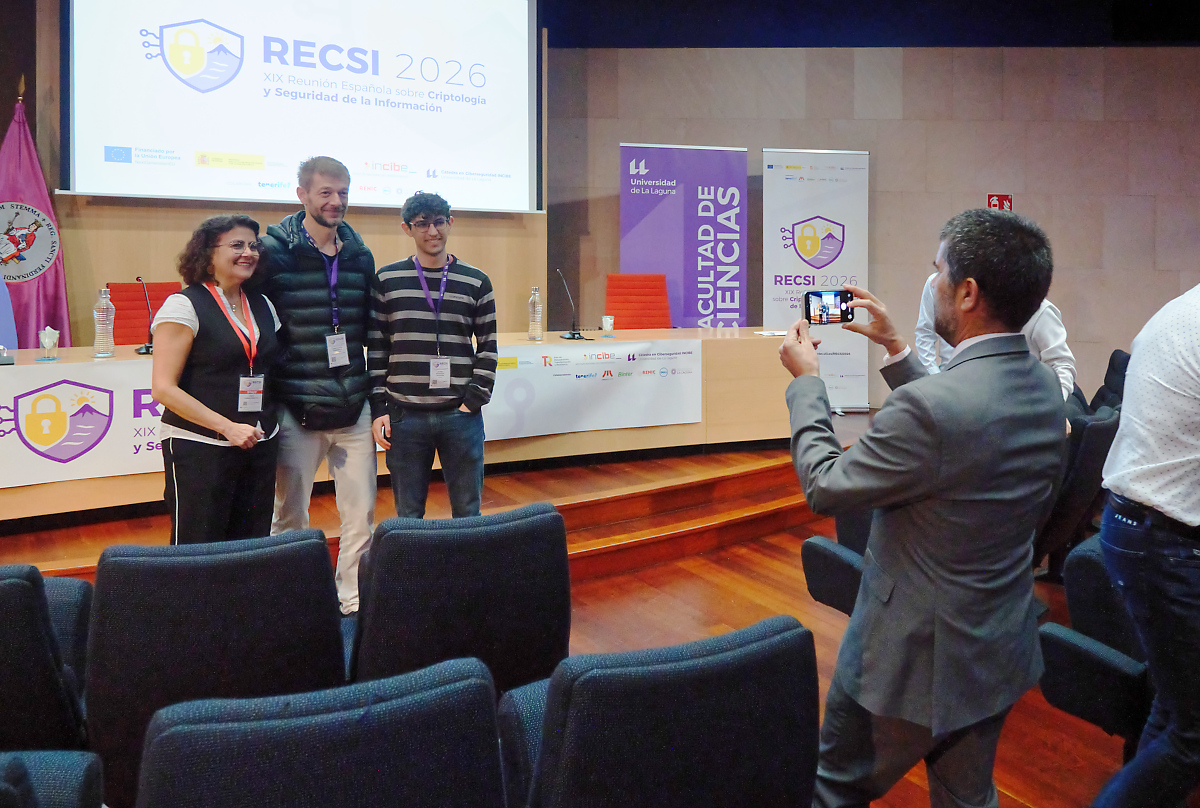
The rector takes a photograph of Pino Caballero and two of the speakers at the congress.
This is the second time that the island (in this edition, La Laguna) has acted as host of this benchmark event in cryptology and cybersecurity.
This congress is organized by the INCIBE Chair of Cybersecurity The project, led by the University of La Laguna (ULL) in collaboration with INCIBE, is part of the Recovery, Transformation and Resilience Plan funded by the European Union (Next Generation). It also has the support of entities such as Turismo de Tenerife, Metro de Tenerife, Binter, the National Network of Excellence in Cybersecurity Research, and the La Laguna City Council.

 Spanish
 English
 French