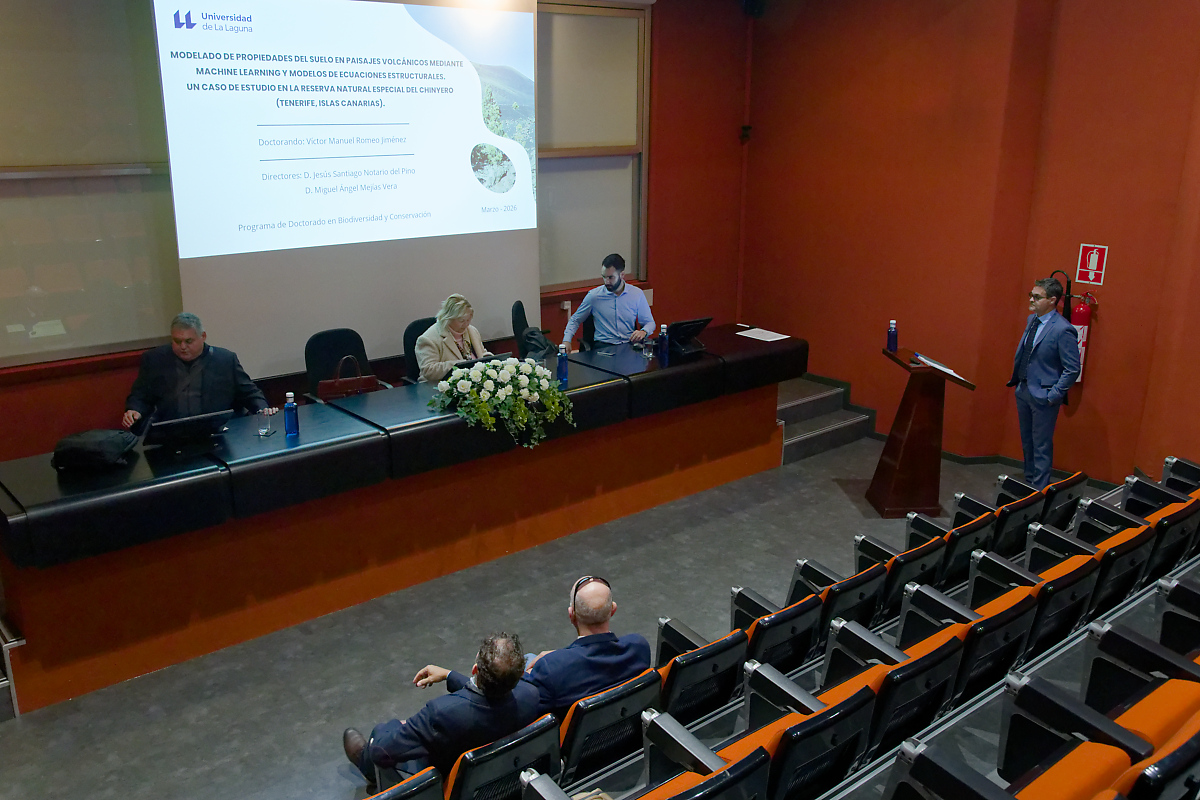
Beyond the visible volcanic phenomena, the materials ejected during eruptions give rise to soils that, over time, become the basis of numerous ecosystems and agricultural activities. Understanding how these soils form, evolve, and function is fundamental for the proper management of these territories. The doctoral thesis “Prediction of some soil properties in volcanic soils using random forest modeling: A case study at Chinyero Special Nature Reserve (Tenerife, Canary Islands)”, recently defended by Víctor Manuel Romeo Jiménez within the Doctoral Program in Biodiversity and Conservation of the University of La Laguna.
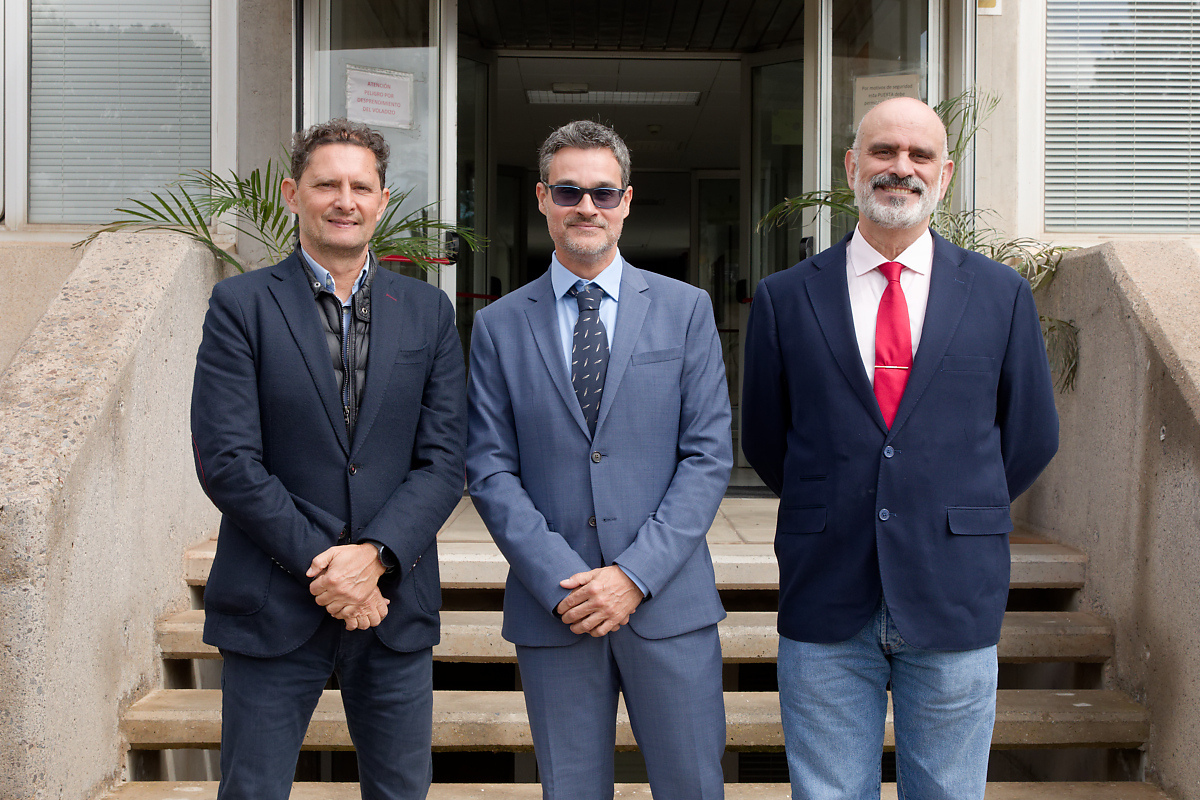
The work, led by doctors Jesús Santiago Notario del Pino y Miguel Ángel Mejías Vera, It was presented at the Antonio González Institute of Bioorganic Biotechnology and received the highest possible grade, summa cum laude. The examining board was chaired by Carmen Concepción Jiménez, from the Department of Animal Biology, Soil Science and Geology of the University of La Laguna, with the secretary Alberto Domingo Lázaro, member of the Higher Council for Scientific Research; and the member, Ricardo Díaz, head of the Department of Environmental Analysis at the Technological Institute of the Canary Islands.
The research proposes an innovative methodology for studying volcanic soils by combining predictive models based on artificial intelligence and structural equation models, to improve the estimation of certain soil properties and better understand the environmental processes that influence their behavior.
 A peculiar terrain
Volcanic soils have very particular characteristics due to their origin from ash and eruptive materials. These properties make them, in many cases, especially fertile and productive soils, and in fact, in different volcanic regions of the world, such as Chile and Japan, they occupy a very significant portion of the agricultural land. Additionally, these soils play a key role in maintaining ecosystems and in the storage of water and nutrients.
However, studying the properties of this soil presents certain difficulties because it typically requires numerous field samples and laboratory analyses, which entails a considerable investment of time and resources. Furthermore, these properties can vary significantly depending on environmental factors such as climate, vegetation, and topography.
For this reason, one of the main objectives of the research has been to develop tools that allow predicting and explaining the spatial variability of some key soil properties, thus facilitating their study in volcanic landscapes.
Among the variables analyzed, organic carbon, pH, and phosphate retention capacity stand out as three fundamental soil properties for assessing soil quality and understanding its function in volcanic ecosystems. Organic carbon, for example, plays an essential role in surface fertility, influencing soil structure, water and nutrient retention, and biological activity. pH, meanwhile, determines the availability of nutrients for plants, while phosphorus retention is a characteristic property of surfaces derived from volcanic ash.
Machine learning and equations
To analyze these properties, the work combines different modeling approaches. On the one hand, it employs techniques of machine learning, Specifically, it uses the Random Forest algorithm, which allows for the processing of large amounts of data and the detection of complex patterns between environmental variables and soil properties. It also utilizes structural equation modeling, a statistical tool that allows for the study of direct and indirect relationships between different environmental factors.
This combination of approaches allows not only for improved predictive ability regarding soil properties, but also for a better understanding of the environmental processes that influence its functioning.
Among the most relevant findings of the study is the relationship between environmental factors such as vegetation and rainfall and soil characteristics. Vegetation cover provides organic matter that improves soil structure and promotes water and nutrient retention, while rainfall influences moisture availability and mineral transport. The interaction between these elements explains a large part of the observed differences in the terrain within the study area.
Although the results obtained refer specifically to the Chinyero Special Nature Reserve, the researcher points out that “the methodology developed can be applied in other volcanic territories, provided that the models are first adjusted to the environmental conditions of each area.” In this sense, the proposed approach can become a useful tool for improving land-use planning and the management of protected natural areas.

 Spanish
 English
 French