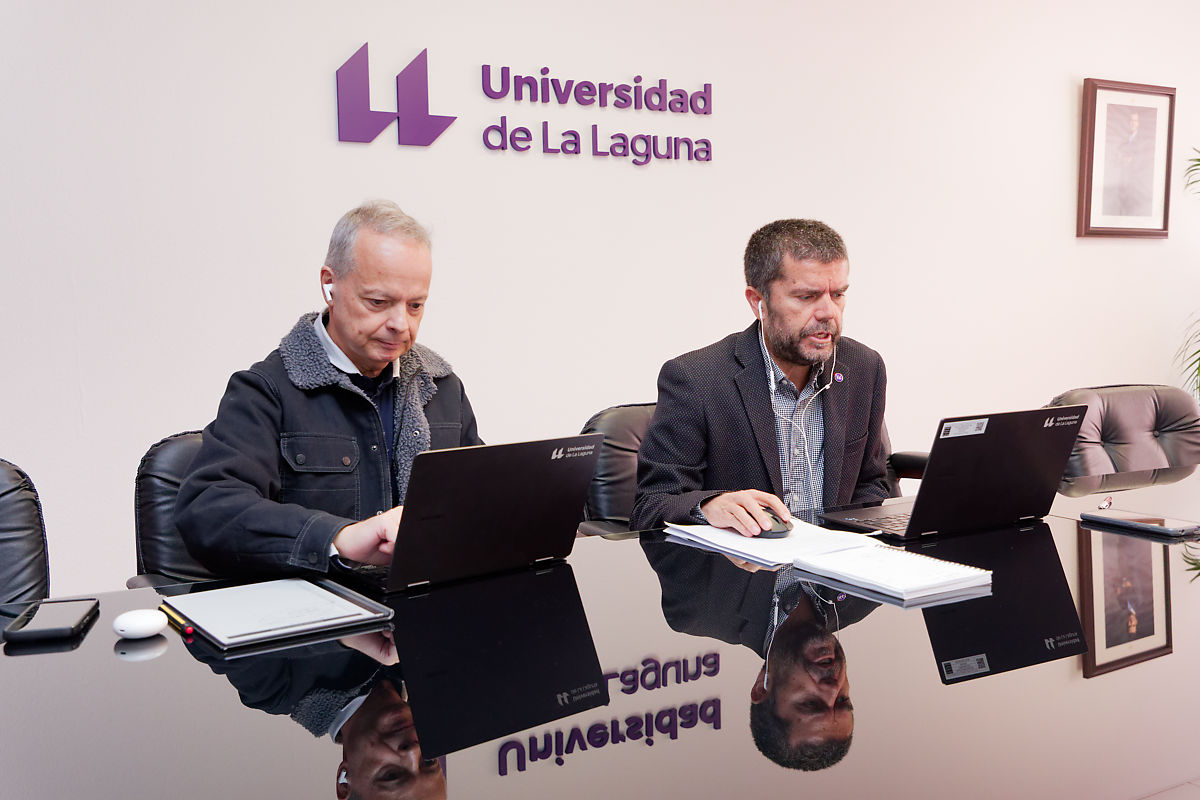
The Governing Council of the University of La Laguna, in its extraordinary session today, Monday, March 23, approved the modification of the job descriptions (RPT) for teaching and research staff (PDI) and for technical, management, and administrative and service staff, both agreed upon with the respective representatives of both groups. This modification is the necessary step to determine which positions can be advertised.
In the case of the RPT of the PDI, this modification was presented by the Vice-Rector of Teaching and Research Staff, Alfonso Ruiz, and is due to being able to execute the positions corresponding to the Public Employment Offer (OEP) of 2023, 2024 and 2025, as well as the Provision and Planning of Positions (PPP) of 2024 and 2025.
Specifically, the modification includes 15 positions from Tenured Professor to University Professor through internal promotion, as well as 156 positions distributed as follows: 35 Tenured University Professor, 9 Tenured University Professor I3/R3, 38 Permanent Labor Professor, 4 Permanent Labor Professor I3/R3, 33 Assistant Professor positions, 27 Associate Professor positions, and 10 Associate Assistant Professor positions.
The proposed job classification plan for the PTGAS Laboral plant was presented by the manager, Lidia Pereira, and approved by 33 votes in favor and one abstention. It includes job eliminations, creations, and modifications. The eliminations affect one position for a university graduate, six for skilled workers, and five for assistants. The new positions include two for university graduates, two for mid-level graduates, four for laboratory technicians, five for skilled workers, and eight for assistants. Finally, the modifications involve six supervisory bonuses, changes to morning and afternoon shifts affecting seven positions, the reassignment of four assistants and two mailroom staff, and six changes in specialization.
During the session, three new university-specific qualifications presented by the Vice-Rector for Teaching, José Manuel García Fraga, were also approved. These qualifications are based on sets of micro-credentials which, once fully completed, lead to the awarding of the corresponding qualifications. Specifically, these are the Certificate of Specific Training in LGTBIQA+ Diversity, the Certificate of Specific Training in Initial Teacher Training (FIP-ULL), and the Inter-University Certificate of Specific Training in the Economic and Fiscal Regime of the Canary Islands (REF). All three are offered entirely online, in order to facilitate access for professionals interested in this training who have different work schedules and who, moreover, often do not reside in Tenerife.
The first of these programs responds to a social, academic, and institutional need to address the realities and challenges of the LGBTQIA+ community from a rigorous, comprehensive, and human rights-based perspective. This multidisciplinary diploma integrates key knowledge from the legal field (for combating hate crimes and implementing legislation), the social sciences (for analyzing identity, power, and intersectionality), and the health sciences (for providing non-pathologizing and specialized care). It aims to equip students—especially staff from public administrations and third-sector organizations—with the methodological and operational tools necessary for transforming environments and practically applying inclusive protocols.
The second objective is to formalize, in a more structured way, the training that newly hired faculty members at the University of La Laguna currently receive. To be able to carry out their teaching duties, they must complete five specific micro-credentials. The Vice-Rector's Office has determined that completing these mandatory micro-credentials constitutes the awarding of this new qualification.
Finally, the third qualification was created at the request of the REF Commissioner of the Government of the Canary Islands, with the aim of addressing the training gaps that exist among different professional and even institutional sectors regarding the region's economic characteristics. Therefore, the qualification is jointly offered by the two public universities in the Canary Islands. It consists of 13 required credits, plus the remaining two credits (to reach the total of 15) obtained by taking one of the two available elective courses.
Throughout the session, specific modifications were also made to some regulations issued by the School of Doctoral Studies and Postgraduate Studies, as some ambiguities or areas for improvement were detected in their application, specifically in the Regulations on dedication and permanence in doctoral studies, the Regulations on Official Doctoral Studies and the Modification of the Regulations on Conditional Enrollment in University Masters.

 Spanish
 English
 French