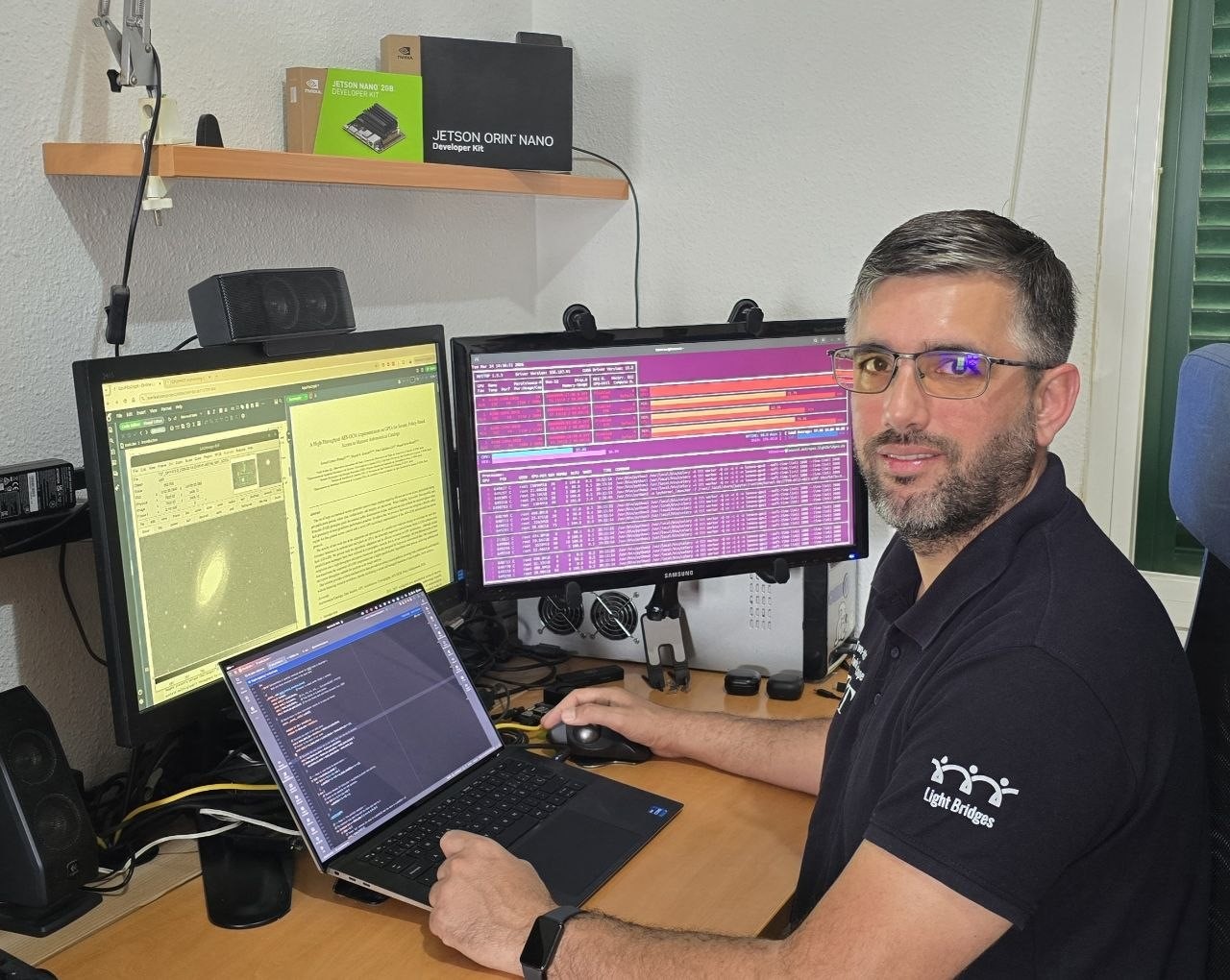
The University of La Laguna, the Institute of Technology and Renewable Energies (ITER) and the company Light Bridges are making progress in the development of a pioneering industrial doctorate: GPU Applications for Astronomy in Massively-Multiplexed Optical Observatories.This is the first PhD in computer science in Spain fully funded by a start-up, according to the design of the public-private collaboration researcher, Antonio Maudes, consolidating the viability of this cooperation model and making use of the Canary Islands Tax Regime (REF).
The project combines the academic excellence of the University of La Laguna (ULL), the computing power of ITER, and the company's cutting-edge research. "This collaboration between the University of La Laguna and the start-up Light Bridges has proven to be a very valuable initiative," he explains. Pino Caballero Gil, Professor of Computer Science and Artificial Intelligence at ULL, “by making it possible for a graduate of this university, Samuel Lemes, to return to the university environment with a solid research objective.”.
This industrial doctorate has allowed "not only to boost applied innovation in the company, but has also allowed it to successfully and scientifically address a practical safety problem in astronomy, connecting doctoral research in an exemplary way with real needs of the sector," explains the professor.
Under the direction of Caballero Gil and astrophysicist Miquel Serra-Ricart, scientific director of Light Bridges, the team recently announced its first research results. The work, with Lemes as first author, addresses a critical challenge in modern astronomy: the generation, processing, and efficient access to massive catalogs of astronomical images from robotic telescopes before their use in science or official publication.
The article has been submitted to a high-impact international journal and is currently under review. The preprint, titled “A High-Throughput AES-GCM Implementation on GPUs for Secure, Policy-Based Access to Massive Astronomical Catalogs,” is available here. here.
“One of the main security problems addressed in this thesis is commonly found in astronomical studies that generate massive image catalogs, which require efficient and secure access, and where data confidentiality and integrity are paramount,” says Caballero Gil.
To that end, they have developed a framework or framework This innovative solution combines advanced cryptography (using granular access control policies to ensure the integrity of scientific data) with GPU acceleration, employing these graphics processors to implement high-speed encryption protocols. This eliminates traditional bottlenecks in processing large volumes of data, ensuring its integrity and traceability. This advancement is fundamental to complying with the FAIR principles (findable, accessible, interoperable, and reusable data) without compromising confidentiality during critical research phases.
The TTT: The robotic brain of Teide
The research has direct applications at the Two-meter Twin Telescope (TTT), operated by Light Bridges at the Teide Observatory. The TTT, with its robotic telescopes measuring two meters and eighty centimeters, is currently the world's largest fully automated robotic infrastructure.
Thanks to a layered computational architecture, the TTT uses Artificial Intelligence to optimize its nighttime programming, while GPUs handle synthetic tracking and the processing of precision photometry and astrometry. This industrial PhD allows the TTT to complement its scientific activity as an observatory with its technological objectives, establishing a unique technological testbed with twenty focal stations for the rapid validation of new instruments.
“Robotic telescopes are the future of modern astronomy. And the only way to achieve high competitiveness is to be able to extract information from the images as quickly as possible. Thanks to GPU processing, TTT telescopes can deliver fully processed images in a maximum of one hour after observation,” says Serra-Ricart, co-director of the thesis.
A model for the future
This industrial PhD program, supported by the supercomputing infrastructure of ITER, belonging to the Tenerife Island Council, and the Light Bridges data center, positions the Canary Islands as a leader in the knowledge economy and the smart employment of REF (Regional Economic Fund) for R&D. It demonstrates that local startups have the capacity to drive research projects that solve global problems in strategic sectors such as aerospace, cybersecurity, and artificial intelligence.
“I am confident that this fruitful collaboration can continue and expand in the future, for example, in the field of quantum communication, an area in which both the company and the cryptology research group at the University of La Laguna, which I lead, are specialists and in which we have been working intensively for several years now,” concludes Pino Caballero.

 Spanish
 English
 French