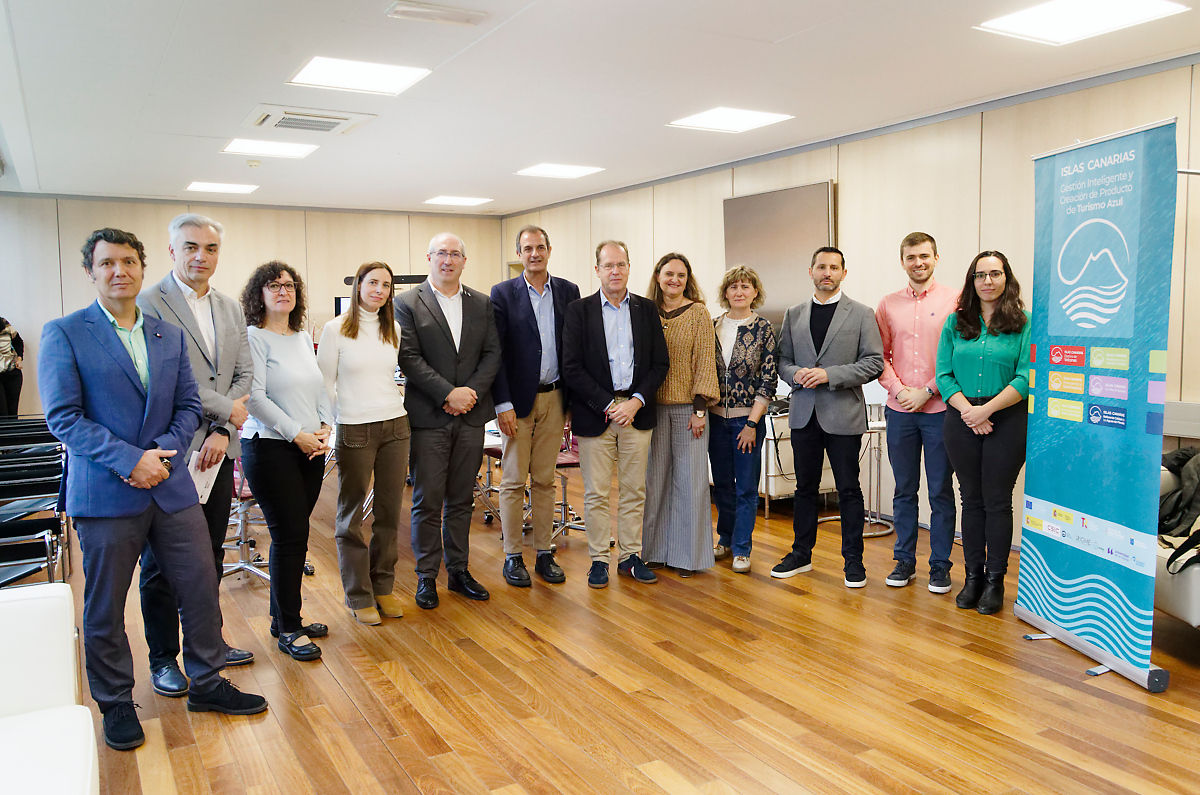
For over a year, 63 researchers (19 newly hired) from the University of La Laguna, the University of Las Palmas de Gran Canaria, and the Spanish National Research Council (CSIC) have been working on six projects that will lead to initiatives with a positive environmental impact through an agreement signed with Turismo de Tenerife. The shared goal is to consolidate a blue, regenerative, and sustainable tourism model aimed at strengthening the destination's environmental sustainability, improving scientific knowledge applied to tourism, and contributing to the archipelago's climate neutrality and economic diversification model.
Although this program ends in June, the projects are very advanced and their content was presented by the main researchers at a working meeting held on Friday, March 27 at the Canary Islands Oceanographic Center (IEO-CSIC).
The Agreement for the Smart Management and Creation of Blue Tourism Products amounts to 4.1 million euros: Turismo de Tenerife contributes 3.2 million euros from the European Union's Recovery and Resilience Facility (RRF), while the CSIC, the ULL and the ULPGC contribute almost one million euros in terms of working hours of their staff.
The scientific community plays an essential role in strengthening sustainable tourism management, expanding knowledge to enable progress towards new ways of reducing environmental impacts, and promoting a smart tourism management model alongside a higher-value blue product.
The six projects
- “Canary Islands: Destination of Volcanoes,” coordinated by the Spanish Geological and Mining Institute (IGME-CSIC) and the University of La Laguna (ULL), is working to identify and promote the archipelago's most impressive volcanic landscapes, transforming them into safe, accessible, and science-based tourism experiences. Fifty volcanic geosites of high scientific value, well-preserved and visually striking, have been selected to develop interpretive products, routes, and outreach resources supported by immersive technologies such as 360º tours, virtual reality, and StoryMaps. This project will create a robust, distinctive, and competitive volcano tourism product, aligned with the geological identity of the Canary Islands.
- “The project ”Promoting the Oceanic Health of the Canary Islands,” coordinated by the University of La Laguna (ULL), the University of Las Palmas de Gran Canaria (ULPGC), and the Spanish Institute of Oceanography (IEO-CSIC), has studied marine litter washing up on the Canary Islands' shores, especially plastics and microplastics, to determine its origin, movement, and how long it has been circulating in the ocean before reaching the archipelago. This project will provide the tourism sector with key scientific information to understand how waste arrives on the beaches, allowing them to anticipate events, improve coastal management, and design contingency plans based on real data.
- “The project ”Canary Islands: Unique Marine Nature, Health and Well-being,” led by the Institute of Natural Products and Agrobiology (IPNA-CSIC), the University of La Laguna (ULL), and the Spanish Institute of Oceanography (IEO-CSIC), studies unique marine microorganisms that live in the volcanic ecosystems of the Canary Islands. These microorganisms, adapted to special environmental conditions, can produce compounds with potential health and wellness benefits. This project opens the door to new tourism products and experiences inspired by the volcanic and marine nature of the archipelago.
- “The project ”Canary Islands: Protectors Against Climate Change,” coordinated by the IEO-CSIC (Spanish Institute of Oceanography - Spanish National Research Council), has so far sampled 47 beaches in Tenerife, 12 in Lanzarote and Gran Canaria, 11 in Fuerteventura and La Palma, and 6 in El Hierro, analyzing their mineral composition, olivine content, and potential for carbon sequestration and mitigating ocean acidification. The results of this project can be integrated into innovative tourism experiences, such as interpretive trails, visitor centers, environmental education programs, and training for tourism professionals, explaining the mineral composition of the beaches within the context of the islands' volcanic origin.
- “Canary Islands: A Sea of Sounds,” coordinated by the University of La Laguna (ULL) and the Spanish Institute of Oceanography (IEO-CSIC), has involved the installation of nine hydrophone and underwater camera systems for acoustic monitoring of marine biodiversity. The goal is to create a public database of sounds and images of marine species in reserves and protected natural areas. This information will be used for scientific research and to promote responsible and non-invasive marine tourism. Disseminating these results will allow residents and tourists to identify some of the sounds they hear while swimming at certain beaches, diving, or whale watching, as well as gain a deeper understanding of the archipelago's biodiversity.
- “Canary Islands: A Benchmark for the Study of Global Water Quality,” coordinated by the IEO-CSIC (Spanish Institute of Oceanography - Spanish National Research Council), leverages cutting-edge satellite technologies to better understand how the ocean and atmosphere surrounding the Canary Islands are changing. To this end, a smart data layer, updated in real time, is being created to monitor sea temperature, water quality, marine productivity, and other key variables. Furthermore, all satellite data will be compared with actual measurements taken in the archipelago, thus strengthening the Islands' bid to host one of the world's most important satellite calibration infrastructures (OC-SVC). This project will provide a crucial tool for the intelligent management of marine resources in the context of climate change, improving the management of beaches, ports, natural areas, and recreational activities at sea.
(Note and photo provided by Tenerife Tourism)

 Spanish
 English
 French