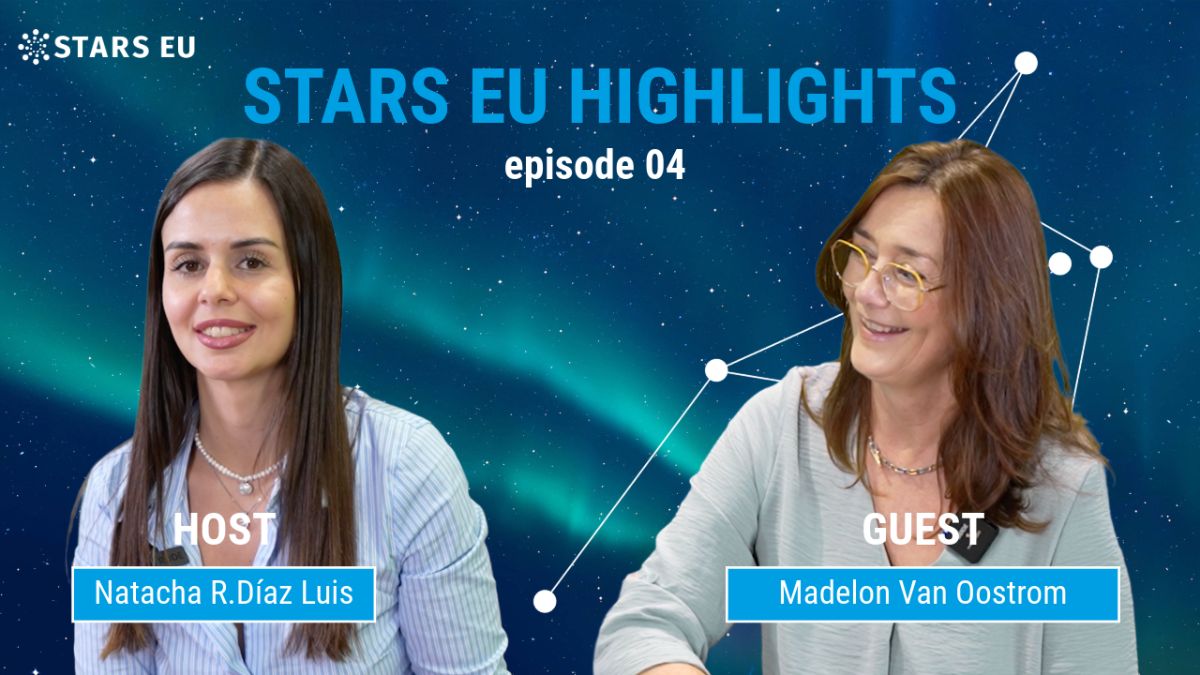
The sociologist and associate professor at Hanze University of Applied Sciences (Netherlands), Madelon van Oomstrom, She advocates for the use of game-based learning to promote digital literacy, critical dialogue, and student engagement. According to this expert in digital transformation, gamification is becoming established as one of the most effective methodologies for transforming higher education.
She stated this during her participation in a workshop for teachers held in Tenerife, focused on digital literacy and inclusion, as well as in the fourth episode of the videopodcast on educational innovation, STARS EU Highlights: Playing to Learn- Gamification, Digital Literacy and Inclusion that has been published Today, Wednesday, April 8. “The best way to foster a productive dialogue about opportunities and risks is to create gamified learning experiences,” explained the expert, who emphasized that this approach allows students to share knowledge and learn collaboratively.
Van Oomstrom emphasized that game-based learning not only makes classes more dynamic but also boosts student confidence. “Students feel more confident and proud of what they know,” she noted, while also stressing that this type of methodology encourages more active participation.
Promoting critical thinking
One of the main benefits of gamification, she indicated, is the promotion of critical thinking. In contrast to traditional models, which are more based on direct guidance and recommendations, the expert advocates for a more participatory approach: “Instead of saying 'this is dangerous,' it's better for the students themselves to identify potential problems.‘.
In this regard, he argued that gamification facilitates the creation of "spaces for dialogue" where students can compare experiences and build knowledge together. "It allows for critical conversations, the generation of useful ideas, and sparks interest in continuing to learn and develop," he stated.
From her perspective as a sociologist, Van Oomstrom also focused on the social dimension of technology, noting that while digitalization offers great opportunities, it cannot ignore its potential for exclusion. “Technology can be a solution for some, but at the same time a problem for those who lack access or the skills to develop digital competencies.” For this reason, she believes it is essential that higher education incorporate inclusive methodologies that facilitate access to knowledge. In her opinion, game-based learning contributes precisely to “reducing these gaps” by making content more accessible and engaging.
Workshop for teachers
In addition to her participation in the STARS EU videopodcast, Van Oostrom gave a lecture in Tenerife—during the meeting of STARS EU Held in November 2025, this workshop for university faculty was attended by approximately ten people. This initiative, undertaken within the framework of this alliance to which the University of La Laguna belongs, is part of a series of efforts to adapt teaching to an increasingly digitalized environment.
In this context, the expert in digital transformation and people-centered technologies, among other areas, stressed the importance of updating teacher training, in line with the changes of an increasingly technological society: "Teachers have a lot of experience, but they need spaces where they can learn interactively and practically.".
The expert took the opportunity to call for the integration of gamification in classrooms as a "way to promote a more innovative, critical and inclusive education," capable of responding to the challenges of digital transformation.

 Spanish
 English
 French